Wave propagation is the process by which a disturbance travels through a medium or field, transferring energy and momentum without net transport of matter. This concept covers sound waves in air, seismic waves in the Earth, electromagnetic waves in vacuum, and gravitational waves in spacetime. Understanding wave propagation is essential for fields ranging from acoustics and optics to seismology and astrophysics, as it explains how signals travel, how they are absorbed or scattered, and how they can be manipulated.
History
The wave theory of light was championed by Christiaan Huygens in the 17th century, while James Clerk Maxwell unified electricity and magnetism into electromagnetic waves in the 1860s. Gravitational waves, predicted by Einstein in 1916, were directly detected in 2015 by LIGO.
How it works
A wave propagates because local disturbances couple to neighboring regions: in a mechanical medium, particles push their neighbors; in electromagnetic waves, oscillating electric and magnetic fields regenerate each other. The wave's speed depends on the medium's properties (density, elasticity, refractive index). Wave behavior — reflection, refraction, diffraction, interference — emerges from the superposition principle, where multiple waves add linearly. In nonlinear media, waves can form solitons that maintain their shape over long distances.
In practice
Wave propagation principles are used in medical ultrasound, earthquake early-warning systems, wireless communications, and gravitational-wave observatories.
Fun fact
Gravitational waves travel through the universe essentially unimpeded, carrying information from events like black hole mergers that occurred billions of years ago — they are the only signals that can pass through dense matter without being absorbed.
A wave packet is like a traveler who either loses steam and spreads out along the way, holds a steady pace, or gathers into a fist. In a 50-meter flume with water 5 meters deep, scientists tracked how a bell-shaped group of waves behaves when its height is changed but not its width.
A spotlight with an adjustable beam width sweeps along the shore. Its light is the long ocean waves that are born in the surf zone and spread in both directions: toward the beach and out to the open sea. Previously, this spotlight was considered a point source, but the actual breaking zone, where short waves break, has a finite width, and it changes as the wave front advances and retreats.
A laser beam passes through a glass cell filled with cesium vapor. The atoms in the vapor dart around chaotically, like a crowd at a train station: each one enters the beam, spends a moment there, and flies back out. Their internal state, something like the orientation of a tiny magnet, changes under the influence of light. If all atoms were identical and stationary, the signal would be steady.
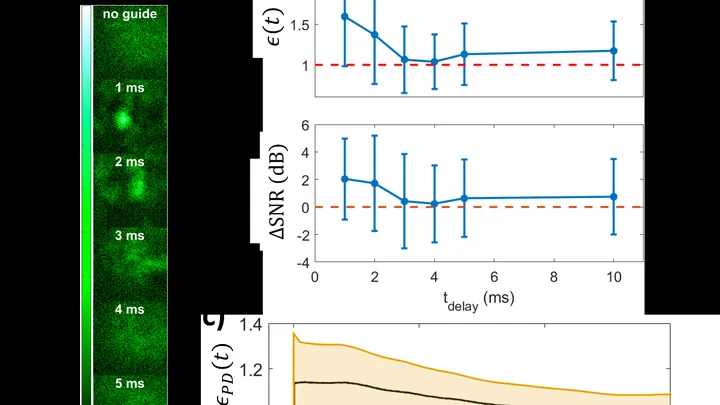
An ordinary flashlight shines in all directions, and after just a couple of dozen meters its beam fades so much it barely lights a wall. The atmosphere scatters light, and wind and heat currents distort it even more. But if you lay an invisible pipe for light right in the air, the beam will travel through it like water through a hose.
In a crystal, heat travels on waves. Atoms vibrate, and these vibrations, called phonons, carry energy from the hot edge to the cold one. For a long time, it was believed that if phonons hit resonance (their frequencies exactly match) and can exchange energy, heat would flow like an avalanche. It turns out that's not the case.
In 2017, detectors picked up a gravitational wave from the collision of two neutron stars. Just 1.7 seconds later, telescopes saw a flash of gamma-ray burst from the same spot. That tiny delay became a treasure for physicists.
Right after the Big Bang, space cooled unevenly. In some places, folds could have formed — threads of energy as thin as a hair but incredibly dense. Physicists call them cosmic strings. They oscillate, collide, and emit gravitational waves — ripples in the fabric of space itself.
A disease outbreak is like a wildfire: the fire runs through dry grass, and its speed depends on wind and humidity. But an infection has its own 'wind'—how often people infect each other. When this rate changes along with the fraction of already infected, the epidemic wave can behave differently.
When two black holes merge far away, we receive a tremor of space — gravitational waves. Usually, they are described by Einstein's equations, but what if gravity works differently at the tiniest distances? The authors took one such hypothesis — Hořava–Lifshitz gravity.
Radio signals in a room act just like sound in a concert hall: bouncing off walls and objects, they create a unique pattern — a silent melody for every location. Your phone, like a keen ear, catches this melody amid noise and distortion. It remembers which chord matches the corner of the couch, and which one fits the doorway.
A stone drops into a pond, and ripples spread across the water. If a protruding branch blocks the ripples' path, part of the wave reflects, and part bends around the obstacle. Gravitational waves, ripples in spacetime itself, behave similarly when passing by galaxy clusters or black holes.
Einstein and Rosen imagined a bridge connecting two sheets of reality. Wheeler gave it a name — wormhole, and Thorne with Morris proved: the tunnel is traversable if you fill it with exotic matter.
Each vowel sound is a distinct shape of the mouth, tongue, and throat. When you say 'ah,' 'ee,' or 'oo,' not only does the air inside your head change, but so does the way radio waves pass through it. Researchers peered into this process using MRI scans taken right during speech and built a precise computer model of the head — from bones to soft tissues.
A pebble drops into a pond, and neat circles spread across the water. But the pond's bottom is strewn with invisible glass shards: each one slightly delays the wave, scatters it here, or alters its pace. That's roughly how gravitational waves, the trembling of space itself, pass through distant galaxies and dark clumps of matter.
Interstellar space is not empty: it is filled with tenuous gas, which is warm in some places and cold in others. The boundaries between such regions resemble the walls between soap bubbles.
Lymphatic vessels are one-way streets. Through them, fluid flows only forward thanks to tiny flap valves. These valves open in just one direction, creating asymmetry, directionality, without which the flow would stop.
In the lab, scientists modeled a vessel and sent compression waves along it, like a parade of gentle nudges.
A cell is a city with gates. Each gate is a protein channel in the membrane: through it, ions, sugars, and signaling molecules pass in and out. Some gates are almost always open, while others open and close randomly, like subway doors that let a passenger through one moment and slam shut in their face the next.
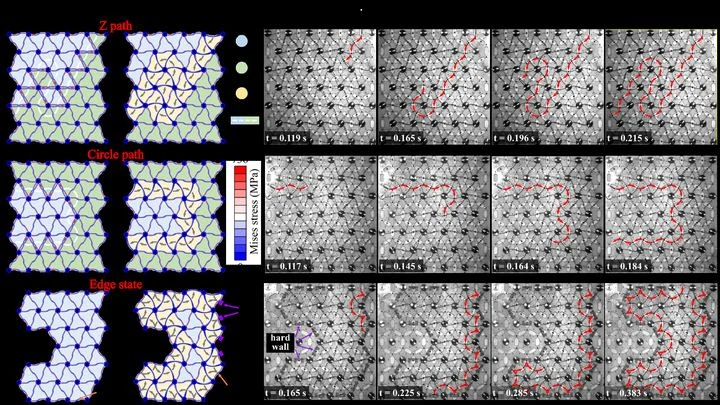
The popping lid of a jam jar is the hero of this story. Press it, and with a loud click it flips from a convex to a concave shape. Exactly the same happens with a hinged beam inside each cell of a new mechanical lattice.
Scientists assembled these snapping beams into a hexagonal grid, like honeycomb, but made of elastic plates. When one beam is sharply compressed, it snaps and pushes its neighbor.
A stone drops into a pond — ripples spread across the water. Do short waves outrun long ones? No, in deep water it's the opposite: long waves overtake short ones. In metal, sound of one pitch travels at one speed, another pitch at another.
Toss a handful of peas into a pot of semolina porridge — the peas quickly sink, pushing the grains aside. But if you make the porridge very thick and sticky, the peas get stuck. That's roughly how light lithium atoms behaved in a cloud of heavy potassium atoms at temperatures just a few millionths of a degree above absolute zero.
Sound in a thin plate behaves like ripples on water: it travels, reflects off edges, and changes shape. But sound has a peculiar trait: it can pass through places where waves are forbidden to exist. It's as if ripples on a pond suddenly vanished before a stone barrier and reappeared on the other side, without going around it.