An edge current is a type of electric current that flows along the boundary of a material, rather than through its interior. What makes it special is that it is 'protected' — meaning it can flow without scattering or losing energy, even when the material contains impurities or defects. This protection arises from the material's topological properties, which are global characteristics of its electronic structure rather than local ones.
History
The theoretical prediction of protected edge currents is associated with the discovery of the quantum Hall effect in the 1980s, and later generalized to topological insulators in the mid-2000s. The concept was formalized through the work of Thouless, Haldane, and others, who linked the quantization of conductance to topological invariants.
How it works
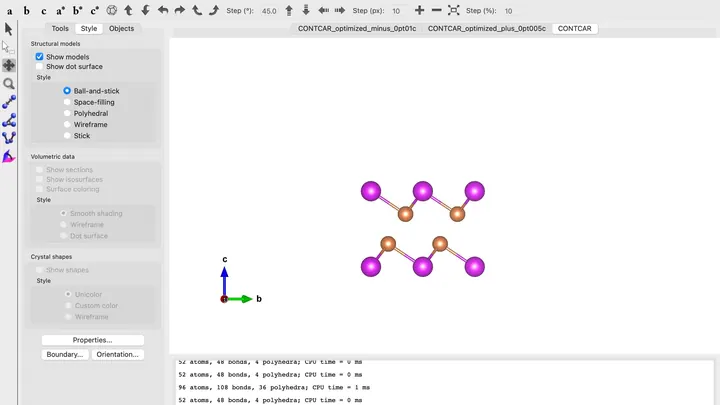
In certain materials, the electronicband structure has a non-trivial topology, which forces the existence of conductingstates at the edges. These edge states are chiral: electrons in them can only move in one direction along the edge. Because there are no states available for them to scatter into (the interior is insulating), they propagate without resistance. This is fundamentally different from ordinary currents, which lose energy due to collisions with impurities.
In practice
Edge currents are key to the development of low-power electronics and quantum computing, where dissipationless transport could reduce energy loss and improve coherence times.
Fun fact
In a topological insulator, the edge current flows without any applied voltage once it is set in motion, because there is no mechanism for it to dissipate.
A highway where opposing flows are separated not just onto different sides, but onto two independent roads: each with its own entrance and exit. Something similar happens to electrons in a new type of topological insulator described by the authors of the study.
A thin sandwich made of two different materials. You run an electric current through it, and the top slice magnetizes in one direction, the bottom in the opposite. This isn't a magic trick; it's the layer Edelstein effect, just described by physicists.
The book is open to the middle. Current runs along the spine, while the pages remain cool. That's roughly how a two-dimensional topological insulator works — a material where electricity flows only along the edges, while the interior stays still.
In the new model, each active particle has an internal rhythm: it spins either left or right. Chirality is key: some twirl clockwise, others counterclockwise. But when such a particle bumps into an obstacle or a neighbor, it flips its spin, like a figure skater who, after touching the board, explodes into a reverse pirouette.
A superconductor is like an ideal highway with no traffic lights: electrons race along without hindrance. But apply a voltage, and the picture changes. In a new experiment, physicists found that an electric field penetrates the superconductor and creates a mixed regime inside.
A switch that knows which way to let current flow. That's how a Josephson diode works — a superconducting bridge where current goes willingly in one direction but meets resistance in the other. In the new study, such a bridge was made from graphene — a sheet of carbon just one atom thick.
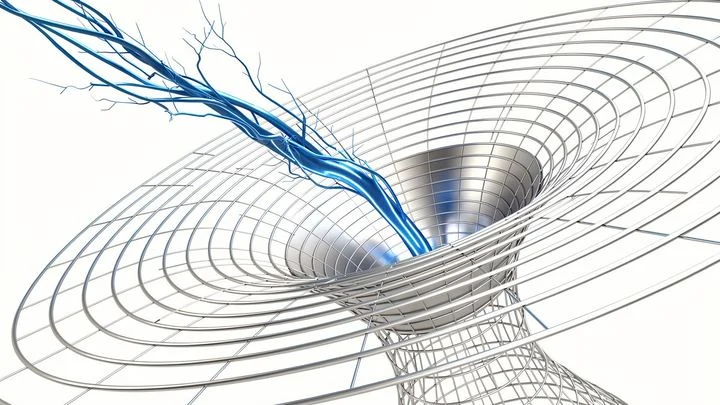
Since time immemorial, physicists have dreamed of tunnels piercing the cosmos — wormholes, capable of connecting far-flung corners of the Universe in an instant.
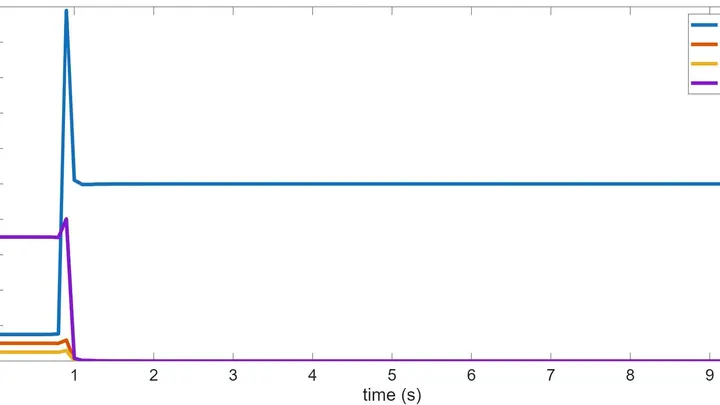
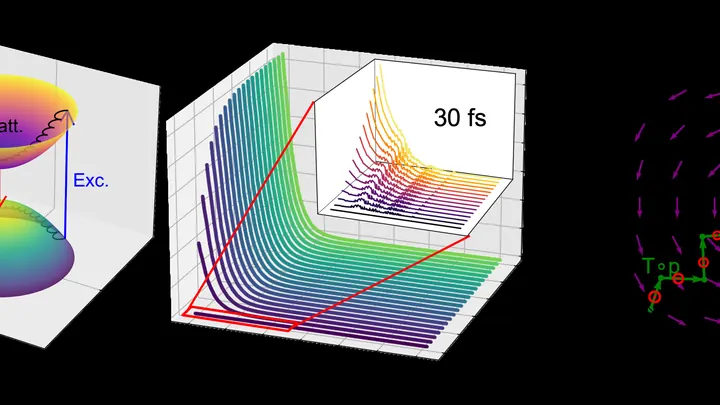
When you flip a switch, the light doesn't come on immediately — electrons in the wires need time to 'get going' and move together. In ordinary metals and semiconductors, current builds up gradually, like water in a hose when you first open the tap.
Atoms settled along a chain of traps, like a line of coastal forts. Nearby, a quantum sea: a Bose-Einstein condensate (a substance with zero resistance, where particles move as a single wave).
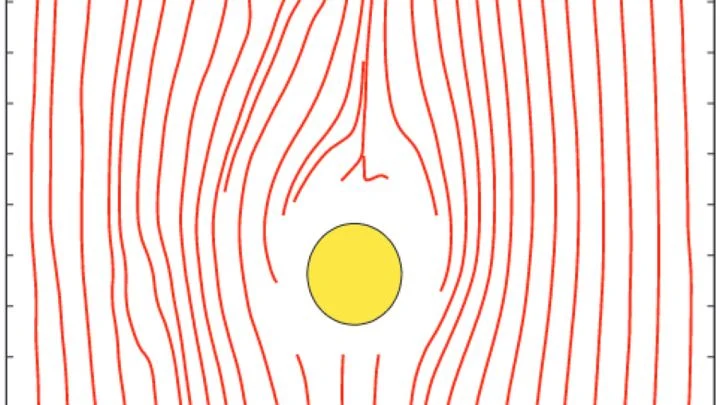
Liquid helium cooled to near absolute zero behaves like two fluids at once: a normal viscous part and a superfluid part that flows without friction. When such a flow hits a cylinder, vortices are born behind it. But sometimes vortices appear in front of the cylinder — where classical laws say they shouldn't be.
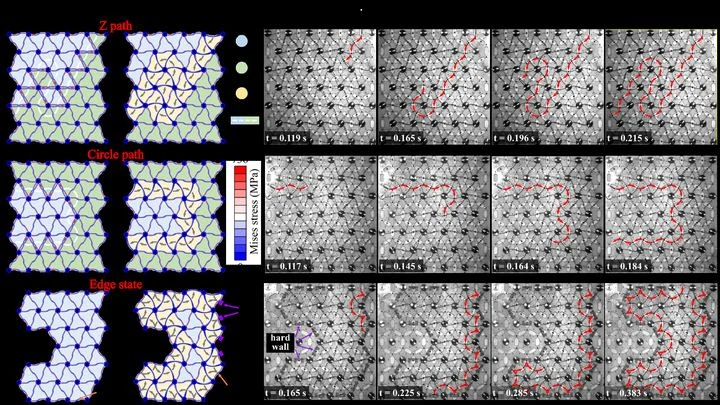
The popping lid of a jam jar is the hero of this story. Press it, and with a loud click it flips from a convex to a concave shape. Exactly the same happens with a hinged beam inside each cell of a new mechanical lattice.
Scientists assembled these snapping beams into a hexagonal grid, like honeycomb, but made of elastic plates. When one beam is sharply compressed, it snaps and pushes its neighbor.
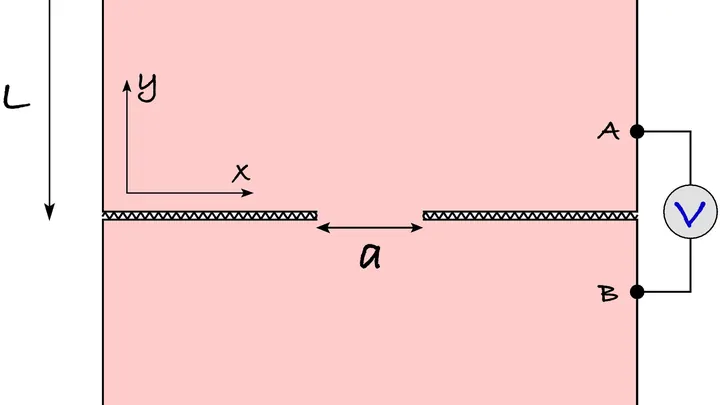
If you force water through a narrow neck, the flow speeds up right at the edge, and a whirlpool forms behind the obstacle. Electrons in ultra-clean two-dimensional materials, such as a thin layer of graphene, behave in much the same way.
A crystal without a center of symmetry is like a staircase where all the steps are tilted in the same direction: electrons, given a kick by light, roll predominantly in one direction. This is how a direct current is born — the photogalvanic effect.
An ordinary insulator conducts no current, neither in its interior nor along its edges. A topological insulator is a different story: it remains insulating inside but conducts electricity without loss along its edges.
Picture a globe divided into cells: near the poles they shrink into narrow wedges, while at the equator they stretch into wide bands. If you connect random points on such a globe with lines, the compass arrows will lie: connections will point to where there are more cells, not where the flows actually go.