Metamaterials are artificially engineered materials whose properties arise from their structure — specifically, from sub-wavelength repeating patterns — rather than from their chemical composition. By designing these patterns, scientists can create materials with electromagnetic, acoustic, or mechanical behaviors that do not occur naturally. For example, metamaterials can have a negative refractive index, bending light in the 'wrong' direction, or can be designed to absorb specific frequencies of sound or vibration.
History
The concept was formalized in the late 1990s by John Pendry, who proposed structures that could achieve negative permittivity and permeability. In 2000, David Smith and colleagues experimentally demonstrated a negative refractive index material. The field has since expanded to acoustics, mechanics, and thermal management.
How it works
The key is that the repeating structural units, often called 'meta-atoms', are much smaller than the wavelength of the phenomenon they affect. For light, these are tiny metallic or dielectric resonators that interact with the electric and magnetic fields of the wave. By tuning the shape, size, and arrangement of these resonators, the material's effective permittivity and permeability can be controlled independently, enabling exotic responses like negative refraction or cloaking.
In practice
Metamaterials are used in antennas for improved performance, in superlenses that can image below the diffraction limit, in acoustic cloaking and vibrationdamping, and in research on novel optical devices.
Fun fact
Some metamaterials can be designed to have a refractive index of exactly zero, causing light to travel with infinite phase velocity and no phase change across the material.
Imagine a book with latches on its pages: you can only flip a page if you know how to click its edge. That is roughly how the mechanical metamaterial we are about to discuss works. Each cell is a small mass inside a larger one, connected by an elastic beam. The beam can sit in two stable positions, like a switch.
A sheet of paper left on a wet table warps and lifts its edges. No one controls that motion, but it follows the same laws as plant growth: some areas of the sheet shrink more than others, and the flat form becomes three-dimensional. Engineers have long dreamed of taming this process so that a flat blank folds itself into a desired sculpture. In the new work, that trick succeeded with accuracy down to one percent.
Old treasure maps were drawn from hearsay: someone found gold by a river, someone else in the mountains, and each person dug in their own spot. High-temperature superconductors went the same way: cuprates were found in some compounds, iron pnictides in others, nickelates in yet others, and there was no common map.
The laser beam in an optical tweezer is not just a spot of light but a force bag. A particle caught in it usually rolls toward the brightest point, like a ball into a dimple.
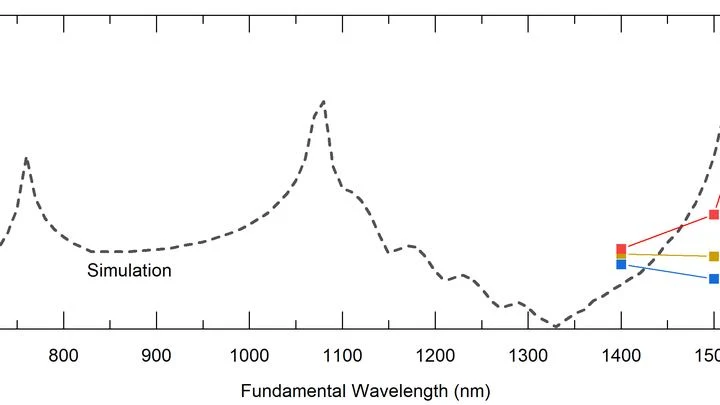
When light hits ordinary plastic, some of it reflects, like a glare on a window. To eliminate this glare, a special coating made of tiny structures is applied to the surface, which cancels out the reflection.
When light hits ordinary plastic, some of it reflects, like a glare on a window. To eliminate this glare, a special coating made of tiny structures is applied to the surface, which cancels out the reflection.
Some crystals behave like a switch: nudge the temperature or pressure, and they turn from a conductor into an insulator. This is called a metal–insulator transition (a change in the ability to conduct electricity).
A stack of magnetic plates, each magnetized opposite to its neighbor, is like a layered sandwich where electrons move as a single organism. The whole material starts mimicking an axion — a ghost particle that physicists suspect might be dark matter.
An ordinary piece of semiconductor weakly changes the color of light passing through it. For decades, physicists worked around this limitation by placing the crystal in clever surroundings, but the material itself remained the same.
Now researchers have assembled a "sandwich" of alternating thin layers of gallium arsenide and aluminum gallium arsenide.
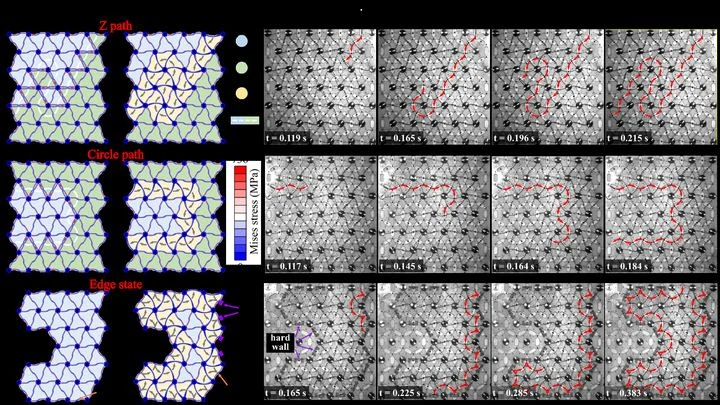
The popping lid of a jam jar is the hero of this story. Press it, and with a loud click it flips from a convex to a concave shape. Exactly the same happens with a hinged beam inside each cell of a new mechanical lattice.
Scientists assembled these snapping beams into a hexagonal grid, like honeycomb, but made of elastic plates. When one beam is sharply compressed, it snaps and pushes its neighbor.
An ordinary rubber pad dampens vibration the way a thick blanket muffles sound: the thicker and heavier, the better. Engineers have long dreamed of a material that is light yet "eats" oscillations as well as a massive damper.
A thin, flexible beam shivers from a blow, and a wave runs along it like ripples on water. Along the beam, seven pairs are placed: a sensor feels the bending, and a motor immediately pushes the beam in response. Each pair is like a tiny tuning fork that oscillates in antiphase and quells the tremor at its spot. The wave cannot pass beyond — at certain frequencies, silence falls.