Rubidium Glows in Response to Faint Light express
An ordinary lamp won't make an atom glow: it's too weak. But if you slow atoms down to nearly a standstill, even a tiny stream of photons, like rare drops from a pipette, can make them respond with a bright flash.
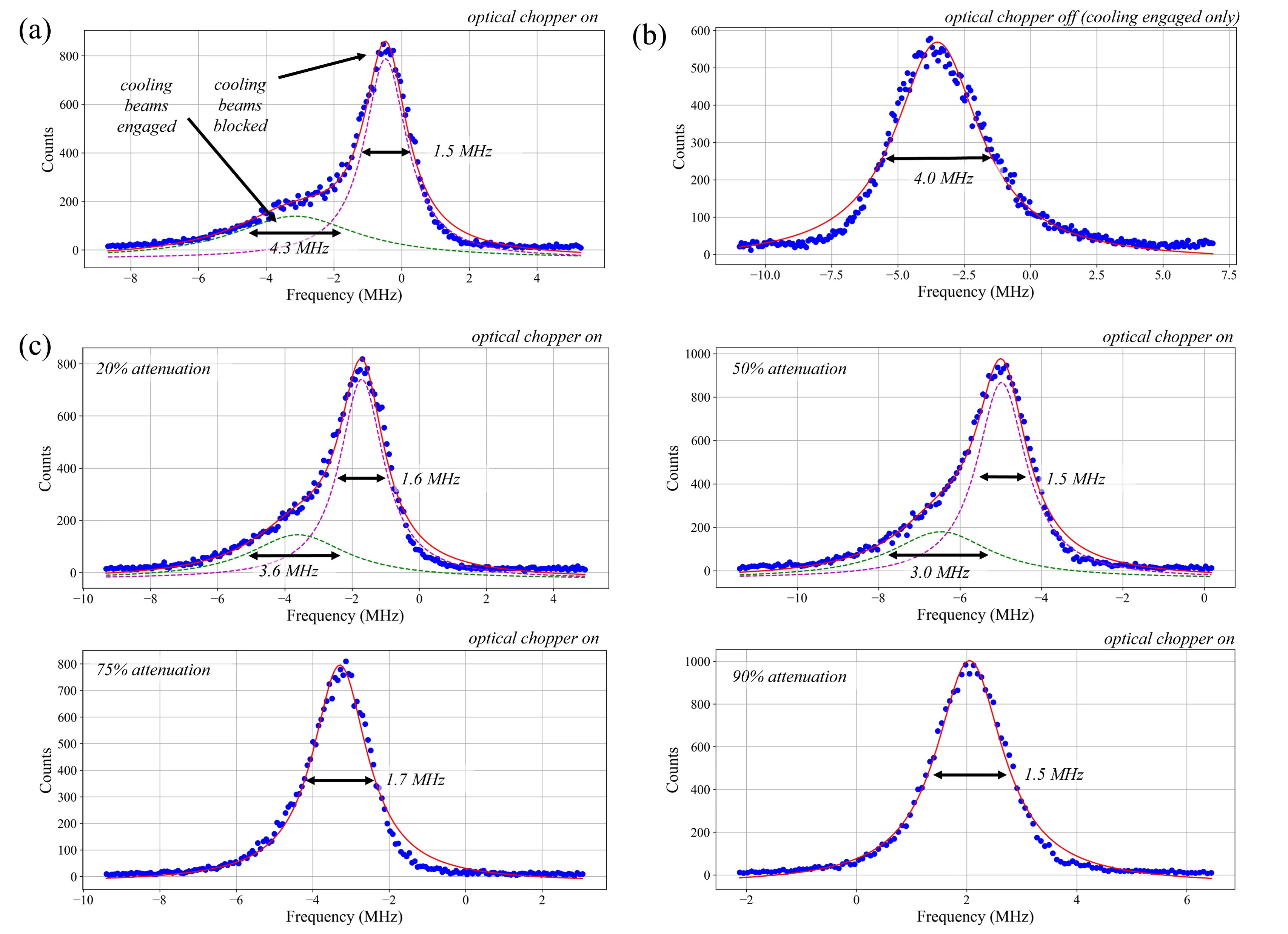
In the experiment, rubidium atoms were cooled in a magneto-optical trap — a device where laser beams and a magnetic field hold atoms in a small cloud and quench their thermal jitter. Then a very weak laser beam was directed at this cloud: just one microwatt of power, thousands of times weaker than a laser pointer. Each atom absorbed not one but two photons at once, transitioning to an excited state, and then emitted a single photon with higher energy. This is called two-photon fluorescence.
Remarkably, rubidium responded to such faint light. Typically, two-photon processes require powerful pulsed lasers, but here a continuous weak beam sufficed. This is all because the cooled atoms barely move, and their energy levels become very sharp, like tuning forks that don't go off-key from jitter.
Such sensitivity paves the way for detectors capable of catching single photons and for precise spectroscopic measurements where every particle of light matters. Rubidium atoms frozen in a trap become perfect antennas for weak signals.
Original abstract
as written by the authors arXiv:2602.07161
We report the results of two-photon-excited fluorescence (TPEF) measurements of the $$5\mathrm{S}_{1/2} \rightarrow 5\mathrm{D}_{1/2}$$ transition of $$^{85}$$Rb and $$^{87}$$Rb cooled in a magneto-optical trap (MOT). We observe TPEF at excitation powers as low as 1 $$\mu$$W or fluxes as low as $$4.30 \pm 0.22 \times 10^{18}\ \text{photons}\,\text{cm}^{-2}\,\text{s}^{-1}$$ ($$^{85}$$Rb) and $$5.17 \pm 0.26 \times 10^{18}\ \text{photons}\,\text{cm}^{-2}\,\text{s}^{-1}$$ ($$^{87}$$Rb). Our results show that Rb, with additional benefits due to its ability to be optically cooled to the point where Doppler-broadening is negligible, is a promising platform for observing sensitive two-photon spectral signatures at low photon fluxes.
To cool rubidium atoms, they are irradiated with a laser tuned just below resonance. Photons, like tiny balls, strike the atoms and slow them down, reducing the temperature to millionths of a degree above absolute zero.