Two-photon absorption is a nonlinear optical process in which an atom or molecule absorbs two photons simultaneously, with the combined energy of the two photons matching an electronic transition. This process is fundamentally different from sequential absorption, as it requires the two photons to arrive at the same time and place, and its probability scales with the square of the light intensity. Because the energy of each photon can be half of what would be needed for a single-photon transition, two-photon absorption allows the use of longer-wavelength (lower-energy) light to excite materials that would otherwise require higher-energy photons, such as ultraviolet light.
History
The theoretical foundation for two-photon absorption was laid by Maria Goeppert-Mayer in her 1931 doctoral thesis, where she predicted the process using quantum mechanics. It was first experimentally observed in 1961 by Wolfgang Kaiser and C. G. B. Garrett, shortly after the invention of the laser, which provided the necessary light intensity.
How it works
In two-photon absorption, an electron in a material does not have a real intermediate state to occupy; instead, it makes a virtual transition to a short-lived, non-stationary state. This virtual state exists only for a fleeting moment (on the order of attoseconds) due to the Heisenberg uncertainty principle. If a second photon arrives within that time window, the electron can absorb it and complete the transition to a real excited state. The process is highly nonlinear, meaning it is negligible at low light intensities but becomes significant under intense, focused laser pulses, such as those from femtosecond lasers.
In practice
Two-photon absorption is widely used in fluorescence microscopy to image living tissues with high resolution and minimal damage, as well as in photodynamic therapy for cancer treatment and in 3D optical data storage.
Fun fact
Two-photon absorption allows scientists to see deep inside the brain of a living mouse, capturing images of individual neurons firing in real time.
On the table lies a layered cake of hexagonal boron nitride flakes, a material similar to graphite but made of boron and nitrogen atoms. One flake is carefully transferred onto another, and at the spot where they overlap, after heating in oxygen, bright single light sources are born.
A courtroom interpreter must relay every word without being distracted by noise in the room. In the quantum world, a superconducting resonator plays that role, losing photons on schedule without straying into spurious effects.
A stack of playing cards lies still. You can slide the top card with your finger: that's crude intervention. Or you can blow so that the whole stack momentarily changes shape, but the cards don't scatter. That's roughly how light, in a new experiment, rearranges a crystal of tin selenide (SnSe).
Usually, to change the structure of a solid, you heat it or pass a current through it.
An X-ray flash tears through matter in billionths of a second. To remember it, physicists make atoms briefly absorb the light and then release it back. But pulling out a photon on command is like grabbing the right book from a shelf when the shelves move on their own.
The usual approach is to move several absorbers with extreme precision, like a well-coordinated orchestra.
The lifetime of the entangled triplet pair in the protein is about 60 picoseconds, which is eight times longer than in solution.
Sunlight is like a continuous stream of balls flying at a wall.
In 2021, the LHAASO observatory registered gamma quanta with energies above a petaelectronvolt from sources like the Crab Nebula — a supernova remnant with a pulsating neutron star at its heart.
Ordinary batteries lose charge like tea cools down. A quantum battery works differently: its heart is a tiny cavity with darting photons. If you illuminate it with special photon pairs, energy flows into a chain of qubit cells instantaneously — much like a swing gets a boost from strong pushes.
A swing only gets going if you push it in rhythm. Miss the beat, and your effort is wasted. Light interacts with an atomic nucleus in much the same way: a photon is usually absorbed only when its energy exactly matches the gap between nuclear levels. But what if the photon's energy doesn't fit? The authors of a new study have found a workaround.
Light isn't just straight rays; it's electromagnetic waves that can twist through space like a pair waltzing. Physicists call their total twist orbital angular momentum, and for a long time it was thought to obey the conservation law — a fundamental principle that follows from the symmetries of nature discovered by Emmy Noether.
A typical atom trap works like a funnel: laser light and a magnetic field slow atoms down and gather them at the center. But the funnel has a limit: it only catches atoms moving within a certain speed range.
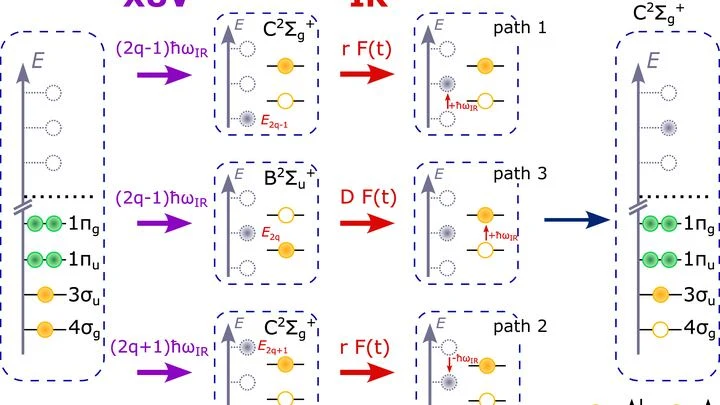
A high-speed camera capable of capturing the motion of electrons is an attosecond interferometer. It sends two laser pulses at a substance with a tiny delay. The first, ultraviolet, acts like a flash, knocking an electron out of the molecule. The second, infrared, like an invisible hand, gently nudges or slows this electron in flight.
Light from a bulb or even a regular laser resembles a crowd at a subway exit: people move haphazardly, sometimes dense, sometimes sparse. Physicists call this behavior shot noise — random fluctuations in the number of particles arriving per second.
A laser beam as faint as a whisper of light has stirred a thorium-229 nucleus into a higher energy state. Most nuclei demand a blast of energy, but thorium-229 has such a tiny energy gap that even this gentle nudge works.
Inside every cell, there are tiny power stations — mitochondria. They burn nutrients and store energy. Two helper molecules, NADH and FAD, oversee this process. Previously, they were detected by their faint glow, but it was dim, and signals from different molecules overlapped.
The new microscope works differently.
A security guard needs to check five rooms but can't go inside. He knocks on the door and listens: silence means someone is inside, while an echo means the room is empty.
Light usually pushes an atom straight ahead, like wind pushing a sail. But if the beam is twisted into a corkscrew, the picture changes: the atom can fly off to the side, as if caught by a spinning wheel. In the new work, physicists calculated that such a vortex photon can transfer almost all of its rotation to the atom — up to 100 percent.
Imagine a tap that doesn't pour a stream but releases water strictly one drop at a time: that's the single-photon source the authors describe. In ordinary light, photons travel in a crowd, like water from an open tap.
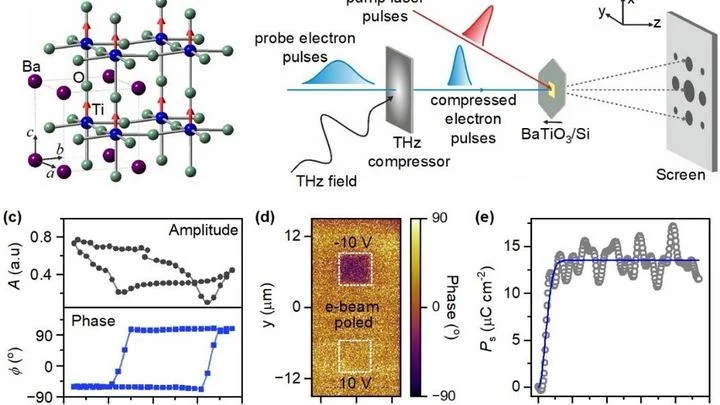
Inside a barium titanate crystal, there's a built-in electric field, like a permanent magnet, but for charges. When a flash of light hits it, electrons are knocked loose and start darting around, colliding with atoms. But the crystal isn't the same in all directions: it has an axis along which the field is strongest.
A water droplet on a leaf disappears faster under the sun than heat calculations would predict. A few years ago, a hypothesis emerged: light itself, without heating, could knock water molecules off the surface. This was dubbed the photomolecular effect. If it exists, clouds, climate, and even everyday clothes drying could work differently.
Two tiny emitters, each about the size of an atom, can together do what neither can do alone. We're talking about light scattering — when light hits particles and bounces off in all directions. Usually, a pair of particles scatters light only slightly more than a single one.
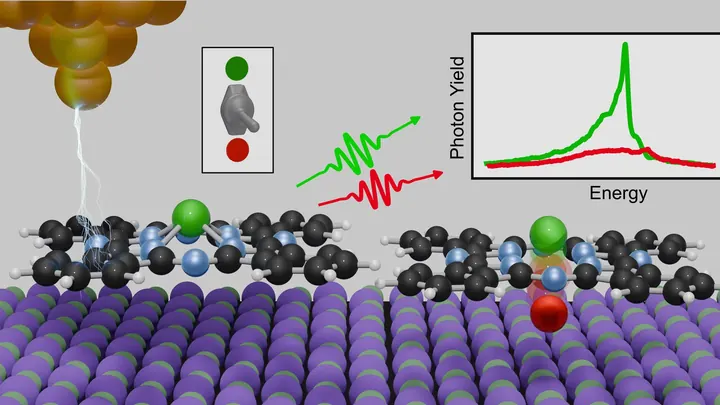
A glowing dot the size of a molecule. Run a current through it, and it flashes like a tiny lightbulb. That's what the experiment with dye molecules on a thin salt film looks like.
When current enters a molecule, one electron hands it energy. The molecule immediately gives that energy back, as light. It's like a swing: give it one push, and it rocks and then stills.
An ordinary comb parts hair into even strands. A laser 'comb' does the same to light: it emits not one color but thousands, spaced at exactly equal frequency steps. Such a tool has already helped measure time to billionths of a second and peer inside atoms.
An ordinary lamp won't make an atom glow: it's too weak. But if you slow atoms down to nearly a standstill, even a tiny stream of photons, like rare drops from a pipette, can make them respond with a bright flash.
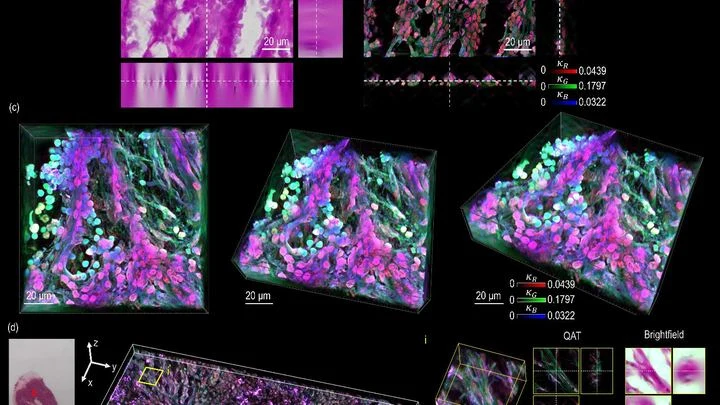
Light passing through a stained cell loses some of its strength, like a flashlight beam cutting through a glass of tea. The denser the color, the more light is absorbed. But until now, a microscope could only show a flat shadow of this process, not its volume.
Light is a great tool for studying tissues, but it fades fast deep inside the body. Within a few millimeters, photons scatter so much that you can't make out anything. Scientists came up with a workaround: instead of shining light from outside, deliver a tiny light source right inside. The challenge is how to power that source without wires.
Atoms, like a swarm of fireflies, shine in unison. When they flash together, the light multiplies — a hundred atoms shine ten thousand times brighter than one. Physicists have turned this trick into a heat engine. A typical motor needs both a hot and a cold source, but here the atoms operate with just a cold one.
Light is a finicky guest. It flies into a cavity but doesn't stay: part of the pulse inevitably reflects and carries away quantum information. Classical single-pass capture schemes hit this limit no matter how much you improve control. Reflection was considered a loss, but the authors of a new study suggest looking at it differently.