Debris from an Exploded Star Changes Course express
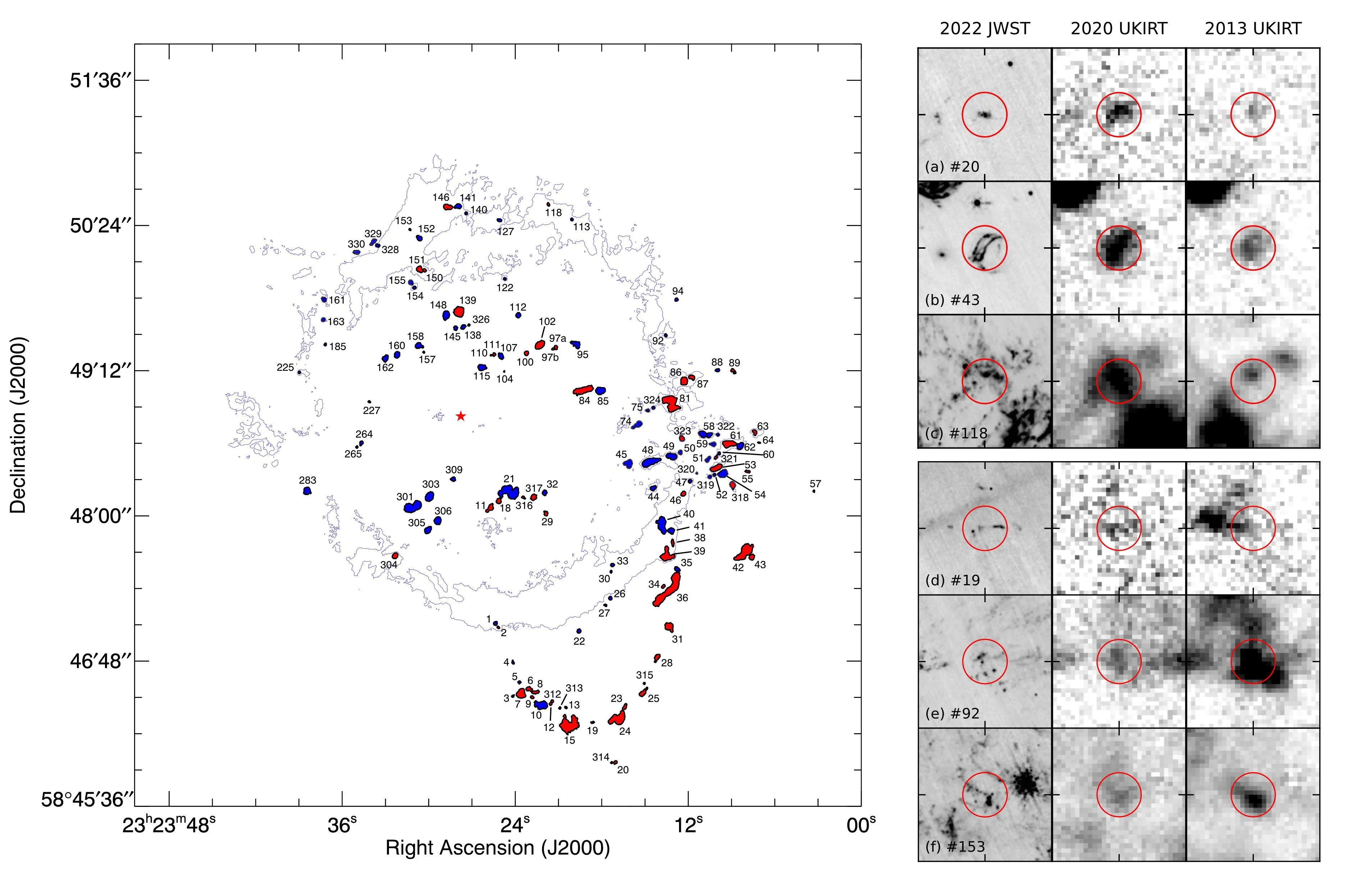
In 2013 and 2020, the same telescope in Hawaii looked at the remnant of an exploded star — Cassiopeia A. The images were taken in the light of glowing iron, as if photographing invisible streams of metal flying through space.
Over seven years, astronomers found 263 dense clumps — debris ejected by the explosion. Some of them have barely moved: they likely collided with gas that the star shed before it blew up. Others are moving fast, but some of these fast clumps are slowing down, especially on the eastern side of the remnant.
This is not just cosmic dust: in these clumps travel iron, silicon, and other elements that will later form new stars and planets. By watching them slow down and disappear, scientists are refining how much material remains in the galaxy after a star dies.
Seven years is a blink of an eye by cosmic standards, but even in that time you can see the explosion still living: debris collides, fades, and changes course. Cassiopeia A is like a slow-motion fireworks display that has been going on for three hundred years.
Original abstract
as written by the authors arXiv:2602.09175
We present a comparative analysis of supernova remnant Cassiopeia A based on two deep, narrow-band images covering the [Fe II] 1.644um + [Si I] 1.645um lines obtained in 2013 and 2020 with the same instruments on the UKIRT 3.8m telescope. The identical setup and observing procedure allow for direct, accurate measurements of morphological and kinematic changes over a seven-year baseline. We identified 263 compact knots in the 2020 image and, through comparison with the 2013 catalog of Koo et al. 2018 (arXiv:1809.07935), classified them into quasi-stationary circumstellar knots and fast-moving knots (FMKs) of supernova ejecta. The FMKs show significant flux fluctuations, and many of those detected in 2013 are absent in the 2020 image. Proper-motion measurements derived from cross-correlation analysis indicate that most FMKs follow nearly ballistic expansion, whereas some, particularly those just beyond the eastern Fe-rich, X-ray emitting ejecta region, exhibit noticeable deceleration. The proper motions of the main ejecta shell were also measured and modeled as a uniformly expanding shell with a systemic motion, which reproduces the observed geometric and kinematic asymmetries of the remnant.
Cassiopeia A is the brightest radio source beyond the Solar System, even though it exploded only about 300 years ago.