A Ring of Warmth in a Star's Cradle express
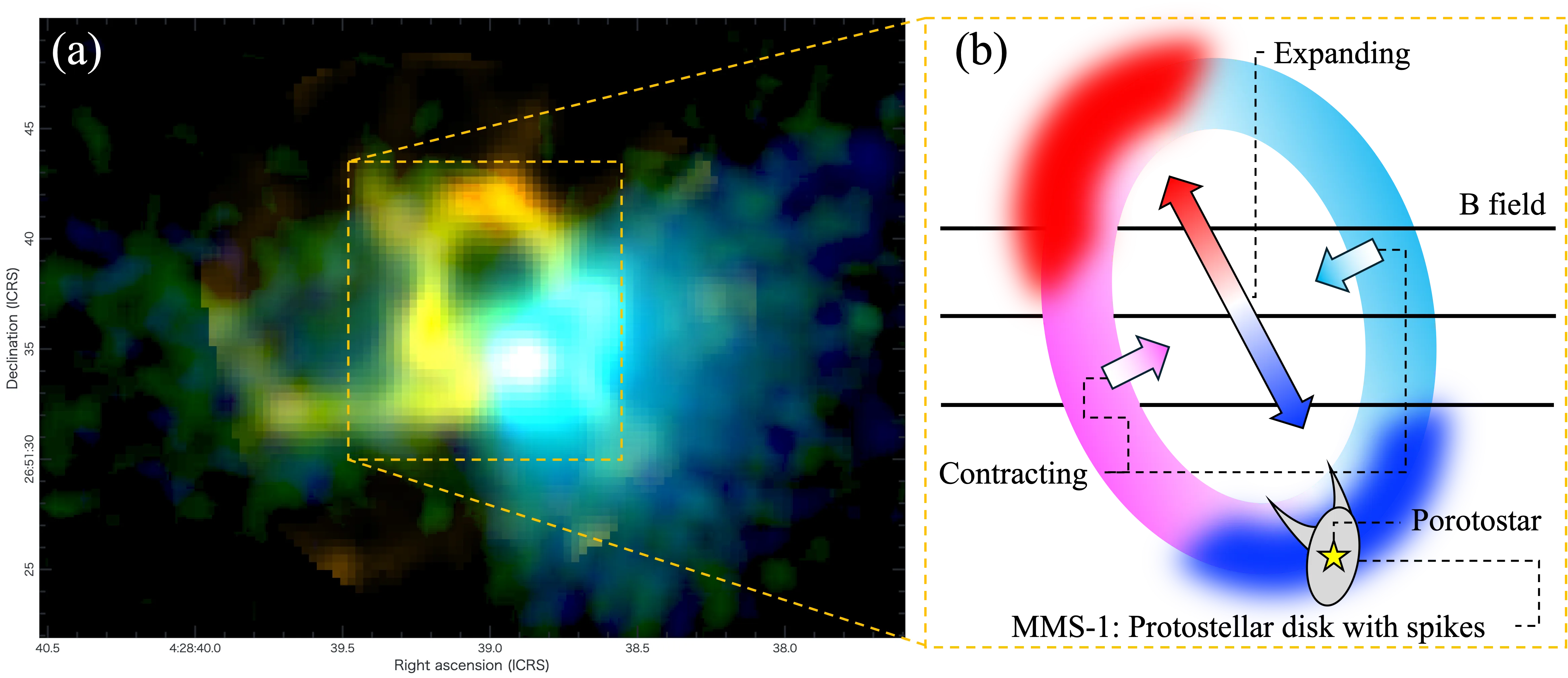
In a cold, dark cloud of gas where a star is just beginning to form, the ALMA telescope has spotted an unusual ring. It is made of gas that is warmer and denser than its surroundings. Such details were previously hidden because the gas at the cloud's center is opaque to ordinary observations.
The ring was likely heated by a shock wave. As material falls toward the forming star and is also ejected from it, the flows collide and are compressed by magnetic fields. At the collision site, the gas heats up and begins to glow in emission lines of carbon monoxide (CO). Observing these lines offers a new way to peer into the very beginning of a star's life.
This discovery shows that even the coldest, calmest-looking clouds are sites of violent activity. The ring of warmth is a trace of the first motions that will eventually ignite a new star.
Original abstract
as written by the authors arXiv:2602.12661
Infall and outflows, coupled with magnetic fields, rapidly structure the gas around newborn protostars. Shocks from interacting components encode the temperature and density distribution, offering a direct probe of the earliest evolution history. However, interferometric observations characterizing warm envelopes using high-excitation lines remain scarce. We present ALMA Band 9 observations of the Taurus dense core MC 27/L1521F, which hosts a Class 0 protostar, targeting the CO($$J$$=6-5) line at an angular resolution of $$\sim$$2\arcsec\ ($$\approx$$300 au). We detect an off-centered ring-like structure with a diameter of $$\sim$$1000 au that was not identifiable in previous low-$$J$$ CO data, where emission close to the systemic velocity is strongly affected by optical depth. The ring shows a typical peak brightness temperature of $$\sim$$3 K at our resolution. Excitation considerations indicate that the detected CO($$J$$=6-5) emission likely arises from relatively warm ($$T \gtrsim 20$$ K) and dense ($$n({\rm H_2}) \gtrsim 10^{5}$$ cm$$^{-3}$$) gas embedded within the surrounding cold, dense core. The morphology and kinematics suggest an energetic and localized shock-heating event, potentially linked to dynamical gas--magnetic-field interactions in the earliest protostellar phase. Our results demonstrate that high-$$J$$ CO observations provide a powerful new window on warm and dense gas components, enabling a more direct view of the physical processes operating at the onset of star formation.
Carbon monoxide (CO) is the second most abundant molecule in the universe after hydrogen. It glows in the radio range, so astronomers use it as "paint" to map cold clouds.