A Ring of Warmth in a Star's Cradle express
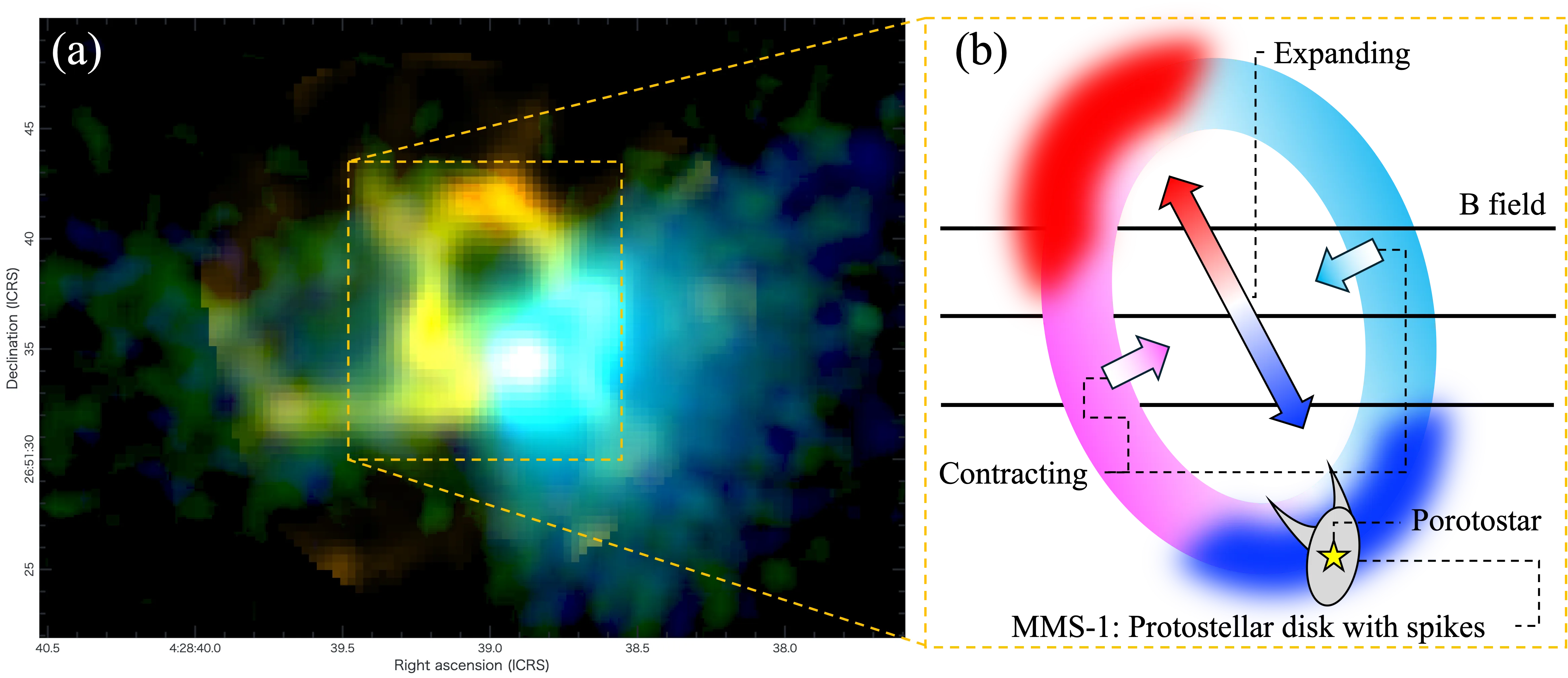
In a cold, dark cloud of gas where a star is just beginning to form, the ALMA telescope has spotted an unusual ring. It is made of gas that is warmer and denser than its surroundings. Such details were previously hidden because the gas at the cloud's center is opaque to ordinary observations.
The ring was likely heated by a shock wave. As material falls toward the forming star and is also ejected from it, the flows collide and are compressed by magnetic fields. At the collision site, the gas heats up and begins to glow in emission lines of carbon monoxide (CO). Observing these lines offers a new way to peer into the very beginning of a star's life.
This discovery shows that even the coldest, calmest-looking clouds are sites of violent activity. The ring of warmth is a trace of the first motions that will eventually ignite a new star.
Carbon monoxide (CO) is the second most abundant molecule in the universe after hydrogen. It glows in the radio range, so astronomers use it as "paint" to map cold clouds.