Gamma Rays Weighed to One Part per Million express
Gamma rays are the most energetic flashes of light born deep within atoms. Their energies are like fingerprints: each radioactive element has its own pattern. But measuring that pattern with high precision is like weighing a grain of sand on a scale sitting on a vibrating truck.
The new setup works like an ultra-sensitive thermometer. Magnetic microcalorimeters catch a gamma quantum and measure the tiny temperature jump — less than one millionth of a degree. Eight such detectors look at four sources containing a mix of different radioactive elements. From their emissions, the instrument calibrates itself and corrects for inaccuracies.
In the end, the energies of 27 gamma rays became known with new precision. For four of them, the uncertainty decreased tenfold. Previously, such measurements were done with semiconductor detectors: they were like a ruler with coarse markings. Now we have a microscope. This level of precision is needed to test nuclear theories, calibrate medical scanners, and even search for signs of new physics.
Original abstract
as written by the authors arXiv:2602.12836
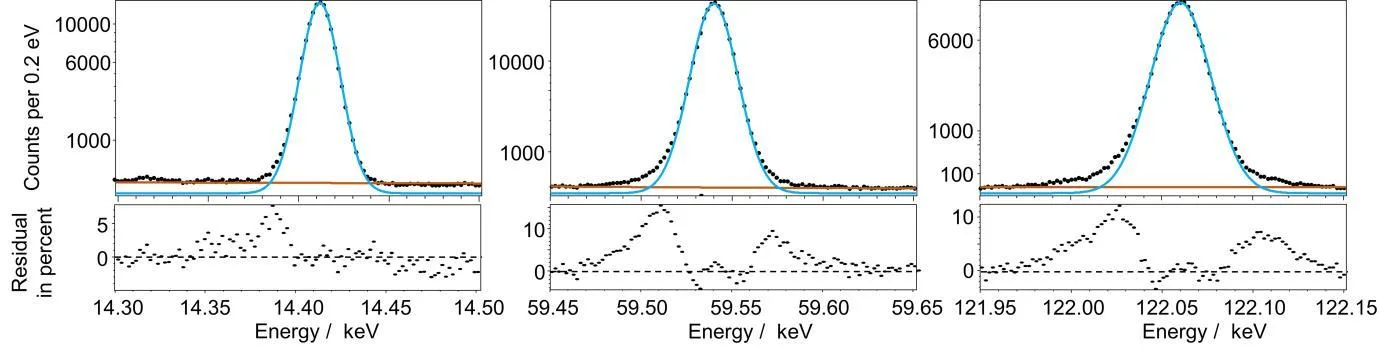
We present new measurements of 27 gamma ray energies ranging from 14 keV to 136 keV, obtained using high-energy-resolution magnetic microcalorimeters for energy-dispersive spectrometry. The spectrometer has eight pixels and achieves an energy resolution between 15 and 30 eV across the entire energy range. It faces a cryogenic source sampler with four movable sources. Each source contains a mixture of radionuclides, including Yb-169 and Co-57 used to calibrate the spectrometer and correct its non-linearity. The gamma-ray energies, emitted through the decay of Co-57, Cd-109, Ba-133, Gd-153, Eu-154, Eu-155, Yb-169, Tm-170, Pb-210, Np-239, Am-241 and Am-243, have been reassessed. The lowest absolute uncertainty achieved is 0.13 eV at 105.3 keV, which corresponds to a relative uncertainty of 1.3 ppm. Of the 27 measured gamma rays, the uncertainties of 19 energies were improved with respect to the available literature: 10 by a factor of 5 and 4 by more than one order of magnitude. Good agreement is observed with energies obtained elsewhere by wavelength-dispersive spectrometry. This work significantly improves upon previously reported gamma energies obtained by energy-dispersive spectrometry using semiconductor detectors, thanks to the ultra-high energy resolution of magnetic microcalorimeters.
The energy of a 105.3 keV gamma quantum was measured with a precision of 0.13 eV: that's like the weight difference between two identical coins if a speck of dust landed on one.
In the series 'Star Trek', the tricorder determines the composition of matter by its energy spectrum: this new technology takes a step toward such precise pocket analyzers.