New physics refers to any phenomenon or particle that cannot be explained by the Standard Model of particle physics, the remarkably successful but incomplete theory describing known fundamental particles and forces. The Standard Model leaves several mysteries unresolved: the nature of dark matter, the tiny mass of neutrinos, the hierarchy problem (why gravity is so weak), and the matter-antimatter asymmetry of the universe. New physics would encompass the particles or forces that fill these gaps, such as supersymmetric partners, axions, sterile neutrinos, or extra spatial dimensions.
History
The term 'new physics' gainedprominence in the 1980s as the Standard Model became established and its limitations became clear. The concept of physics beyond the Standard Model has been a major driver of theoretical and experimental work since then.
How it works
The search for new physics typically involves looking for deviations from Standard Model predictions. This can be done at high-energy colliders (like the LHC) by searching for new particles produced in collisions, or in precision experiments that measure known quantities with extreme accuracy, looking for tiny discrepancies. Cosmologicalobservations, such as the expansion rate of the universe or the distribution of galaxies, also provide indirect probes of new physics that might have influenced the early universe.
In practice
While new physics has not yet been discovered, the search drives the development of advanced detector technologies, superconducting magnets, and data analysis techniques that find applications in medical imaging and computing.
Fun fact
The muon's anomalous magnetic moment shows a 4.2-sigma discrepancy between experiment and Standard Model prediction, one of the most significant hints of new physics that has not yet reached the gold-standard 5-sigma threshold for discovery.
In the depths of a neutron star, the remnant of an exploded star, matter is compressed so tightly that a teaspoon would weigh billions of tons. Within this superdense material, a special kind of force might be at work, one that affects only muon and tau neutrinos.
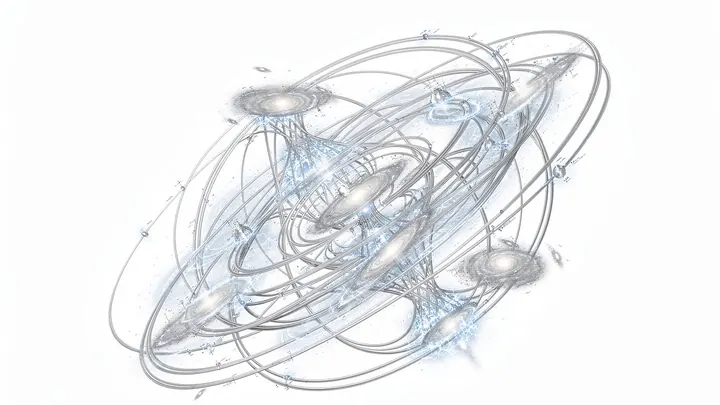
A stone thrown into water leaves ripples. A satellite orbiting Earth also leaves a trace — not on water, but in the laws of physics. Its orbit is not a frozen line: it slowly rotates, like the hand of a giant clock.
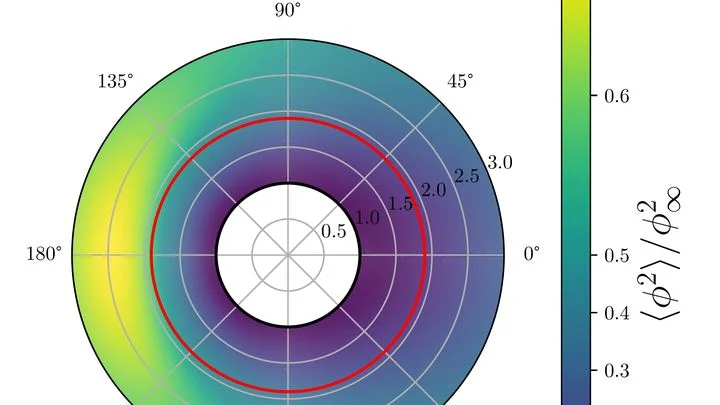
A fluffy ball of invisible web envelops a black hole. This web is dark matter, which doesn't shine but, through its weight, governs the motion of stars on the outskirts of galaxies. Astrophysicists have long seen such 'fluffy' clouds around cosmic objects and have mapped their profiles — how density falls from the center to the edge.
Picture the Universe as a book with a finite number of pages. Its accelerated expansion, driven by dark energy, a mysterious substance pushing space apart, acts like an invisible binding: distant pages are forever glued together, becoming inaccessible chapters.
Back in the 1930s, Fritz Zwicky noticed that the speeds of galaxies in clusters were too high for the visible mass. Later, Vera Rubin confirmed this for individual galaxies.
Neutrinos are the most abundant massive particles in the universe. Trillions of them pass through us every second, yet they leave barely a trace. Their collective gravity, though tiny, can influence the motion of entire galaxies. Think of two people approaching each other on a busy street; invisible passersby alter their speed.
An attempt to suppress room background noise by adding anti-sound turns into speaker howl if the circuit has an error. A similar glitch occurred with a theory that set out to remove the main cosmic hum — the inexplicably weak dark energy.
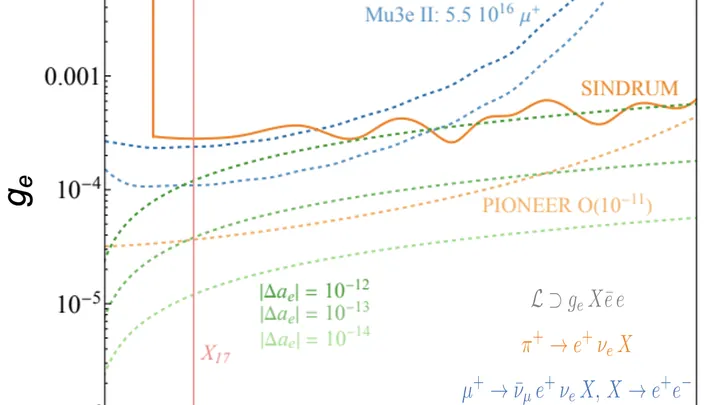
In nuclear transitions of beryllium-8, helium-4, and carbon-12, physicists from the ATOMKI collaboration have been seeing extra events since 2020—as if, when an excited nucleus decays, something else is sometimes born besides the usual photons. The energy of this "something" is always the same: about 17 million electron-volts.
Traditional cosmology begins with the Big Bang — the idea of Georges Lemaître. However, a new approach, inspired by the work of Stephen Hawking, bypasses the mystery of the initial moment.
In the thirties, Pauli realized: without tiny ghost-like particles, the energy of stars doesn't add up. Thus neutrinos were born — intangible wanderers that permeate everything.
The universe is a pie baked from a single recipe, but the teaspoon and the kitchen scale stubbornly show different amounts of sugar. That’s how it is with the expansion of the universe: measurements from nearby stars (the spoon) give one number, while those from the ancient light of the Big Bang (the scale) give a completely different one.
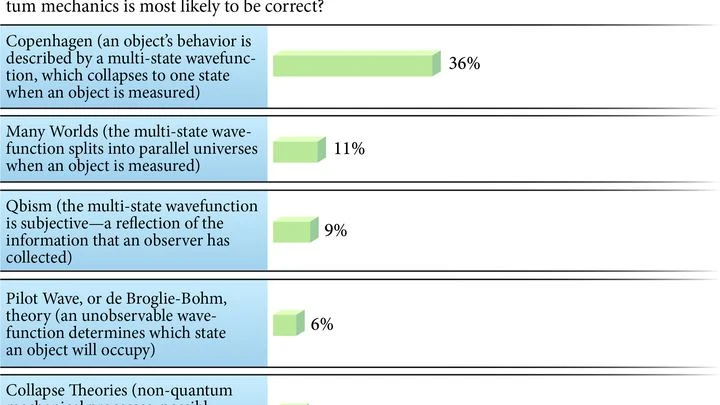
A quantum particle, an inhabitant of the elementary particle world, resembles a coin spinning in the air: neither heads nor tails, but a blend of possibilities. Yet when it lands on the table, the outcome becomes definite. What serves as the table in a measurement?
Two great theories describe reality: one — how massive bodies cause curvature of space, the other — the Standard Model — governs elementary particles. Reconciling them remains elusive, like trying to describe an ocean storm in the language of a diamond lattice.
In 1976, Gerard 't Hooft noticed that the vacuum of a gauge theory is not as simple as it seems: it possesses a topological structure that manifests itself in a nonzero topological susceptibility.
At night, an astronomer points a telescope at the edge of the visible universe and sees not stars but ripples — the imprint of the first moments. He knows these ripples should obey statistics, like the heights of people in a crowd. But he has only one crowd, and nothing to compare it with.
This is cosmic variance.