Radioactive decay is the spontaneous process by which an unstable atomic nucleus loses energy by emitting radiation. This transformation changes the original element into a different element or a different isotope of the same element, often leaving the nucleus in a more stable configuration. It is a fundamental phenomenon in nuclear physics, underlying everything from the heat of Earth's interior to the dating of archaeological artifacts and the operation of nuclear reactors.
History
Discovered in 1896 by Henri Becquerel, who found that uranium salts fogged photographic plates. Marie and Pierre Curie subsequently isolated polonium and radium, and Ernest Rutherford identified alpha and beta particles and proposed the concept of half-life.
How it works
The nucleus of an atom is held together by the strong nuclear force, which competes with the electrostatic repulsion between protons. In unstable nuclei, this balance is off, and the nucleus can spontaneously emit particles or electromagnetic radiation to shed excess energy. Common modes include alpha decay (emitting a helium nucleus), beta decay (converting a neutron to a proton or vice versa, emitting an electron or positron), and gamma decay (emitting high-energy photons). The process is probabilistic: for a given nucleus, there is a constant probability per unit time of decay, characterized by the half-life.
In practice
Used in radiometric dating (e.g., carbon-14), medical imaging and cancer treatment (radiotherapy), nuclear power generation, and as a power source for spacecraft (radioisotope thermoelectric generators).
Fun fact
The decay of a single atom was first observed in 2019 using a technique that trapped a radioactive atom and detected the emitted particle, confirming a prediction made by Einstein in 1917.
After a nuclear explosion, soot rises into the sky. It settles high above the clouds, in the stratosphere, and stays there for years. This soot acts like a thick curtain: it blocks some sunlight and alters the chemistry of the sky.
Diamond is a symbol of perfection, but its true magic is revealed through flaws. Perfect lattice purity gives transparency and hardness, while defects, such as color centers, open a portal to the quantum world, becoming the foundation for quantum computers and quantum sensors.
The Standard Model is a set of rules for all known particles. But it says nothing about dark matter, which makes up a quarter of the Universe. To find it, you don't need to build city-sized colliders. Radioactive molecules act like sniffer dogs: their incredible 'scent' picks up the faintest traces of unknown forces that slip past giant machines.
When many excited atoms are gathered together, they often fire light in concert, like a crowd clapping in rhythm. This well-known phenomenon is called Dicke superradiance. But the authors of the new study asked: what happens if the atoms are not identical and each one feels its neighbors?
A swing only gets going if you push it in rhythm. Miss the beat, and your effort is wasted. Light interacts with an atomic nucleus in much the same way: a photon is usually absorbed only when its energy exactly matches the gap between nuclear levels. But what if the photon's energy doesn't fit? The authors of a new study have found a workaround.
In a molecule resembling chlorophyll and built from carbon, a metal atom at the center acts as a toggle. Shifting it by fractions of a nanometer can make the molecule glow, quench, or boost its brightness a hundredfold.
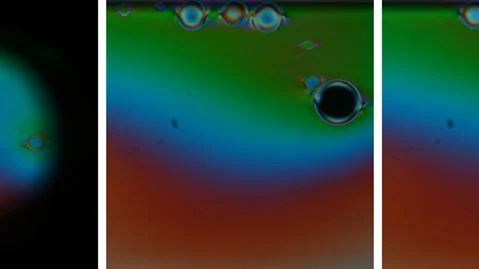
Molecules in a solution behave like a crowd in a square: they can jostle randomly or line up in neat rows. An aqueous solution of disodium cromoglycate is a well-known model for chromonic liquid crystals, where such 'rows' form spontaneously. But if you shine ultraviolet light on the solution, order collapses: molecules start breaking apart.
A tiny glass sphere floats in a laser beam like a speck of dust in sunlight. Inside it is radioactive lead, which decays from time to time. Each decay ejects charged particles, and the sphere loses or gains a tiny electric charge.
An atomic nucleus isn't always round. It can stretch out like a melon or flatten like a pumpkin. And its size depends on this shape — just as the size of a pie depends on the shape of the dough.
Scientists calculated the shapes and sizes of nuclei of berkelium isotopes — a heavy element produced in reactors.
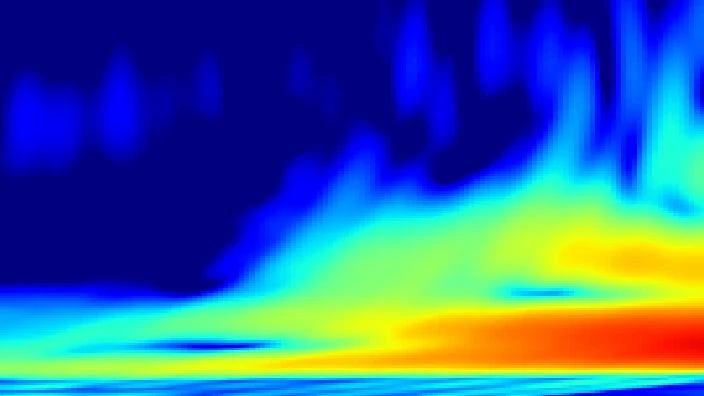
In the stream of charged particles that constantly blows from the Sun, radio bursts sometimes occur — short, powerful signals at frequencies you can pick up on an ordinary radio. Until now, it was unclear how exactly these signals are born in that stream.
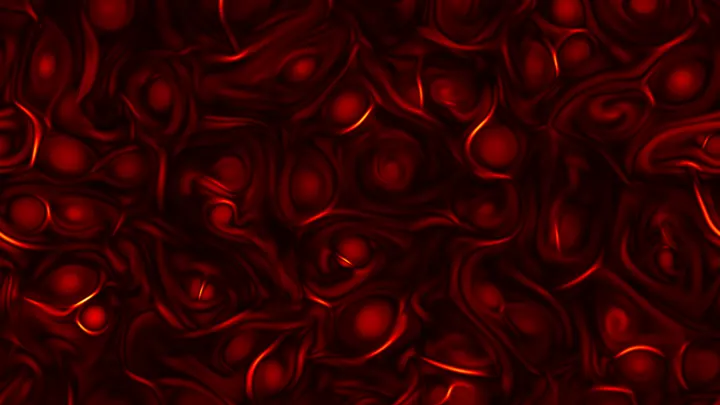
In a pot of boiling soup, small bubbles churn, but gradually large-scale flows come to dominate. Something similar happens in cosmic plasma, where magnetic fields behave like tangled threads.
Emptiness isn't always empty: it can hide energy, like supercooled water hides ice. Physicists call this false vacuum — a state that only needs a nudge to cascade into the true one.
A thin film of thorium dioxide, just 10 nanometers thick, is deposited on a steel disk. A laser pulse strikes it, but instead of the expected glow, the detector catches a stream of electrons.