Complexity on the Edge of Order and Chaos express
A magnetic film divided into tiny arrow-shaped cells behaves like a crowd in a square. While it's cold, all arrows point in the same direction — perfect order. Heat the film, and the arrows start darting around like pedestrians who have lost their purpose. Somewhere between these extremes, there is a moment when the system stops being uniform but hasn't yet dissolved into random noise.
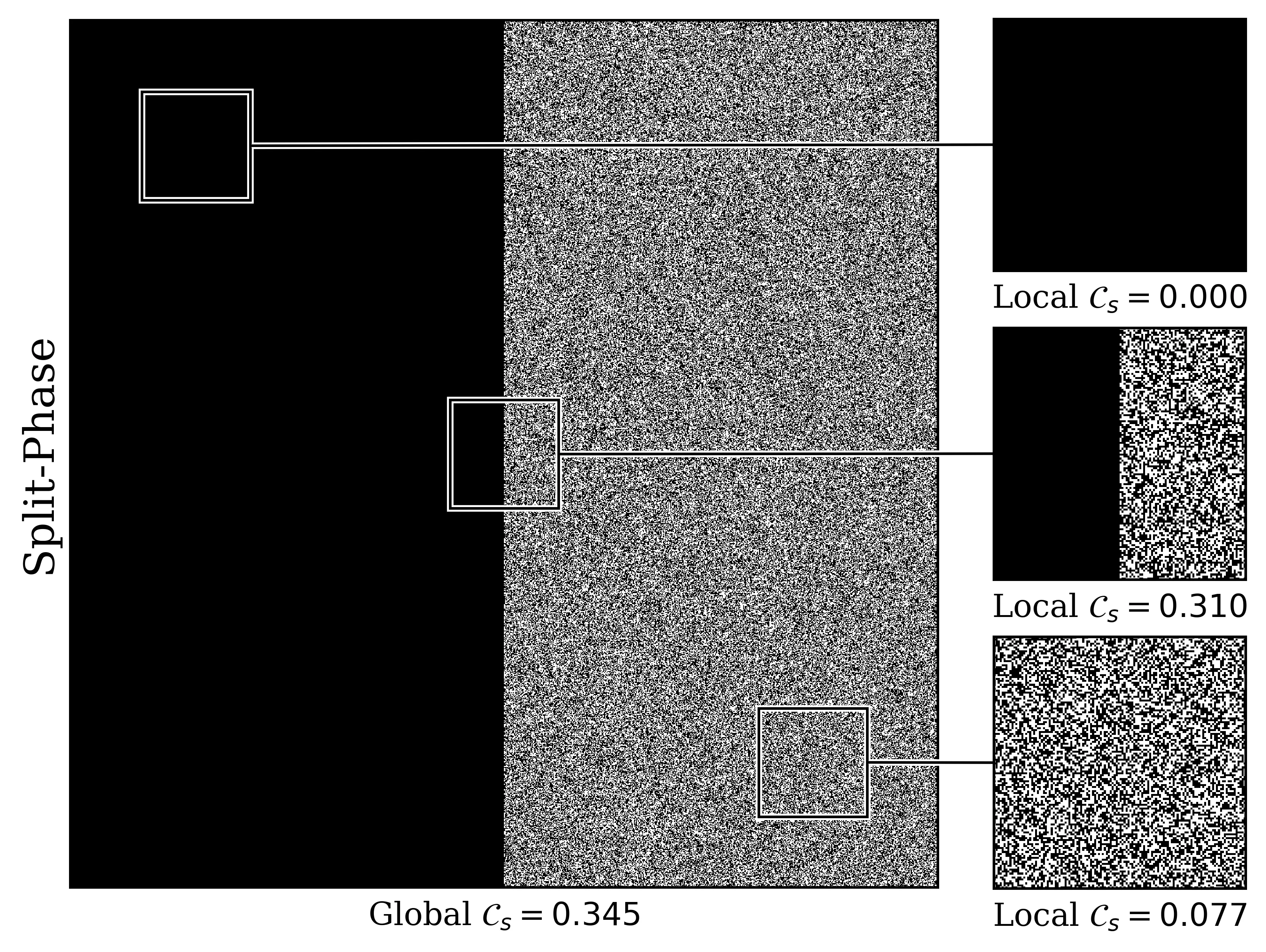
Physicists took such a model — the two-dimensional Ising lattice, known for its abrupt change at a critical temperature. They captured snapshots of the lattice states at different temperatures and compressed them like ordinary pictures on a phone. Compression reveals how much regularity is in an image: a perfectly uniform pattern packs into a tiny file, while white noise barely compresses. To account for both order and chaos, the researchers compared each state with its shuffled versions — one sorted by colors and one completely mixed.
They built a complexity measure as the product of two numbers: how far the system is from perfect order and how far from complete disorder. A plot of this measure against temperature showed a sharp peak exactly at the phase transition point. This means that structural complexity is a reliable beacon of the critical state, which can be found without complex formulas, simply by compressing data.
This approach is useful where analytical solutions are unavailable: in biology, climate, and social networks. Everywhere a system churns on the edge of order and chaos, data compression can hint when to expect abrupt changes.
Original abstract
as written by the authors arXiv:2602.15185
The data-driven characterization of the ``complexity'' present in dynamical systems remains an open problem with broad applications across the physical sciences. We investigate the ``structural complexity'' of the 2D ferromagnetic Ising model, a paradigmatic system exhibiting a second-order phase transition at a certain critical temperature which is often cited as a canonical example of complex morphology. We define a quantitative metric for this structural complexity, $$\mathcal C_s$$, through the lens of algorithmic information theory by approximating the Kolmogorov complexity of lattice configurations via standard lossless image compression algorithms. We regularize our proposed metric, $$\mathcal C_s$$, by comparing the compressibility of a configuration to that of its pixel-wise sorted and randomly shuffled counterparts. We arrive at a definition of $$\mathcal C_s$$ as a product of two components representing the systems departure from perfect order and disorder respectively which we then plot as a function of temperature. Our numerical simulations reveal a distinct peak in $$\mathcal C_s$$ at the known critical temperature $$T_c$$. This result demonstrates that such information-theoretic measures can act as sensitive, model-agnostic indicators of criticality, directly quantifying the emergence of complex structure at the boundary between order and chaos, opening the door to data-driven applications in domains where analytic solutions are unavailable.
Compression algorithms used for storing photos turned out to be capable of detecting subtle changes in a physical system, as if a phone camera could recognize a phase transition.