Complexity on the Edge of Order and Chaos express
A magnetic film divided into tiny arrow-shaped cells behaves like a crowd in a square. While it's cold, all arrows point in the same direction — perfect order. Heat the film, and the arrows start darting around like pedestrians who have lost their purpose. Somewhere between these extremes, there is a moment when the system stops being uniform but hasn't yet dissolved into random noise.
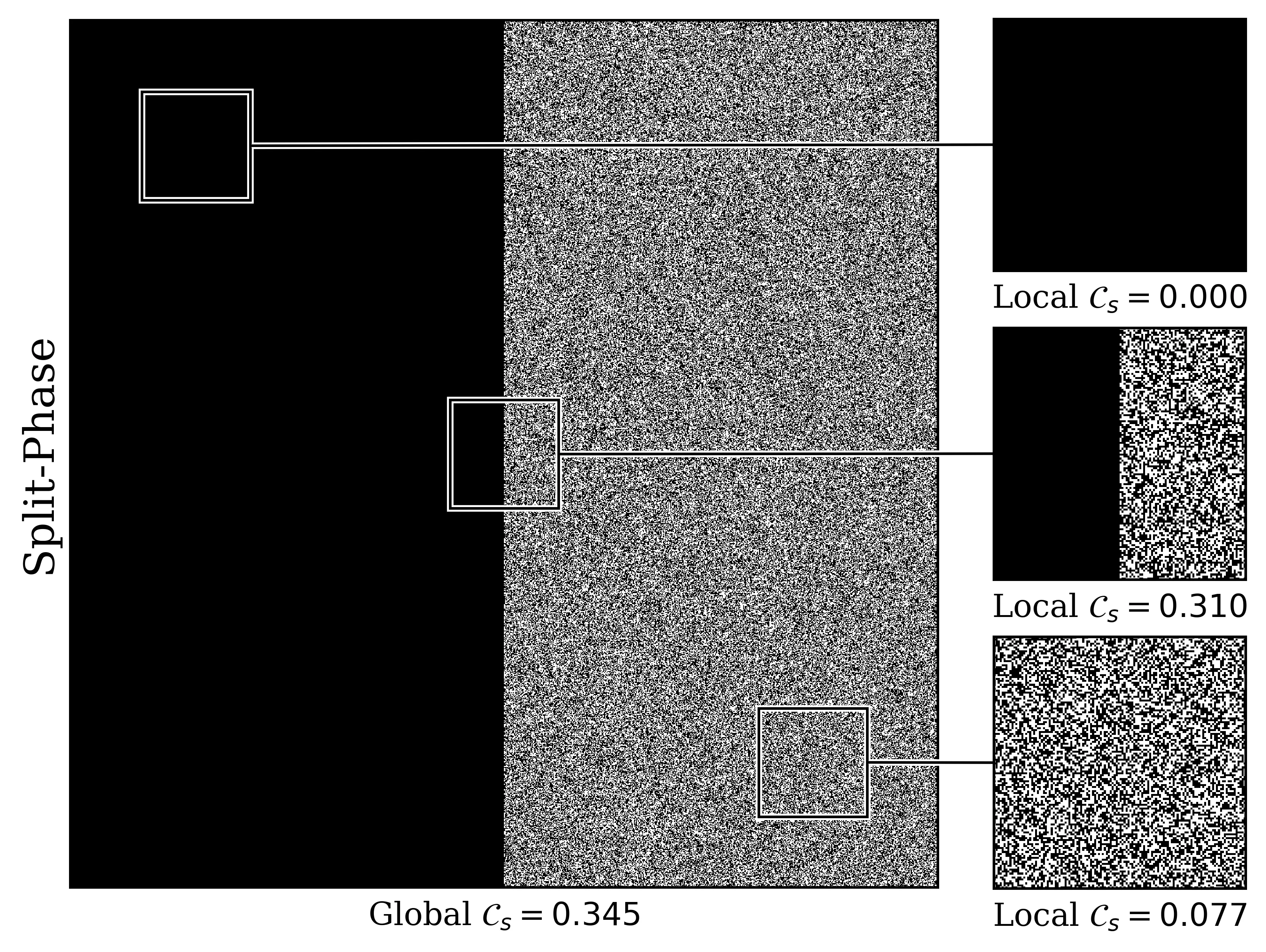
Physicists took such a model — the two-dimensional Ising lattice, known for its abrupt change at a critical temperature. They captured snapshots of the lattice states at different temperatures and compressed them like ordinary pictures on a phone. Compression reveals how much regularity is in an image: a perfectly uniform pattern packs into a tiny file, while white noise barely compresses. To account for both order and chaos, the researchers compared each state with its shuffled versions — one sorted by colors and one completely mixed.
They built a complexity measure as the product of two numbers: how far the system is from perfect order and how far from complete disorder. A plot of this measure against temperature showed a sharp peak exactly at the phase transition point. This means that structural complexity is a reliable beacon of the critical state, which can be found without complex formulas, simply by compressing data.
This approach is useful where analytical solutions are unavailable: in biology, climate, and social networks. Everywhere a system churns on the edge of order and chaos, data compression can hint when to expect abrupt changes.
Compression algorithms used for storing photos turned out to be capable of detecting subtle changes in a physical system, as if a phone camera could recognize a phase transition.