How Magnetic Vortices Melt in Plasma express
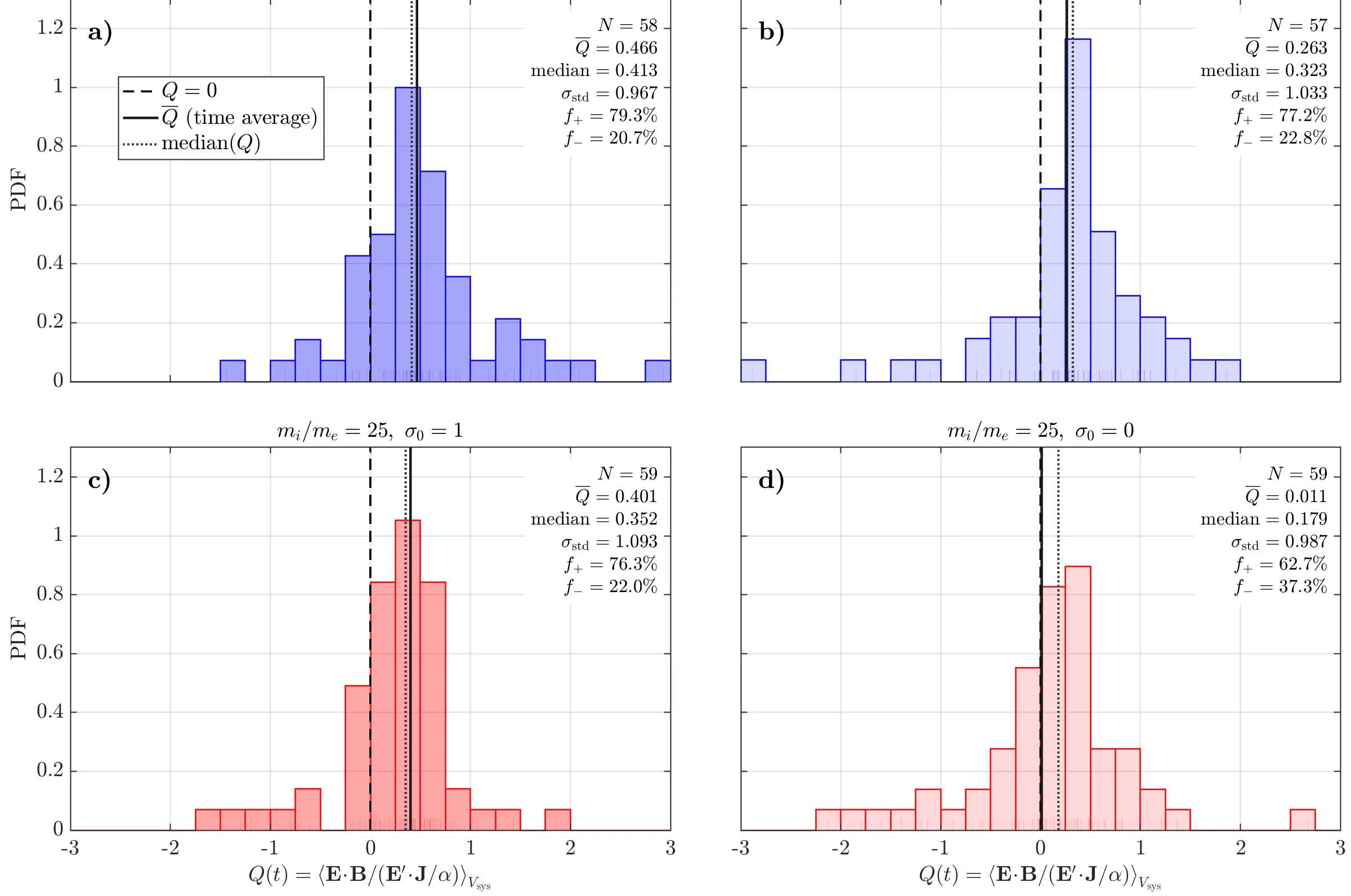
Plasma isn't just hot gas; it's a mix of charged particles that constantly move and generate magnetic fields. When plasma churns, these fields intertwine like spaghetti in a boiling pot. Scientists simulated what happens when the churning subsides and turbulence decays.
At the very beginning of the decay, while electrons are still actively interacting, distinct regions appear in the plasma where the electric and magnetic fields are not perpendicular to each other. Previously, it was thought they were always perpendicular in such conditions. These regions turned out to be linked to a decrease in a special quantity, magnetic helicity, which measures how strongly magnetic field lines are twisted in one direction. Simply put, the vortices start to unwind.
The scientists noticed that vortices with opposite twists appear very quickly, and the overall helicity drops. This is like if, in a pot of spaghetti, half the noodles suddenly started coiling in the opposite direction — the overall "twistiness" of the dish would decrease. In plasma, such oppositely oriented vortices collide and annihilate the magnetic field.
To describe this process, the scientists proposed a new quantity — the "history" of magnetic helicity at each point. It accounts for how many vortices have already disappeared and allows predicting how quickly plasma will lose magnetic energy. In simulations, this quantity remained nearly constant even as overall helicity fell. This means the decay follows the same scenario, like an hourglass where sand flows evenly.
This scenario is important for understanding cosmic plasma — from the solar wind to accretion disks around black holes. It also helps in building fusion reactors, where plasma must be confined by magnetic fields without losing energy.
Magnetic helicity in plasma is similar to a property of DNA: if all vortices twist in the same direction, the field "lives" longer, but if they twist in opposite directions, it decays rapidly.
In Stanisław Lem's novel "Solaris," the ocean-plasma exhibits strange magnetic field behavior — perhaps it controls its helicity to exist forever.