Vacuum permeability, denoted μ₀, is a fundamental physical constant that quantifies how much magnetic field is generated per unit of electric current in a vacuum. It appears in Ampère's law and the Biot–Savart law, linking electric currents to the magnetic fields they produce. Its value is exactly 4π × 10⁻⁷ H/m (henries per meter) in the SI system, a definition that was chosen to make the ampere consistent with the meter, kilogram, and second.
History
The concept emerged from 19th-century work by Ampère and Maxwell, who introduced it as a proportionality constant. Its exact value was set by international agreement in 1948, and it remained a defined constant until the 2019 SI revision, after which it became a measured quantity with a tiny uncertainty.
How it works
In classical electromagnetism, μ₀ sets the strength of the magnetic interaction: a current I flowing through a long straight wire produces a magnetic field B = μ₀I/(2πr) at distance r. It also appears in the speed of light in vacuum, c = 1/√(ε₀μ₀), where ε₀ is vacuum permittivity. Because μ₀ is defined exactly, it fixes the ampere's definition in terms of force between parallel wires, though the 2019 SI redefinition tied the ampere to the elementary charge instead.
In practice
Vacuum permeability is essential for designing electromagnets, transformers, and inductors, and for calculating the impedance of transmission lines and antennas in telecommunications.
Fun fact
Because μ₀ is now measured rather than defined, its value has a small uncertainty, but it remains so close to 4π × 10⁻⁷ that the difference is negligible for almost all engineering purposes.
Imagine a translator working in a noisy hall. The hum of voices, the clatter of dishes, fragments of other people’s conversations: it seems they should constantly make mistakes. But by the end of the day, their notes match perfectly with what they would have written in the quiet of an office. This is roughly how the quantum rule known as the axial anomaly behaves.
An invisible film, a quantum field, is stretched over a rubber bagel. While the bagel is small, the film stays taut and doesn't sag anywhere: the vacuum remains empty. But once you stretch the bagel to a certain size, a dent spontaneously appears in the film — the field starts to be felt at every point.
This dent is not random.
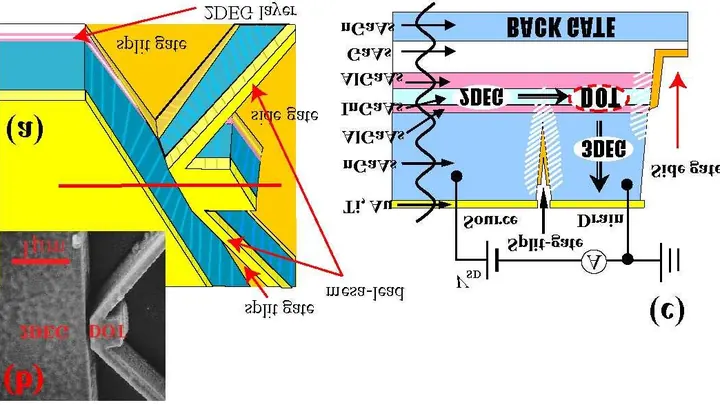
A quantum dot is like a tiny island where one or a few electrons can settle. In this new work, such an island was connected to two 'seas' of electrons: one flat like a pancake, the other bulky like an ocean. Electrons can hop from the island to the seas and back, and this hop depends on the shape of the electron's wave on the island.
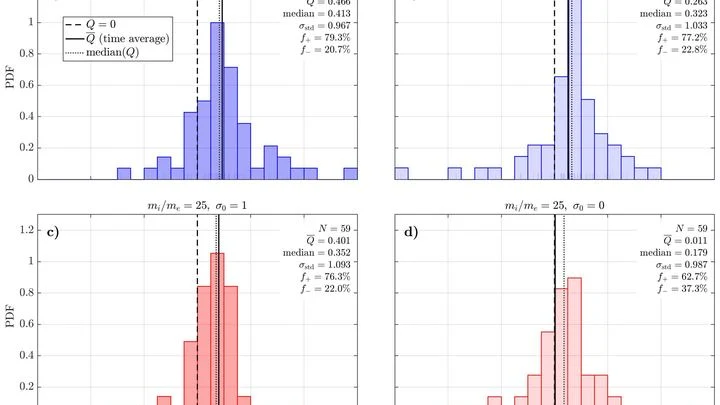
Plasma isn't just hot gas; it's a mix of charged particles that constantly move and generate magnetic fields. When plasma churns, these fields intertwine like spaghetti in a boiling pot. Scientists simulated what happens when the churning subsides and turbulence decays.
A magnetic field is invisible, but you can make it 'glow'. To do that, take a tiny diamond with defects — places where a carbon atom is replaced by nitrogen and a neighboring lattice site is vacant. These defects, like sensitive compass needles, respond to the slightest changes in the magnetic field and emit light of varying brightness.
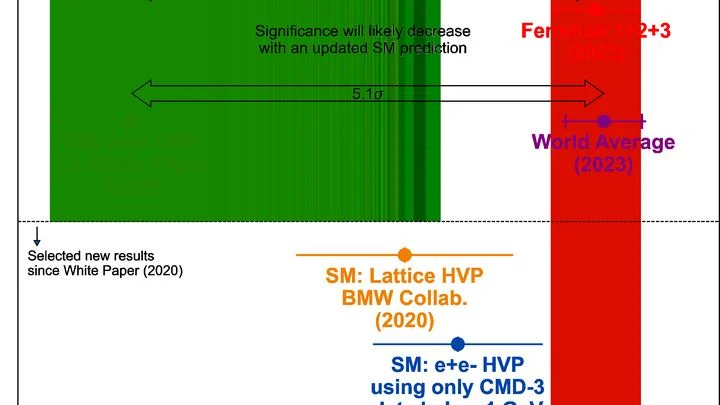
The muon is a tiny spinning top, twirling in the turbulent sea of the vacuum. Its magnetic axis points slightly away from what the Standard Model predicts. The deviation is just a couple of parts per million, but for physicists, it's a full-blown mystery.
The vacuum is not a dead calm.
The universe is expanding faster and faster, and the standard explanation is a positive cosmological constant, that is, a de Sitter vacuum. String theory, which aspires to be the theory of quantum gravity, should be able to describe such a vacuum, but after decades of effort, no reliable construction has emerged.