The von Klitzing constant, denoted R_K, is the fundamental constant equal to h/e², the ratio of Planck's constant to the square of the elementary charge. It appears as the precise value of the Hall resistance plateaus in the integer quantum Hall effect. When a two-dimensional electron gas is subjected to a strong perpendicular magnetic field at low temperatures, the Hall resistance exhibits quantized plateaus at values R_K / i, where i is an integer. This quantization is extraordinarily precise, with an accuracy of about one part in a billion, making it a cornerstone of metrology.
History
The effect was discovered by Klaus von Klitzing in 1980, for which he received the Nobel Prize in Physics in 1985. The constant was subsequently named in his honor. The discovery revolutionized electrical metrology, leading to the redefinition of the ohm in terms of R_K.
How it works
In the quantum Hall effect, electrons in a two-dimensional system form Landau levels in a magnetic field. When the Fermi level lies between Landau levels, the longitudinal resistance drops to zero, and the Hall resistance becomes quantized. The quantization arises from the topological properties of the electron wavefunctions, which lead to a robust, material-independent value of the Hall conductance, exactly i e²/h. This robustness is why the effect can serve as a primary standard for electrical resistance.
In practice
The von Klitzing constant is used as the international standard for electrical resistance, defining the ohm in the International System of Units (SI) since 2019. It is also used in precision measurements of fundamental constants and in quantum metrology.
Fun fact
The von Klitzing constant is now exactly 25812.80745... ohms by definition, and its value is used to define the ohm in the SI system, making it a fixed constant rather than a measured quantity.
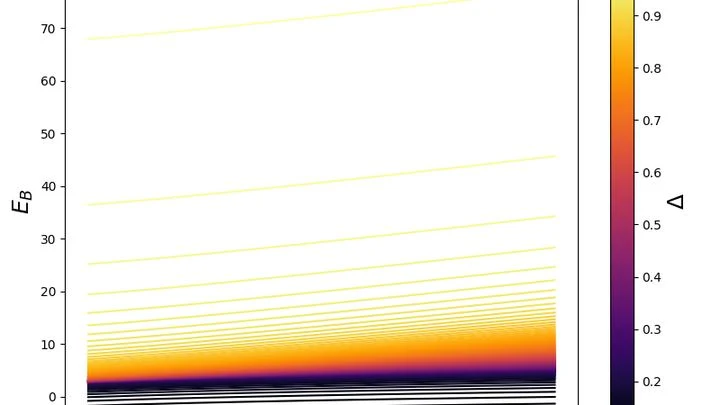
A pale green crystal was placed in a magnetic field and cooled below one kelvin — almost to absolute zero. Inside it hide chains of copper atoms that behave like tiny magnetic needles. Usually their orientation is chaotic, but the strong field and cold make the needles align in a unified impulse, like soldiers on a parade ground.
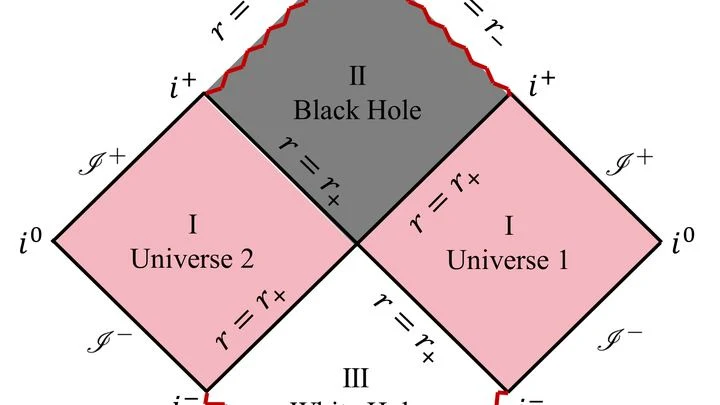
In a two-dimensional universe, a black hole looks like a funnel in spacetime. But the authors of the new work went further: they proposed that the space where particle momenta 'live' is also curved, like a saddle.
A rotating black hole is like a whirlpool in a river — spacetime swirls around it, dragging along everything nearby. In some gravity theories, this whirlpool also includes an extra field — a vector field. At each point, it has a direction and a length, like a compass needle.
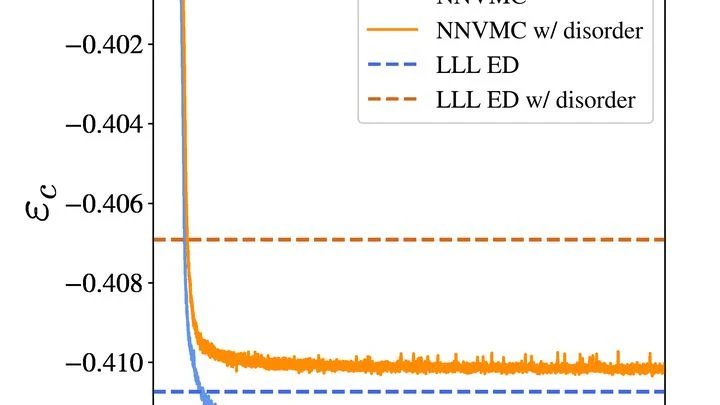
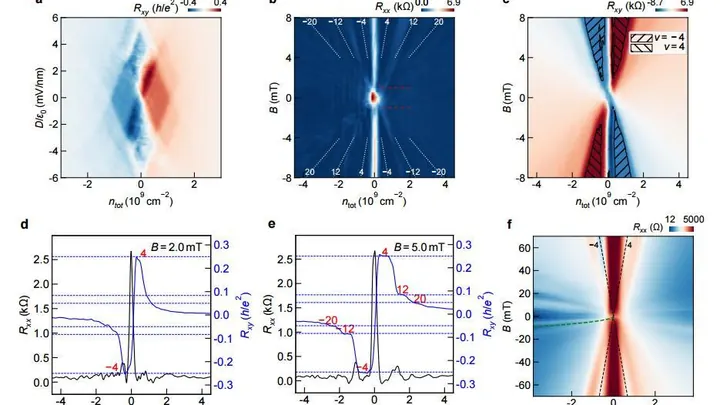
In the world of two-dimensional materials, states sometimes emerge that are as extraordinary as they are fragile. One of them — the fractional anomalous Hall crystal (FAHC)—is like a quantum centaur: half ordered lattice, half topological liquid.
At the centers of many galaxies lurk supermassive black holes. One of them, Sagittarius A* at the heart of the Milky Way, has become a testing ground for a new idea. The authors of the work took Einsteinian gravity and added an unusual electromagnetic field to it.
A wormhole is a tunnel connecting two distant regions of the universe. If such a wormhole existed and were traversable, a particle inside it would feel not only gravity but also a force from its own electric field. This force depends on how spacetime is curved around it.
A regular object moves along a predictable path, like a ball. In the quantum world, a particle is smeared into a probability cloud. To find order in this fog, scientists have recast Schrödinger's equation in the language of flowing water.
In a strong magnetic field, electrons trapped in a thin layer sometimes arrange into a regular pattern, like guests at a crowded party who find a spot where no one jostles them. This order is called a crystal, although it is not ice or salt, but the electrons themselves, frozen in place.
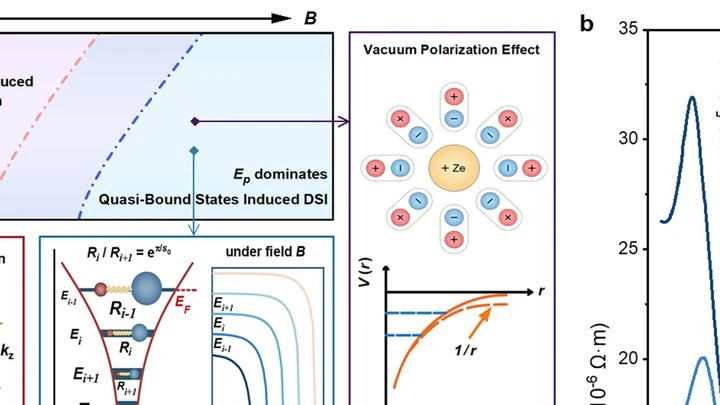
In the crystal HfTe5, electrons behave almost like light: their mass is so small that they obey the laws of relativity. If you place such a crystal in a strong magnetic field, the electrons start to circle in tiny orbits. Their energy then changes not smoothly but in steps, like floors in a building.
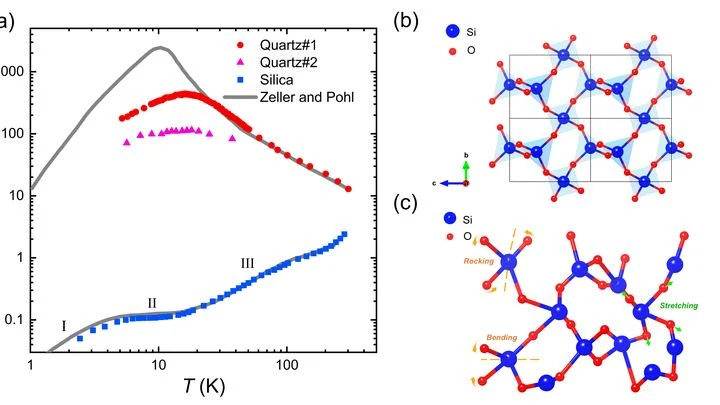
If you push heat through a piece of quartz, it usually goes straight, like water through a pipe. But switch on a magnetic field, and the flow veers slightly sideways, as if the pipe suddenly grew a side branch.
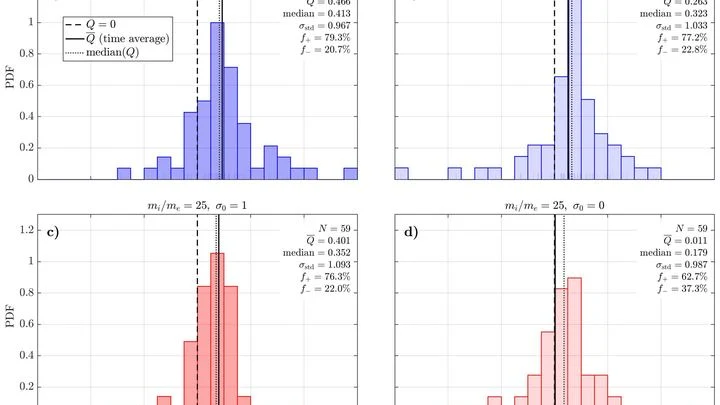
Plasma isn't just hot gas; it's a mix of charged particles that constantly move and generate magnetic fields. When plasma churns, these fields intertwine like spaghetti in a boiling pot. Scientists simulated what happens when the churning subsides and turbulence decays.
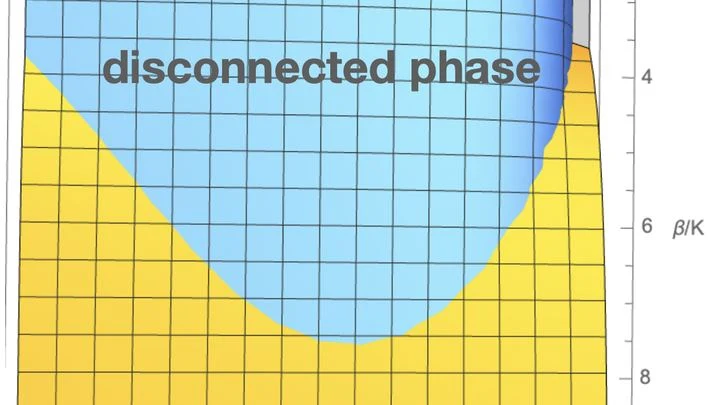
A layer of electrons trapped between two semiconductor plates lines up into a neat lattice at low temperatures, like beads on a string stretched between your fingers. As the temperature rises, order collapses: the crystal melts. But exactly how it melts has long been a puzzle.
In layers of molybdenum telluride twisted at a specific angle, electrons behave unusually: they can split into parts. This is akin to a whole pie suddenly being cut into perfectly equal slices, even though there's only one knife. In ordinary materials, the electron's charge is indivisible, but in these layers, under strong cooling, states emerge where the charge splits into three parts.
A black hole that has almost stopped consuming matter is like a kettle coming to a boil: calm on the outside, but seething with invisible processes within. Physicists have peered into this boundary world, where space and time no longer follow the familiar rules.
They have described everything that happens right at the horizon: that invisible boundary beyond which even light cannot return.
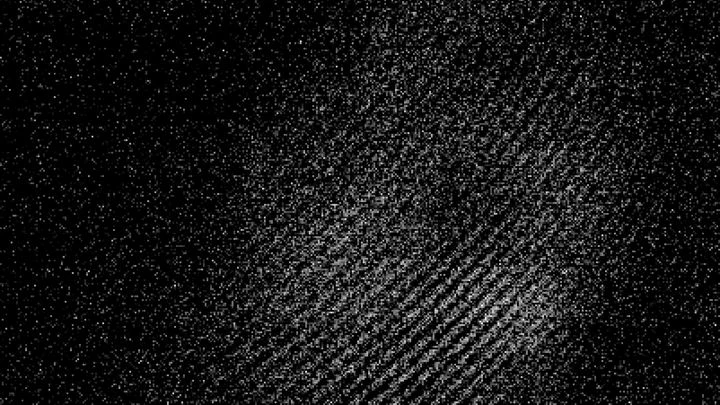
In a container the size of a coin, light behaves like water: it gathers into a single quantum fluid. When energy is added, whirlpools, quantum vortices, spin up on their own. Each vortex is like a tiny whirlpool that cannot simply disappear.
Physicists illuminated this fluid with a laser and took snapshots.
The visible edge of the universe is a holographic screen that, like a black hole, obeys laws discovered by Bekenstein and Hawking. Normally, information is preserved on it, but calculations show that if a few bits are lost, energy is released that accelerates expansion.
Graphene is a carbon sheet just one atom thick, a fantastic conductor. But its surface is crinkly, like a wrinkled tablecloth that hasn't been ironed. Scientists built a 'sandwich': two of these sheets pressed together with a non-conductive spacer in between. They iron out each other's folds, like two halves of a sandwich making the surface perfectly even.
An electron beam strikes a proton like a billiard ball hitting another ball. But between them is no empty space: the particles exchange virtual photons and Z bosons, like players passing a ball behind their backs. This exchange slightly alters the scattering trajectory, and hidden within it is a hint of new physics.