A Meson on the Quantum Stage express
Inside a proton, quarks are held together by gluons, like springs. Let go of one quark — the spring stretches and snaps, creating a new quark. That's the strong force at work, and simulating it in real time on a regular computer is nearly impossible: there are too many possibilities, all tangled together.
Enter the quantum computer. In this work, 156 qubits of an IBM processor played out the behavior of a particle on a lattice of 60 sites. The researchers used a clever encoding — instead of tracking each spring individually, they watched only the overall patterns, like an artist who paints not individual brushstrokes but whole shapes.
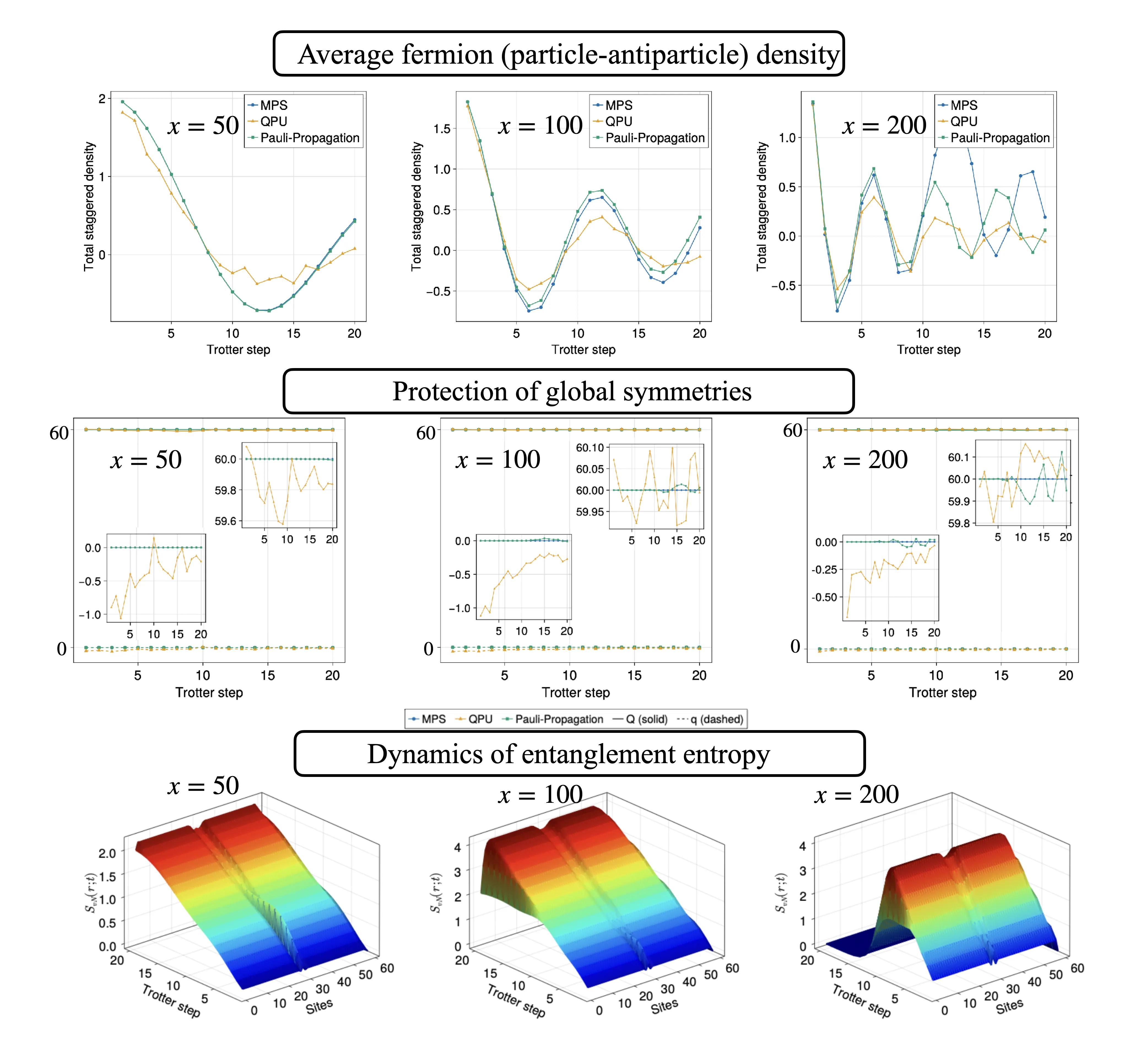
As a result, a moving meson appeared on the screen — a bound pair of a quark and an antiquark. It moved along the lattice and pulsed slightly, like a plucked string. The frequency of this pulsation was measured and compared with calculations on classical computers. They matched.
Why does this matter? The strong force governs the world of atomic nuclei. Understanding it in minute detail means better understanding what matter is made of. Classical computers struggle with such problems, but quantum computers, noisy and imperfect as they are, are already taking their first steps. And these steps lead deep into the nucleus.
Original abstract
as written by the authors arXiv:2602.18080
The real-time evolution of strongly interacting matter remains a frontier of fundamental physics, as classical simulations are hampered by exponential Hilbert space growth and rapid, unmanageable growth of quantum entanglement. This study reports the quantum simulation of hadron dynamics within a $$(1+1)$$-dimensional SU(2) lattice gauge theory using a 156-qubit IBM superconducting processor. Leveraging a hardware-efficient Loop-String-Hadron (LSH) encoding, we simulate the dynamics of the physical degrees of freedom on a $$60$$-site lattice in the weak-coupling regime, as a crucial step toward the continuum limit. The hardware data reveal confined meson propagation and early-time oscillations of the mesonic profile, from which we extract a breathing-mode frequency as a spectroscopic observable. Benchmarking against tensor-network simulations of the full LSH Hamiltonian and Pauli-propagation simulations of the noiseless circuit supports the validity of the physical approximation, the quantum algorithm and the observed dynamics within the accessible time window. These results show that physics-native encodings can enable scalable access to coherent non-Abelian real-time dynamics on noisy quantum hardware.
The processor on which the calculation ran is cooled to a temperature lower than that of deep space — about 15 millikelvins, which is a hundred times colder than the cosmic microwave background.
In the TV series "Devs," a quantum computer is used to simulate an entire universe — here, they're simulating just a single particle, but every journey begins with a single step.