Star S2 Puts the Black Hole at the Center of the Galaxy to the Test express
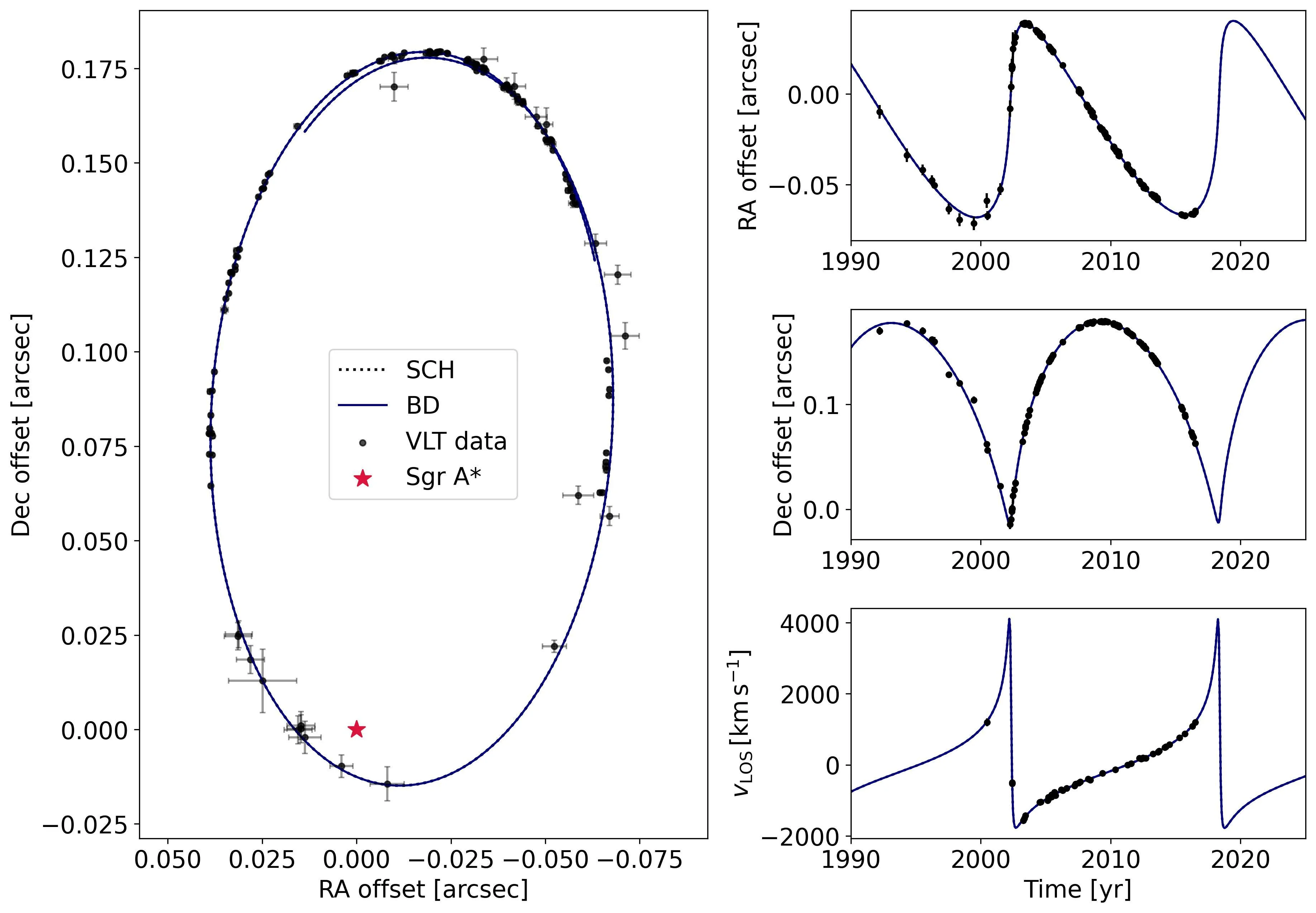
Something massive hides at the center of the Milky Way — four million times heavier than the Sun. The star S2, like a racer on a steep curve, loops around this object every sixteen years in an elongated orbit, accelerating to 7650 kilometers per second. By tracking exactly how it moves, astronomers are trying to figure out what that 'something' is.
Usually, it's thought to be a black hole — a region where gravity is so strong that even light can't escape. But physicists have come up with other possibilities: a black hole with an electric charge, 'regular' black holes without a point of infinite density at their core, and even a 'naked singularity'—an exotic object with no horizon behind which a singularity could hide. The authors of the new study took the trajectory of the star S2 and calculated what it would look like in each of these scenarios.
Comparing with observations from the Very Large Telescope showed that an ordinary black hole, a charged black hole, and one of the regular models give almost identical predictions. No differences between them are visible yet. However, for the 'naked singularity' and other exotic options, constraints on their parameters were established. The more precise the measurements of the star's position, the tighter these limits will become.
The star S2 is like a probe launched by nature itself into the very heart of the Galaxy. Right now, its trajectory says: 'I can't yet tell one black hole from another.' But new observations with the VLT and the Keck telescopes promise greater precision, and then, perhaps, it will become clear what kind of 'beast' is lurking at the center of the Milky Way.
Original abstract
as written by the authors arXiv:2602.18994
In this work, we perform a relativistic test of the spacetime geometry of Sagittarius A* (Sgr A*) using the orbit of the S2 star. We consider a broad class of compact object models, including Schwarzschild, Reissner-Nordstr\"om, Bardeen, Hayward, and Simpson-Visser black holes, as well as the Janis-Newman-Winicour naked singularity spacetime. For each geometry, we integrate the timelike geodesic equations and consistently project the resulting trajectories onto astrometric and spectroscopic observables, incorporating R{\o}mer time delay and relativistic redshift effects. The theoretical predictions are tested with current Very Large Telescope (VLT) observations of the S2 star, while simultaneously imposing constraints from the Event Horizon Telescope shadow size. We find that several spacetimes that are degenerate at the level of shadow imaging, most notably Schwarzschild, Reissner-Nordstr\"om, and Bardeen regular black hole geometries, remain statistically indistinguishable when tested against present S2 data. We further carry out a statistical model comparison based on the Akaike and Bayesian information criteria (AIC and BIC) to evaluate the relative performance of the alternative spacetime models. Our analysis also constrains the generalized charge like parameter $$q/M$$ in non-Schwarzschild spacetimes based on current S2 star observations, and identifies specific black hole and horizonless geometries that can be further tested with forthcoming high precision astrometric observations from the VLT and Keck telescopes.
When the star S2 approaches the central object, it moves at about 2.5% of the speed of light — making it one of the fastest objects we can track in orbit.