Gravitational theory is the framework that describes gravity as a fundamental force. The modern theory, general relativity, was developed by Albert Einstein in 1915 and describes gravity not as a force but as the curvature of spacetime caused by mass and energy. This theory has been tested extensively, from the bending of light by the Sun to the recent detection of gravitational waves. It also predicts exotic objects like black holes, whose properties are now being studied with increasing precision.
History
Albert Einstein formulated general relativity in 1915, building on his earlier special relativity and the equivalence principle. The theory was quickly confirmed by Arthur Eddington's 1919 solar eclipse expedition.
Gravitational theory is essential for the Global Positioning System (GPS), where relativistic corrections are needed for accurate positioning, and for predicting the orbits of spacecraft and satellites.
Fun fact
The GPS satellites in orbit experience time faster than clocks on Earth by about 38 microseconds per day, and without relativistic corrections, GPS positions would drift by about 10 kilometers per day.
Imagine an interferometer as a giant ear listening to the radio whisper of a distant galaxy. Three antennas spread across continents capture the signal, and the difference in their phases combines into a quantity that is immune to atmospheric jitter. This quantity is called the closure phase.
A superconductor pushes out a magnetic field like a sponge squeezing out water. This Meissner effect has been known for nearly a century, but it's usually calculated in a flat world — without gravity. In the strong field of a black hole or at enormous speeds, the picture changes.
Drop two stones of different shapes into a pond — the ripples will tell you which one was smooth and which was jagged. Gravitational waves work the same way: when two ultra-dense objects merge, the trembling of spacetime carries details about their inner workings.
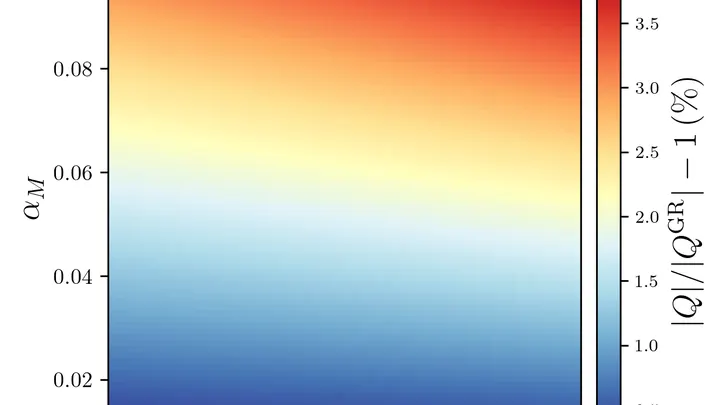
Space is expanding, and that expansion is accelerating. But what if, in the first instants after the Big Bang, gravity behaved differently? The authors of a new study added an invisible field to Einstein's equations that siphons energy from ordinary matter and radiation.
Quantum field theory is the language physicists use to describe elementary particles and their interactions. The authors of the work decided to slightly "tweak" this language: they introduced deformations, that is, small changes to the rules of the game.
Newton gave us a world where bodies move in a void and clocks tick the same for everyone. For three centuries, this picture worked flawlessly. But it relies on many invisible props: absolute position, the 'up-down' direction, and a single rhythm of time for the entire universe. We have never measured these directly — only through the relations between objects.
In the far reaches of space, there exists a hypothetical object: an ultracold black hole. It is charged and resides in an expanding universe (de Sitter space). Its temperature hovers just above absolute zero — about one trillionth of a degree above it.
A black hole spun up almost to its limit is like an athlete balancing on the edge of a record. The most interesting action isn't inside the hole itself, but in the thinnest film of spacetime at its horizon. It's there that tiny corrections to Einstein's gravity can suddenly swell to gigantic proportions.
Light freezes at the edge of the abyss: that's what the event horizon of an ordinary black hole looks like. But at the center of this abyss lurks a singularity, a point where the laws of physics break down. What if, instead of a point, there were a hard shell?
A gravastar is not a black hole.
A pendulum in a noisy room is constantly jostled by people passing by. Its motion is a mix of regular swings and random jerks. Something similar happens with weak gravitational waves against the backdrop of an expanding universe. In Einstein's general relativity, these waves are tiny ripples in spacetime.
A star circles a rotating black hole like a figure skater at the center of a rink. While it is far away and can be treated as a point, the dance remains predictable: the orbit follows clear laws, like music that is easy to glide to. But as it approaches, gravity begins to act unevenly.
In the quiet of the quantum world, there is no emptiness. Particles are intertwined by invisible threads — entanglement. The authors of the work proposed that the very fabric of spacetime is woven from these threads. This is not just a metaphor: they built a mathematical framework where the distance between points is determined by how much shared information they hold.
At the very heart of the Milky Way, stars whirl around an invisible supermassive black hole. One of them, S301, completes an orbit in just 8.7 years. Its path is a highly squashed ellipse: sometimes it grazes the black hole, sometimes it shoots far away. At closest approach, the distance to the black hole is tiny by cosmic standards.
The first three minutes after the birth of the world are a cosmic kitchen where nature cooked the lightest atomic nuclei. The recipe is set by gravity: it controls the cooling rate of the hot 'broth' of particles. If gravity worked differently than we are used to, the dish would have turned out different — with different amounts of helium and deuterium.
At the center of the Milky Way, shrouded in dust and glare, lurks a supermassive black hole — Sagittarius A*. Around it, like moths around a flame, swarm dozens of guide stars. Two of them, S2 and S38, with eccentric orbits and periods of just a few years, have become the protagonists in testing the fundamental laws of the cosmos.
A black hole usually hides its singularity behind an event horizon — an invisible boundary from which not even light can escape. But sometimes this 'cloak' is absent, and the singularity, a point where familiar physics breaks down, is exposed to an outside observer.
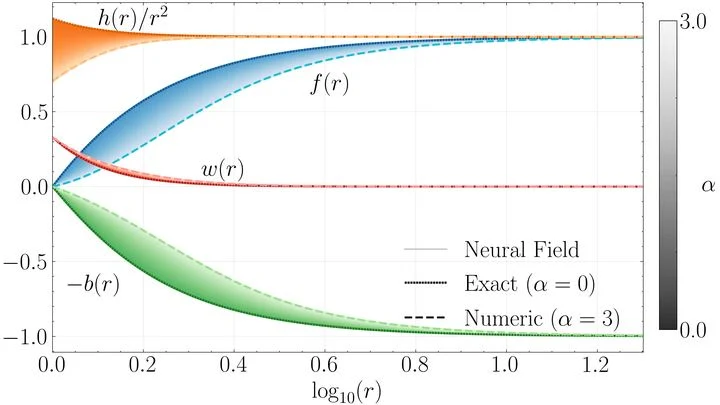
A black hole is not just a dark spot. It rotates, drags space along with it, and can carry imprints of the quantum world. To describe such a hole, one must solve gravitational field equations.
In cricket, there's a special delivery — the googly. The ball spins in a way that deceives the batsman. Physics had its own googly: for nearly half a century, mathematicians couldn't make twistor theory work with real gravity. It described 'nice' fields perfectly, where everything twists in one direction. But as soon as an 'awkward' component appeared, the machinery broke down.
An endless ocean where every wave carries information about what happens in the depths. That is roughly how our Universe works under the holographic principle: the physics inside a volume can be described by processes on its boundary.
An object cannot be a point. At least, not in Einstein's gravity. The equations of general relativity require that the source of the field, matter, be smeared out in space, not concentrated in an infinitesimal volume. Otherwise, infinities appear in the formulas, and a smooth spacetime cannot be constructed.
At the centers of many galaxies lurk black holes — regions with gravity so strong that even light cannot escape. Stars often orbit them, and sometimes one of those stars is a pulsar, a cosmic lighthouse sending out strictly periodic radio pulses. When such a pulsar moves behind a black hole, its signals reach us with a delay.
The boundary sets the rules
Quantum gravity is like a theater where spacetime is the stage and fields are the actors. When the stage has an edge, you need to know exactly what happens at the boundary; otherwise, the play falls apart. In 2018, Edward Witten proposed an elegant recipe for such a case.
The early universe was a restless place. Space trembled with gravitational waves — ripples in the very fabric of reality. In this churning cauldron, dark matter is thought to have been born. But the newborn particles had no mass: it had to come from somewhere.
Usually, the Higgs field is responsible for mass.
The Universe has a rate at which it expands — called the Hubble constant. The problem is that the two most precise ways to measure it give different numbers. One method, using the early light of the Universe (the cosmic microwave background), gives one value.
In the early 20th century, Einstein showed that gravity is the curvature of space and time. A bit earlier, Maxwell had unified electricity and magnetism into a single theory.
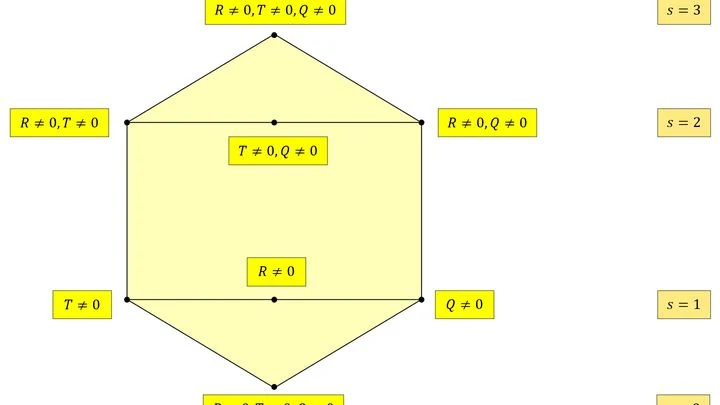
Gravity is usually explained through the curvature of spacetime. Massive bodies press it down like a bowling ball on a stretched rubber sheet. But this approach has two lesser-known twins. In one, gravity arises from torsion (twisting) of spacetime; in the other, from its non-metricity (when lengths and angles change during transport).
At the very beginning of the universe, when all of space was compressed into a point, the laws of physics break down. This point is called a singularity — an edge where our equations lose meaning. But what if it's not an end, but a special type of boundary?
The authors of this work propose viewing the singularity as a free boundary.
A black hole is not just a dark spot in space. It is a region where gravity compresses matter so intensely that even light cannot escape. Among all possible black holes, one stands out — the rotating Kerr black hole. Its description was long thought to be tied to Einstein's equations, like a recipe tied to a specific cookbook.
Gravity seems simple: it keeps us on the ground and makes planets orbit. But if it were classical (described by Einstein's equations as the curvature of spacetime, while all matter follows the quantum laws of the Standard Model) then an ordinary quantum bit (qubit) falling freely…
Time in physics is like a conductor setting the tempo for the whole orchestra. But in the quantum world, there's no single baton: each particle can live by its own clock. Usually, we simplify the picture and assume time flows the same for everyone.
Quantum noise, like the hiss of an untuned radio, filled the infant Universe. Alan Guth showed that superfast expansion (inflation) caused this ripple to freeze, giving rise to clumps of matter — the seeds of galaxies.
A new method extends this picture to any theory of gravity.
Two pebbles drop into water, and the ripples on the surface intersect, blending their patterns. Neutrinos behave much the same way: light particles that pierce us by the billions every second. They can transform from one type to another, like an actor changing masks. Physicists call this dance oscillations.
A light ray skims along the horizon of a black hole: that invisible boundary from which nothing can escape. The closer the ray gets to the horizon, the slower its own 'time' stretches — a special measure of path called the affine parameter.
A taut sheet wrinkles. If you tug a corner, a smooth wave runs across; if you sharply bunch the fabric, a sharp crease forms. Space and time in Einstein's equations behave much the same way. Gravitational waves resemble the gentle ripples of the sheet, while shock fronts are like stiff folds where matter's properties change abruptly.
Gravity is the curvature of spacetime, not just an attraction, as Einstein showed. On such a curved "dance floor", even the hypothetical carriers of gravity — gravitons — move oddly.
The deepest equations of physics, like the Wheeler–DeWitt equation, contain no time. Past and future are scrambled within them, like frames on a film reel with no arrow indicating which way to play it. This symmetry is not a flaw but a feature.
Back in the 1930s, Fritz Zwicky noticed that the speeds of galaxies in clusters were too high for the visible mass. Later, Vera Rubin confirmed this for individual galaxies.
Stephen Hawking imagined that the universe was born not from an explosion, but by smoothly emerging from a quantum 'nothing.' In worlds with concave geometry (anti-de Sitter space), such a birth acquires a rim, like the hoop of a drum.
A galaxy is like a cosmic highway where stars, like cars, race along circular orbits. Their speed is set by the invisible "cargo" of mass enclosed within the orbit: the more massive the central region, the faster the stars at the periphery.
A massive nanodiamond inside a quantum interferometer splits in two, pulling itself into two realities. Its gravity — tiny, almost imperceptible — stirs the quantum field of the vacuum, giving rise to coherent clouds of gravitons. These are the gravitational shadows cast by each position of the mass.