Why Red Dwarfs Have Fewer Chances for Photosynthesis express
Original: "Photosynthetic exergy I. Thermodynamic limits for habitable-zone planets"
Scientists have shown that stars similar to the Sun are best suited for photosynthesis on exoplanets.
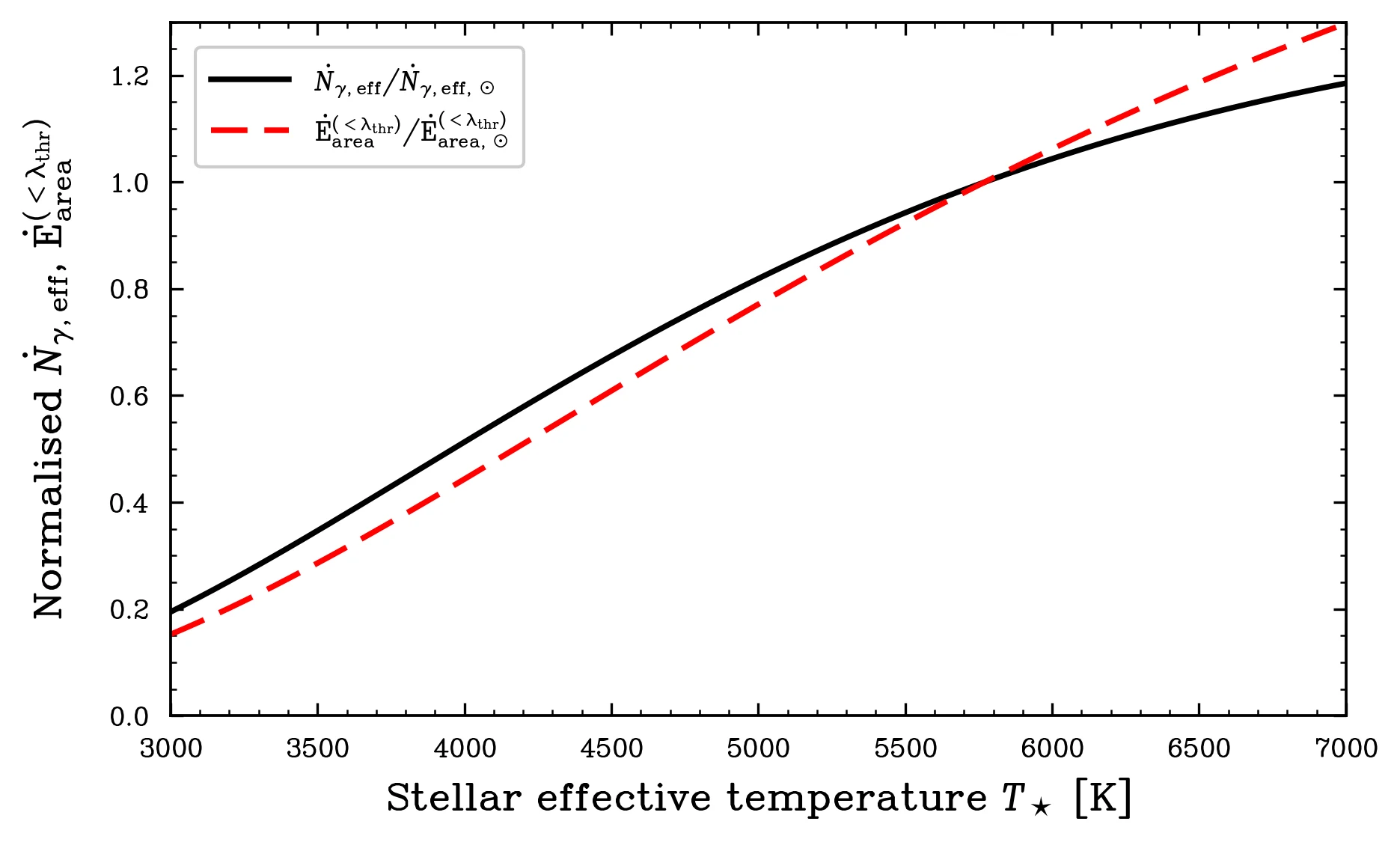
Oxygenic photosynthesis requires splitting water. It's kind of like a water wheel: to make it spin, you need a strong current. Light acts as the current, and light particles are the streams. For red dwarfs, the most common stars, the light is "cool" and weak — the streams barely move the wheel.
Scientists, applying the concept of entropy (a measure of disorder), calculated the maximum work such a wheel could do. The result: around exoplanets near Sun-like stars, the flow of suitable streams is five times stronger.
But even on Earth, with its bright Sun, the wheel uses only a drop of the available energy. The theoretical maximum oxygen output is thousands of times higher than what's actually produced. So complex life might be hiding unnoticed — and we should search for it around stars similar to ours.
The upper theoretical limit for oxygen production on Earth is thousands of times higher than what plants actually produce.
Scientists
Christian DopplerD. B. McLaughlinDidier QuelozMichel MayorR. A. RossiterDavid Charbonneauenergy extraction
photosynthesis
coronal heating mechanism
photon energy
photosphere
core
red dwarf habitability
habitability
Shelford's law of tolerance
terrestrial exoplanet
habitable zone
ozone layer
hot jupiter atmospheres
red giant
europa
water splitting
mercury
multi planet systems
eddington limit
X-ray radiation