Mirror World Not Found: Neutrons Don't Vanish express
The neutron, a particle inside the atomic nucleus, can live in two worlds: ours and a mirror one. The mirror world has its own neutron twin, invisible to our instruments. If an ordinary neutron sometimes hops to the mirror world and back, some neutrons in a trap would seem to dissolve into thin air.
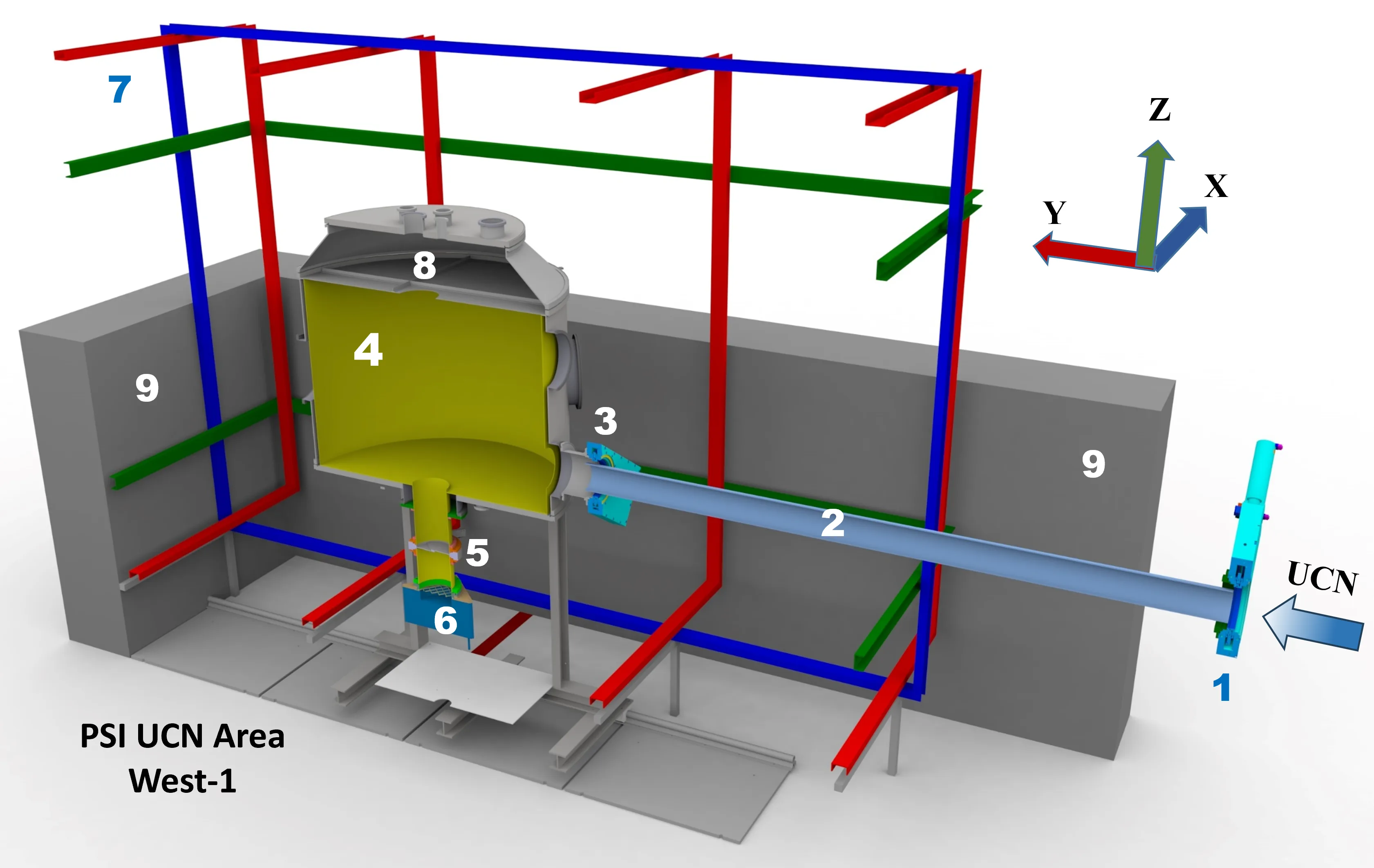
A team of physicists at the Paul Scherrer Institute built a neutron trap — a vessel where particles bounce off the walls and live longer than usual. If a neutron turned into its twin, it would pass through the wall and be lost. Then the counter would register fewer neutrons than expected. The scientists varied the magnetic field from 5 to 109 microtesla, thousands of times weaker than a fridge magnet, and watched for losses. They found no anomalous disappearances.
Earlier experiments hinted at strange neutron losses at certain fields. The new data close those hints with a probability of 99.98%. So if mirror neutrons exist, they hide even deeper than thought. The trap became the most sensitive in the world, yet it caught only silence.
Original abstract
as written by the authors arXiv:2602.23487
In a search for potential signals of neutron (n) to mirror-neutron (n') oscillations, a collaboration centered at the Paul Scherrer Institute (PSI) investigated the remaining parameter space claimed by anomalies with a dedicated high-sensitivity apparatus. An elaborate magnetic-field-mapping analysis and Monte Carlo simulation of the cumulative n-n' oscillation probabilities along the neutron trajectories inside the storage vessel complemented the neutron data analysis. Magnetic fields were scanned in the range 5 microT < B < 109 microT. No evidence of anomalous neutron losses was found. Consequently, new limits for the n-n' oscillation time constant were set. The parameter space, previously claimed for potential signals, has been excluded to 99.98 %.
A free neutron lives for about 15 minutes, but in a trap with mirror walls, you can hold it for hours, like a ball in a room with springy walls.
The mirror matter hypothesis is explored in the TV series 'Fringe': a parallel world made of the same particles exists nearby but is invisible.