Neutrino mass measurement is a central challenge in particle physics and cosmology. Neutrinos were long thought to be massless, but experiments showed they oscillate between flavors, implying they have tiny masses. Determining the absolute scale of these masses — not just the differences — requires combining laboratory experiments with cosmological observations. The corpus titles reflect this dual approach: 'Взвесить призрак' (weighing a ghost) and 'Распад нейтрино' (neutrino decay) point to both direct kinematic measurements and indirect cosmological constraints.
History
The possibility of neutrino mass was proposed in the 1950s, but the first evidence for oscillations came in 1998 from the Super-Kamiokande experiment. The absolute mass scale remains unknown, with current upper limits around 0.8 eV from KATRIN.
How it works
Laboratory experiments like KATRIN measure the energy spectrum of electrons from tritiumbeta decay, looking for a tiny distortion near the endpoint that reveals the neutrino mass. Cosmological methods instead use the imprint of neutrinos on the cosmic microwave background and large-scale structure: because massive neutrinos move slowly, they suppress the growth of structure on small scales. Combining both approaches tightens the constraints, though tensions between datasets sometimes arise, as noted in 'Почему космология дала трещину?'.
In practice
Precise neutrino masses are crucial for interpreting cosmological data, designing next-generation detectors, and understanding the early universe's evolution.
Fun fact
The sum of neutrino masses is so small that all the neutrinos in the universe weigh less than a single electron, yet they still influence the formation of galaxies.
An aluminum sphere the size of a large globe sits in a neutron beam and answers each hit with a precise note. Inside the sphere there is nothing but nitrogen and eleven tiny steel balls, each the size of a pinhead. When a neutron enters the sphere, it knocks a particle out of a nitrogen atom, and that jolt turns into an electrical signal.
A neutron confined in a nucleus behaves differently from a free one. Its gluon cloud, which holds quarks together, compresses like a spring under load. Previously, this could only be assumed, but now physicists have directly observed the effect for the first time.
At Jefferson Lab, an electron beam struck liquid deuterium, knocking photons out of the nuclei.
At the center of a neutron star, matter is compressed so tightly that a teaspoon weighs a billion tons. You'd think there's no better place to look for signs of quantum gravity. But between the laboratory and the fundamental scale lies a chasm of 10⁸⁰ in density.
Three doors lead into this room.
In 1998, physicists caught neutrinos doing something astonishing: the particle changes its type on the fly. That is only possible if it has mass. This became the only laboratory proof of physics beyond the Standard Model. But exactly how much a neutrino weighs remains a mystery.
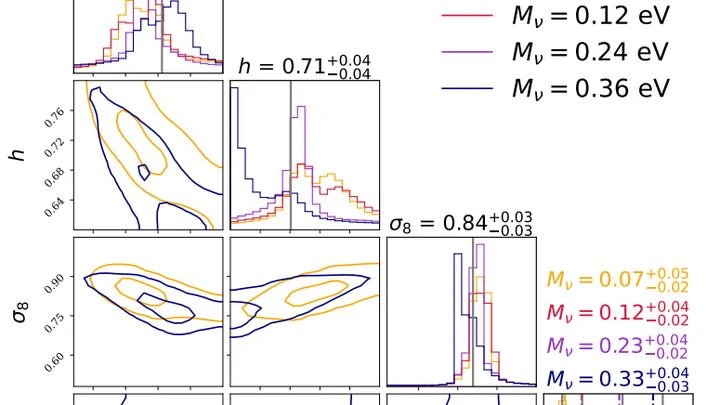
Cosmology is like an orchestra where different sections suddenly start playing out of sync. Measurements of the universe's expansion rate (the Hubble constant) from the early and late universe give different numbers.
The mystery of the missing antimatter has haunted physics since the mid-20th century. The Big Bang should have created equal amounts of matter and antimatter, yet today's world is almost entirely matter. The Standard Model is powerless to explain this baryon asymmetry — we need new particles and mechanisms beyond it.
Neutrinos are the most abundant massive particles in the universe. Trillions of them pass through us every second, yet they leave barely a trace. Their collective gravity, though tiny, can influence the motion of entire galaxies. Think of two people approaching each other on a busy street; invisible passersby alter their speed.
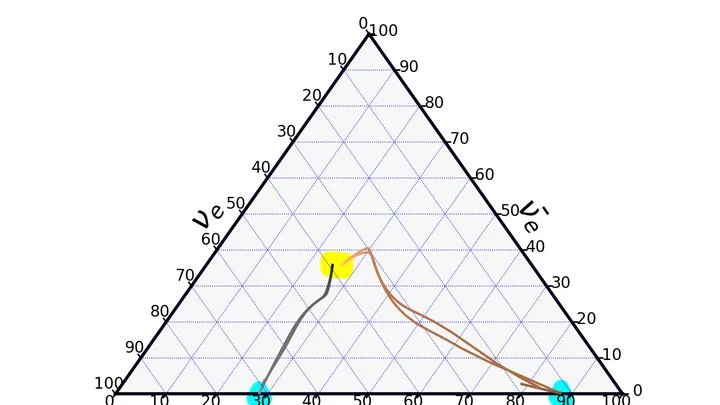
A pot of soup simmering with three ingredients. The chef adjusts the proportions on the fly, and the progress is tracked by the position of a point on a triangular scale. That's roughly how physicists tackle neutrinos from a supernova explosion.
The Universe is a colossal web of invisible dark matter and galaxies, stretched by the expansion of space. Neutrinos, nearly intangible ghost particles, barely cling to the threads, but their collective mass subtly shifts the tension of the entire network.
Neutrinos are tiny particles that zip through Earth, barely noticing it. In the MicroBooNE experiment, they are caught in a tank of liquid argon. When a neutrino strikes an argon nucleus, it produces an electron and protons, like splashes from a stone thrown into water.
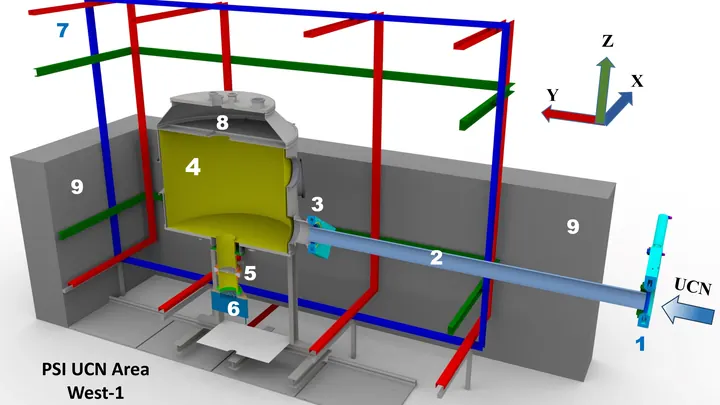
The neutron, a particle inside the atomic nucleus, can live in two worlds: ours and a mirror one. The mirror world has its own neutron twin, invisible to our instruments. If an ordinary neutron sometimes hops to the mirror world and back, some neutrons in a trap would seem to dissolve into thin air.
In one hospital ward it's +40°C, in another +10°C, and on average it's +25°C. If temperature affected something nonlinearly (say, the rate of bacterial growth) the average would give a wrong prediction. The same problem arises when cosmologists describe a universe where galaxies are packed into clusters and voids yawn between them.
The antiproton is a mirror twin of the proton: same mass, but negative charge. When it approaches an atomic nucleus, the particles can annihilate, turning into radiation.
Inside a neutron star, matter is squeezed so tightly that a teaspoon of its material would weigh as much as a mountain. We can't directly see what happens to particles under such conditions, but stars tell us about themselves through gravitational waves and light when two such stars merge.
Inside a neutron star, matter is compressed to unimaginable densities. Previously, scientists speculated about its exact makeup, cycling through possible equations linking pressure and density. The new method tosses out guesswork: it directly ties the measurable mass and radius to the internal structure.
In the thirties, Pauli realized: without tiny ghost-like particles, the energy of stars doesn't add up. Thus neutrinos were born — intangible wanderers that permeate everything.
Inside a giant spectrometer in Karlsruhe, shaped like a huge metal barrel, scientists are catching particles that are nearly impossible to catch. Neutrinos are the ghosts of the microcosm: every second, trillions of these particles fly through your body, and you don't even notice. But they do have mass, and scientists want to measure it.