Neutron star oscillations are vibrations that occur in the densest observable objects in the universe. These oscillations are caused by disturbances in the star's structure, such as starquakes or the accretion of matter from a companion star. They produce gravitational waves that can be detected by observatories like LIGO and Virgo, providing a unique window into the interior of neutron stars.
When a neutron star is perturbed, it can oscillate in various modes, similar to how a bell rings after being struck. These oscillations depend on the star's equation of state, which describes how matter behaves at nuclear densities. The frequencies and damping times of these oscillations are encoded in the gravitational waves emitted, allowing scientists to infer the star's internal composition and structure.
The oscillations of a neutron star can be so rapid that they cause the star's surface to vibrate at frequencies up to several thousand hertz, making them some of the fastest vibrations known in nature.
Picture a guitar string stretched between two frets. When you pluck it, a standing wave forms: some points on the string oscillate strongly, while others, the nodes, remain almost still. The chromosphere, a layer of the solar atmosphere sandwiched between the photosphere and the corona, behaves in much the same way.
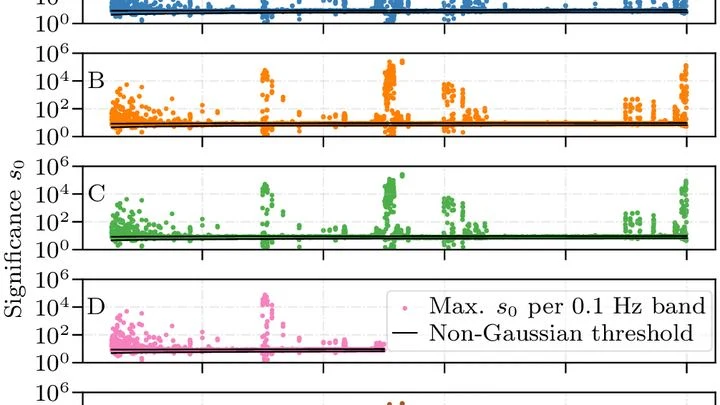
A lighthouse doesn't flash steadily but in short, bright pulses. The neutron star in the system 4U 1323-62 is such a lighthouse in the X-ray range. It pulls gas from a companion star, and when enough material accumulates on its surface, a thermonuclear explosion occurs — an X-ray burst.
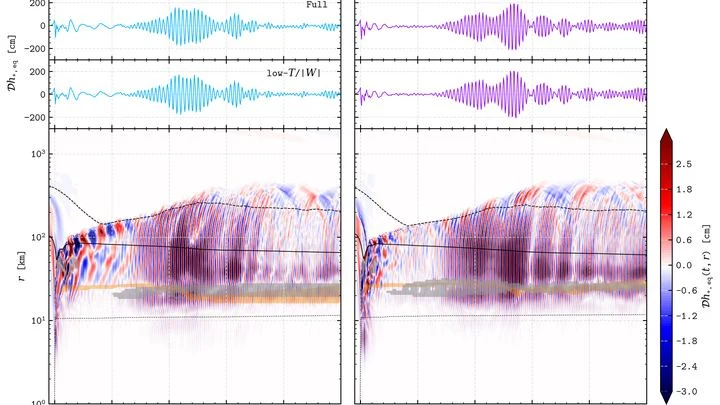
After a supernova explosion, a dense ball the size of a city remains at the center — a newborn neutron star. It is hot, compressed, and rings like a bell after being struck. These tremors, the star's oscillations, emit gravitational ripples that sensitive detectors on Earth can catch.
The calm surface of a lake suddenly ripples — somewhere in the depths, an underwater cliff has collapsed. The water trembles almost imperceptibly, and the circles spread wider and wider until they reach a bobber near the shore.
In a binary star system, one star pulls matter from its companion. Over centuries, this material settles onto the surface of a neutron star — the ultra-dense remnant of a dead star. This process, called accretion, usually proceeds smoothly. Gravity behaves as general relativity predicts, without surprises.
When a star many times heavier than the Sun dies, it collapses and explodes as a supernova. This is not just a flash of light — the entire process, from core collapse to the ejection of the outer layers, makes space itself tremble. These ripples are called gravitational waves.
The very first moment of the universe's existence is like a taut string suddenly struck. It vibrated, and those oscillations froze into galaxies and voids. But physicists suspect there were other vibrations — fast, local, almost like a drumroll against a slow melody.
In the first fractions of a second after the Big Bang, the universe was a stage of rapid change. A stretched rubber sheet that cools quickly becomes covered with microscopic cracks. A similar process on a cosmic scale could have given rise to cosmic strings — ultra-thin but super-dense threads of energy stretching across the entire universe.
These strings are not just defects in space.
The first moments after the big bang: space expands rapidly — physicists call this period inflation. Inside this swelling fabric, like soap bubbles in a stream of air, regions of new vacuum begin to form — a first-order phase transition. Most bubbles pop or merge as soon as they appear.
89 milliseconds. That's how long a vortex avalanche lasts that abruptly speeds up the rotation of the Vela pulsar — one of the most famous 'glitching' pulsars. Pulsars are rapidly spinning neutron stars born in the collapse of supernovae.
In May 2020, the LIGO and Virgo detectors picked up a gravitational-wave burst known as GW200105. Among the many similar gravitational waves recorded, this one stood out for an oddity: the orbit of the colliding neutron star and black hole was not a perfect circle, but a stretched ellipse.
For over a century, astronomers puzzled over the capricious behavior of RR Lyrae stars: their brightness periodically waxed and waned with unpredictable amplitude, like a lighthouse with a faulty mechanism. The Blazhko effect, discovered in 1907, taunted scientists for decades.
The early universe resembled an overcrowded hall where heavy particles collided and decayed at a deafening pace. Among them could have been scalar leptoquarks — particles that simultaneously latch onto a quark (a building block of matter) and a lepton (such as an electron).
The Sun is not just a source of light but a giant laboratory where ghostly particles are born. Every second, billions of neutrinos fly through your body, barely noticing you. But inside the Sun, these particles behave differently: they change their type on the fly, like an actor playing three roles in a single play.
When two neutron stars, compressed to the size of a city, approach in their final dance, the spacetime around them comes alive, emitting gravitational waves.
Two pebbles drop into water, and the ripples on the surface intersect, blending their patterns. Neutrinos behave much the same way: light particles that pierce us by the billions every second. They can transform from one type to another, like an actor changing masks. Physicists call this dance oscillations.
A figure skater pulls their arms in, and their spin suddenly accelerates. When a massive star exhausts its fuel and its core collapses, something similar happens, but on a cosmic scale. The core shrinks to a city-sized sphere, and if it is spinning rapidly, a peculiar instability can arise.
Spacetime is not a passive void but a dynamic membrane capable of elastic deformation. When neutron stars (ultra-dense objects the size of a city, where matter is compressed to nuclear density or black holes) regions with gravity so strong that even light cannot escape their bounds collide, the membrane shudders, generating…
A spinning top whirls at great speed and, instead of a steady hum, emits a quiet buzz — because it is slightly dented. Neutron stars work much the same way: city-sized spheres compressed to such density that a teaspoon of their material weighs as much as a mountain.
In a vast hall, a hundred tuning forks are set out. Each one is a pulsar — an ultra-dense stellar remnant spinning at a furious rate, sending out radio pulses more precisely than any clock. When a low-frequency sound wave sweeps through the hall, all the tuning forks start to go slightly out of tune at the same moment.
A neutron star is the collapsed core of a massive star, squeezed to the size of a city. In its heart, matter is packed so densely that atoms cease to exist, and protons and neutrons dissolve into a sea of quarks.
In the kitchen, there's a bucket of water and an identical bucket of sand. Pour the sand into the water, and you get a mixture where there's exactly five times more sand than water. That's roughly how our universe is arranged: one part ordinary matter — the stuff stars, planets, and we ourselves are made of — and five parts elusive dark matter.
When a massive star dies and collapses into a supernova, a neutron star is born — a city-sized sphere with the Sun's mass. Its matter is so compressed that a teaspoon weighs more than Mount Everest. Physicists are trying to learn the "recipe" of this matter — the equation of state that explains how matter behaves under extreme pressure.
After a supernova explosion, a neutron star neutron star remains: a city-sized ball of unimaginably dense matter, spinning hundreds of times per second. Any tiny bump on its surface would make it wobble like an off-balance spinning top, humming faintly through the fabric of space.
When a massive star dies, its core collapses into a neutron star, and the outer layers are blown off in an explosion. At that moment, an unimaginably dense cloud of neutrinos is born — particles that barely interact with matter but actively 'talk' to each other. There are so many of them that together they behave like a fluid, with waves rippling across it.
A star like the Sun doesn't just shine: it hums quietly. Inside, plasma churns, and these motions make the surface rise and fall rhythmically. Catching such a tremor from Earth is nearly impossible: it gets lost in the noise of the atmosphere and the instrument itself. That's why astronomers listen to stars from space, where it's quieter.
The atomic nucleus isn't a frozen ball but a seething collective of protons and neutrons. They whirl, collide, and arrange themselves into patterns that physicists see as "bands"—ladders of energy levels. In niobium and technetium nuclei, four such ladders have been found, but the last one stubbornly refused to fit the calculations.
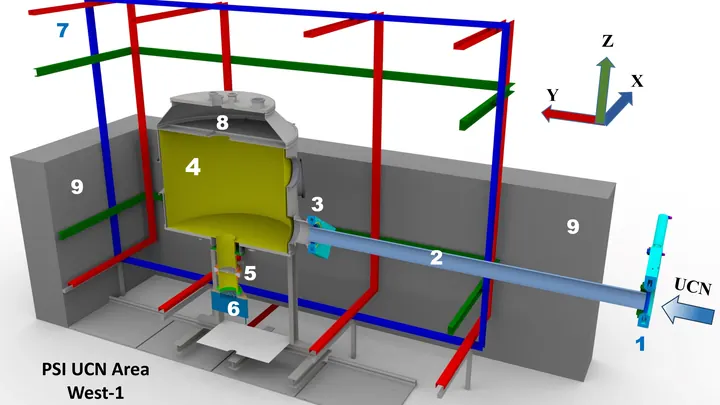
The neutron, a particle inside the atomic nucleus, can live in two worlds: ours and a mirror one. The mirror world has its own neutron twin, invisible to our instruments. If an ordinary neutron sometimes hops to the mirror world and back, some neutrons in a trap would seem to dissolve into thin air.
Long before that, Fritz Zwicky predicted that a supernova explosion gives birth to a tiny neutron star. Years later, Jocelyn Bell Burnell caught its pulses, discovering pulsars.
A kitchen timer ticks once a second. The neutron star SRGA J144459.2-604207 ticks 448 times a second: that's its own rotation, and it shows up in X-ray bursts. In 2024, the star woke up and started throwing thermonuclear explosions on its surface, like a bubbling pot of boiling water.
A star like the Sun hums like a bell: sound waves inside make its surface tremble ever so slightly. From this trembling, astronomers, like doctors reading a pulse, infer the star's temperature, density, and age. But the Kepler telescope spotted an oddity: many stars that spin fast and are covered in spots show no trembling at all. It's as if they've lost their voice.
In 1994, astronomers watched as the star V4332 in the constellation Sagittarius suddenly flared up, becoming thousands of times brighter. It hasn't settled down since: its brightness has changed several more times. These outbursts sit between ordinary novae and supernova explosions, and their cause has long been a puzzle.
Saturn's system 300 million years ago resembled a crowded dance floor. The most massive moon, Titan, began to migrate, and this movement threw its neighbors off balance. One moon crashed into Titan; the debris swirled into a vortex, gathering into Hyperion.
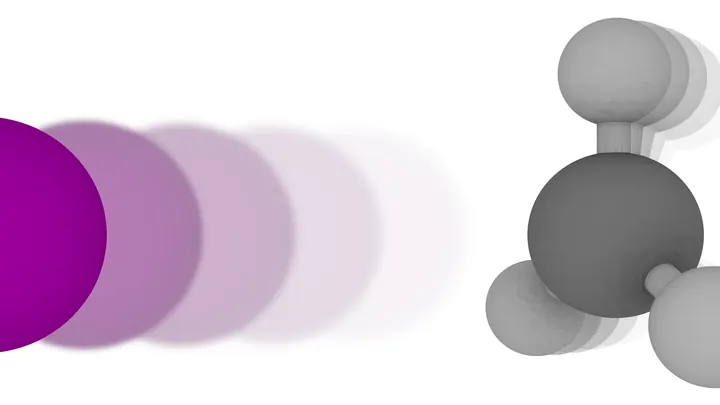
A chemical bond is like a stretched spring between atoms. When it's snapped, the molecular fragments fly apart, but they don't freeze: they keep vibrating, like a plucked string. That's exactly the vibration a team of researchers caught when they broke a methyl iodide molecule with an ultraviolet laser.
A bell doesn't ring with a single note — after being struck, it sounds with several harmonics at once. An atomic nucleus vibrates in much the same way: after a collision, it can oscillate, and these oscillations show up in the emitted gamma rays.
When a massive star runs out of fuel, it collapses and explodes as a supernova. An instant before the catastrophe, neutrinos — ghostly particles — burst from the core. They rush through the star and interstellar space like the smell of smoke, heralding a fire that will only ignite minutes or even days later.
In the first moments after the Big Bang, the cosmos was like a pot of boiling broth. In it, like lumps of flour, dense clumps of energy — oscillons — curdled and swelled. They grew, gained strength, and soon took over the expansion of the Universe.
Right after its birth, the Universe wasn't just expanding: it was inflating at an unimaginable pace. This stage, called inflation, was proposed by Alan Guth. New models compare the process to inflating a balloon with quick, jerky pumps.
Scientists have described a new type of invisible star that behaves like a breathing lens. Such a star is made of ultralight boson particles (not yet discovered). Its gravity causes spacetime curvature — this is the lens, which rhythmically expands and contracts, as if breathing.
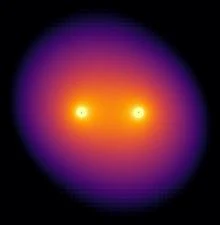
Two black holes circle in a tight dance, and around them something remarkable is born: a gravitational molecule. A cloud of ultralight bosons, particles with masses below an electronvolt, envelops the pair like the electron cloud in an H2+ ion.