Neutrino mass is the intrinsic mass of neutrinos, the ghostly particles that barely interact with matter. For decades, neutrinos were thought to be massless, but the discovery of neutrino oscillations — where neutrinos change flavor as they travel — proved they must have tiny but nonzero masses. The absolute scale of these masses remains unknown, and determining it is one of the key open problems in particle physics and cosmology. Neutrino masses are so small that they are often described as 'weighing a ghost', and their exact values could reveal physics beyond the Standard Model.
History
The possibility of neutrino mass was first suggested by Bruno Pontecorvo in the 1950s, and the first evidence for oscillations came from the Super-Kamiokande experiment in 1998. The absolute mass scale has been pursued since the 1980s, with the KATRIN experiment providing the most stringent direct limits since 2019.
How it works
Neutrino mass is measured indirectly through the kinematics of beta decay, where a nucleus emits an electron and a neutrino. By precisely measuring the maximum energy of the emitted electron, one can infer the neutrino's mass, since the total energy must be shared between the particles. Experiments like KATRIN use a huge spectrometer to analyze the electron energy spectrum near its endpoint. Alternatively, cosmological observations of the cosmic microwave background and galaxy clustering can constrain the sum of neutrino masses, because massive neutrinos suppress the growth of structure on small scales.
In practice
Knowing neutrino masses helps calibrate cosmological models and could guide the search for new particles, but there are no direct technological applications yet; the main impact is in fundamental physics and astrophysics.
Fun fact
The sum of all three neutrino masses is at least a million times smaller than the mass of an electron, yet neutrinos are so abundant that they collectively outweigh all the stars in the universe.
The cosmological standard model is like a recipe for a cake where everything is strictly measured: dark matter is like flour without a single lump (zero pressure), and dark energy is like the perfect leavening agent (equation of state exactly minus one). But what if the flour is a bit damp and the leavening agent has lost its oomph?
In 1998, physicists caught neutrinos doing something astonishing: the particle changes its type on the fly. That is only possible if it has mass. This became the only laboratory proof of physics beyond the Standard Model. But exactly how much a neutrino weighs remains a mystery.
In the first seconds after the Big Bang, the Universe left us not only light but also something far more elusive — the relic neutrino background. This echo of creation permeates every cubic centimeter, yet we barely notice it.
A giant tank of ultrapure water sits deep underground in Japan. Its walls are lined with thousands of light-sensitive sensors that catch faint flashes — the traces of ghostly particles passing through the water.
Imagine an orchestra tuning up: the violins rise in pitch: that's the familiar 'chirp' of black hole mergers in LIGO detectors. Now picture a funeral march: a sound that descends, like a fading siren. That's exactly the gravitational-wave signature a system with one negative mass should leave.
Neutrinos are the most abundant massive particles in the universe. Trillions of them pass through us every second, yet they leave barely a trace. Their collective gravity, though tiny, can influence the motion of entire galaxies. Think of two people approaching each other on a busy street; invisible passersby alter their speed.
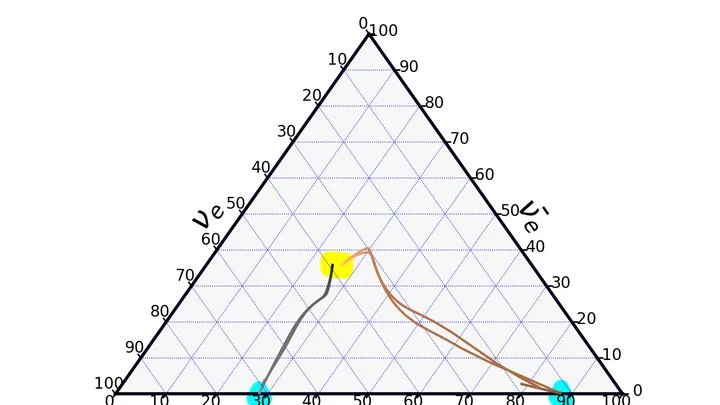
A pot of soup simmering with three ingredients. The chef adjusts the proportions on the fly, and the progress is tracked by the position of a point on a triangular scale. That's roughly how physicists tackle neutrinos from a supernova explosion.
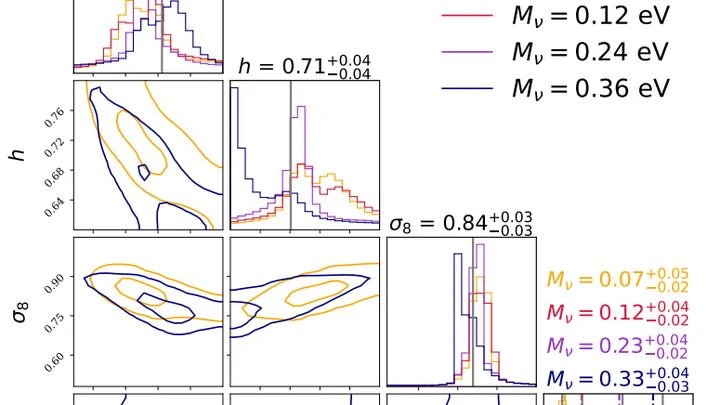
The Universe is a colossal web of invisible dark matter and galaxies, stretched by the expansion of space. Neutrinos, nearly intangible ghost particles, barely cling to the threads, but their collective mass subtly shifts the tension of the entire network.
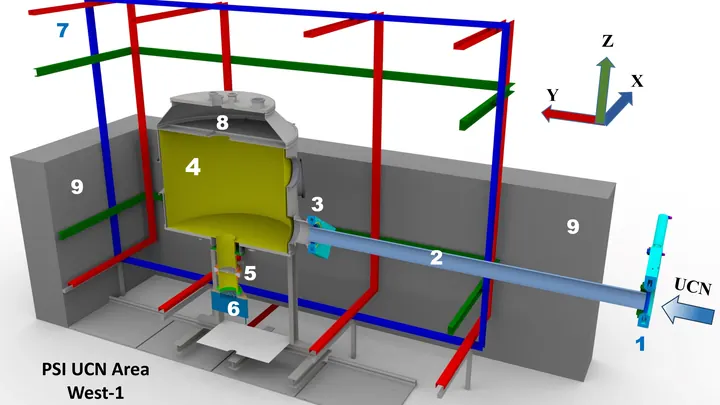
The neutron, a particle inside the atomic nucleus, can live in two worlds: ours and a mirror one. The mirror world has its own neutron twin, invisible to our instruments. If an ordinary neutron sometimes hops to the mirror world and back, some neutrons in a trap would seem to dissolve into thin air.
Inside a giant spectrometer in Karlsruhe, shaped like a huge metal barrel, scientists are catching particles that are nearly impossible to catch. Neutrinos are the ghosts of the microcosm: every second, trillions of these particles fly through your body, and you don't even notice. But they do have mass, and scientists want to measure it.