Freezing Ice and Expanding Space express
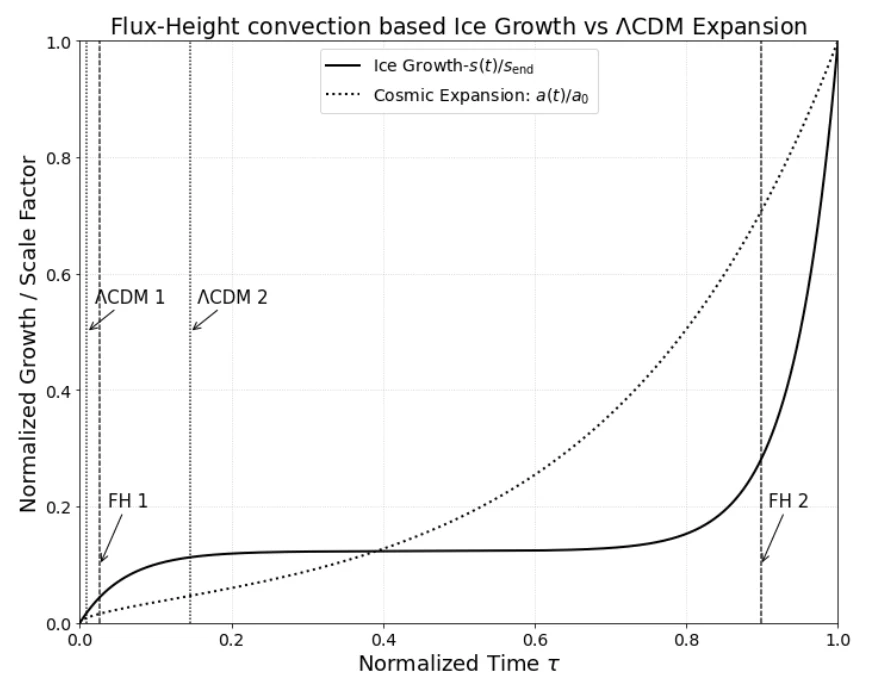
In winter, a lake freezes over, and this simple process turns out to be a living model of an expanding universe. Ice thickness grows according to the same mathematical law as the distances between distant galaxies.
The secret lies in the movement of water beneath the ice crust. When warm layers rise and cold ones sink, this circulation delivers heat to the growing ice. An extra term appears in the equations, behaving exactly like dark energy — a constant invisible force that causes galaxies to rush apart with acceleration. In the lake, this "energy" slows ice growth, while in space, it does the opposite: it pushes expansion forward.
Amazingly, the formula for this scenario was first written by physicist Josef Stefan back in 1891 while studying ice forming on ponds. Now that same equation underpins models that predict the fate of the entire cosmos.
Original abstract
as written by the authors arXiv:2602.24019
We extend previous conduction-based analogies between ice growth in a lake and cosmological expansion by incorporating buoyancy-driven heat transport. Reformulating the Stefan problem with both conductive and convective fluxes yields an evolution equation for the ice thickness $$s(t)$$ that is structurally analogous to the Friedmann equations for the cosmological scale factor $$a(t)$$. Beyond reproducing radiation-, matter-, and curvature-like behaviors, we introduce a reduced description of convection in which the vertically integrated heat flux reaching the moving ice-water interface is modeled as a power-law function of the instantaneous liquid-layer thickness, generating two additional effective contributions. The first is a constant term, directly analogous to a cosmological constant, arising from the persistence of buoyancy-driven transport under geometric confinement. The second is a $$s^{-1}$$ contribution originating from the coupling between the moving ice boundary and the convective boundary layer. This term reflects the specific reduced flux-height Ansatz adopted, rather than a universal physical prediction. When expressed in Friedmann-like cosmological form, this term entails a fluid with negative energy density and equation-of-state parameter $$w=-2/3$$. In cosmology this term may be an effective one associated to a network of domain walls made of exotic energy/matter, but it might also arise from an energy exchange between cosmological components. Overall, the results should be interpreted as a structural analogy between evolution equations, showing how nonlinear transport mechanisms in a classical moving-boundary problem can reproduce the hierarchy of scaling terms familiar from cosmology within a reduced and analytically tractable framework.
Stefan's equation, derived for simple ice, is now even used to calculate the cooling of Mars' surface.