Energy conservation is the principle that the total energy of an isolated system remains constant over time. Energy can change form—from kinetic to thermal, from chemical to electromagnetic—but it cannot be created or destroyed. This law underpins nearly every physical process, from the cooling of your coffee to the fusion reactions that power stars. It also connects to deeper ideas: in thermodynamics, energy conservation coexists with entropy increase, and in gravitational systems, energy flows like water through potential and kinetic forms.
History
The principle was formalized in the mid-19th century by Hermann von Helmholtz and James Prescott Joule, building on earlier work by Sadi Carnot and others. It emerged from studies of heat and mechanical work.
How it works
In practice, energy conservation means that any change in a system's energy must be balanced by an equal and opposite change in its surroundings. For example, when a star fuses hydrogen into helium, the released energy comes from the mass difference, as described by E=mc². In quantum systems, energy conservation holds statistically, allowing temporary violations via the uncertainty principle, but on average, the total energy remains fixed.
In practice
Energy conservation is used in engineering to design efficient engines, in astrophysics to model stellar evolution, and in quantum thermodynamics to develop quantum batteries that store energy with minimal loss.
Fun fact
The energy released by a single cup of coffee cooling to room temperature could, if fully harnessed, power a small LED bulb for about an hour.
A hydrogen bubble on a platinum electrode behaves like a swimmer trying to surface, but every time it almost breaks free, something below grabs its legs. In the lab, high-speed cameras captured this behavior: a millimeter-sized bubble hangs near the surface, even though buoyancy pulls it upward with a force thousands of times stronger than surface tension can hold.
The Kerr-NUT black hole is not just a cosmic vacuum cleaner. It's a solution to Einstein's equations where the hole has mass, rotation, and a strange NUT parameter. This parameter behaves like a magnetic charge for gravity: seemingly invisible, yet it alters the properties of surrounding space.
The race for fusion energy is like trying to bottle a lightning bolt. For decades, physicists have struggled to recreate on Earth the processes that power the Sun. The main challenge is getting light nuclei to fuse despite their mutual repulsion, while extracting more energy than was spent heating and confining the plasma.
An ocean current hundreds of kilometers wide lives its own life, fed by energy from tiny eddies. Something similar happens in the atmosphere: small swirls pass their power on to huge air currents. This process, the inverse energy cascade, has been known for a long time.
Two-dimensional worlds never cease to amaze: here even crystal melting is not a symmetry breaking but a vortex drama discovered by Kosterlitz and Thouless. At the heart of this theater are topological сингулярности, whose energy and энтропия bargain for order. This language is common to сверхтекучести и сверхпроводимости.
A quantum system is like an island gradually eroded by the ocean. The waves, representing environmental influence, wash away the shores, stripping the island of its unique contours. The GKLS equation (Gorini–Kossakowski–Lindblad–Sudarshan) describes exactly how quickly this 'quantumness' fades.
But every wave has an energy source.
If you pour sand into a glass, it settles in a flat layer. But instead of sand, take the tiniest particles of gas: in a gravitational field they don't just fall: each particle races along its own trajectory, collides with neighbors, and all this commotion creates pressure.
An ordinary heat engine is like a mill between the hot and cold banks of a river: the greater the drop, the stronger the current. Here, the drop is tiny, just one or two degrees, but water can still turn the wheel. The secret is that water is made to boil not by heating but by a sudden drop in pressure, so steam bursts out even from barely warm liquid.
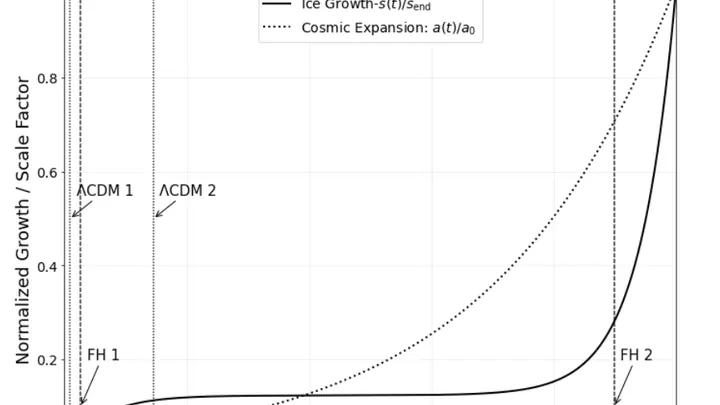
In winter, a lake freezes over, and this simple process turns out to be a living model of an expanding universe. Ice thickness grows according to the same mathematical law as the distances between distant galaxies.
The secret lies in the movement of water beneath the ice crust.
A solar panel on a roof produces little current in the morning, a lot at noon, and stays silent at night. Wind doesn't blow randomly either: it's often stronger in the morning and evening than during the day. Energy providers need to know in advance how much energy will be available in an hour or three, so they can switch on backup plants or store electricity in batteries in time.
A hot coffee cools by radiating invisible light. To maintain temperature, it must receive exactly as much light back. This silent trade of photons is what we feel as steady warmth.
In a freezer, ordinary water turns to ice, but in living cells, such ice is a disaster: sharp crystals tear membranes apart like needles popping a balloon. Scientists who preserve cells for medicine have learned to avoid this calamity, but each method speaks its own language. A new study offers a common vocabulary — thermodynamics.
Heat flow usually evens everything out: hot things cool down, cold things warm up, and in the end you are left with a uniform warm swamp. The same holds in the quantum world: the environment, whether a crystal lattice or a gas of photons, tends to destroy the fragile entanglement between particles.
A wave rolls onto the sand, leaving a pattern of foam and shells. A moment later it recedes, but the traces are no longer the same: the sand is smoothed, the shells are flipped over. Something similar happens in the quantum world when a system moves from a nonequilibrium state toward equilibrium.