Freezing Ice and Expanding Space express
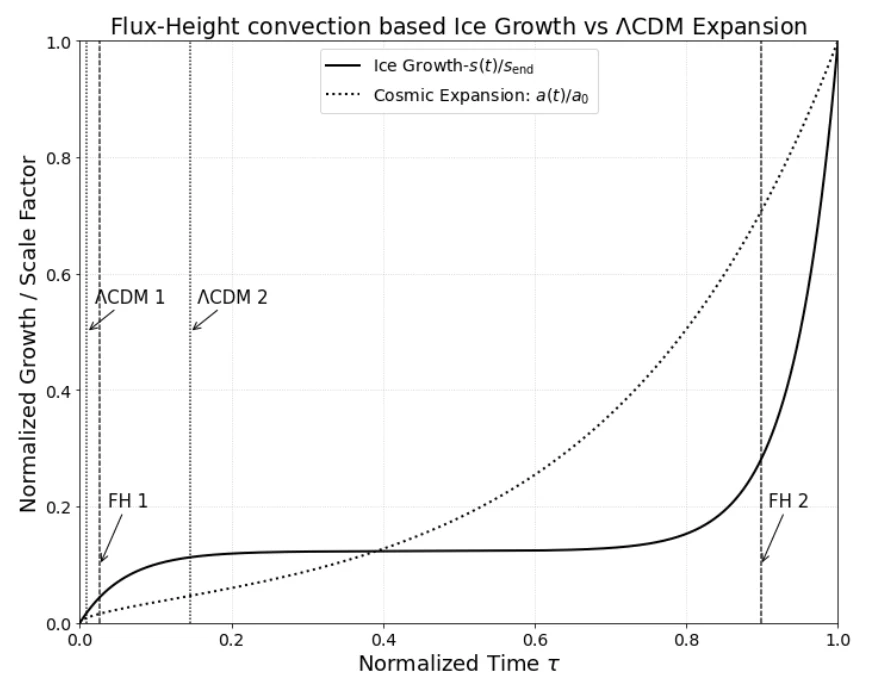
In winter, a lake freezes over, and this simple process turns out to be a living model of an expanding universe. Ice thickness grows according to the same mathematical law as the distances between distant galaxies.
The secret lies in the movement of water beneath the ice crust. When warm layers rise and cold ones sink, this circulation delivers heat to the growing ice. An extra term appears in the equations, behaving exactly like dark energy — a constant invisible force that causes galaxies to rush apart with acceleration. In the lake, this "energy" slows ice growth, while in space, it does the opposite: it pushes expansion forward.
Amazingly, the formula for this scenario was first written by physicist Josef Stefan back in 1891 while studying ice forming on ponds. Now that same equation underpins models that predict the fate of the entire cosmos.
Stefan's equation, derived for simple ice, is now even used to calculate the cooling of Mars' surface.