Newton's second law states that the acceleration of an object is directly proportional to the net force acting on it and inversely proportional to its mass.
Newton's second law quantitatively relates force, mass, and acceleration. It was also published in 'Mathematical Principles of Natural Philosophy' (1687) and became the heart of classical dynamics. Historically, Newton built on the work of Galileo and Kepler. In the modern formulation, the law is often written in terms of momentum change: force equals the derivative of momentum with respect to time. Momentum (mass times velocity) is a measure of the quantity of motion. If mass is constant, F = m·a, but in general (e.g., a rocket losing fuel) the impulse form is correct.
History
The concept of force was discussed even by Archimedes, but the mathematical form of the force-motion connection was sought for a long time. Galileo Galilei established that speed is proportional to the time of fall. Johannes Kepler hypothesized that planets move under a force from the Sun. Isaac Newton in the famous 'Principia' (1687) gave a clear formulation, calling force 'an action exerted upon a body to change its state of rest or uniform rectilinear motion'.
How it works
It is used everywhere in engineering to calculate loads, motion of mechanisms, material strength. In celestial mechanics, it allows calculating orbits under gravity. In biomechanics, it explains why an impact is stronger if the braking time is reduced (force impulse). Limitations: does not work at speeds close to light speed and in strong gravitational fields where general relativity is required; in the microcosm, the Schrödinger equation or quantum mechanics serves as an analog.
In practice
When designing elevators, the traction force of the cable is necessarily calculated to accelerate the cabin with the required acceleration, knowing its mass and passengers.
Fun fact
During the launch of a Soyuz rocket, the thrust of the engines creates an acceleration of up to 4 g, and the cosmonauts feel four times heavier.
In 1934 Jean Leray proved that the Navier–Stokes equations always have solutions "in a generalized sense". Whether a solution stays smooth or can break down into a singularity he could not tell, and nobody could for ninety years. In 2000 the Clay Institute made the question one of its seven Millennium Prize problems.
As planets orbit the Sun, they don't just follow their paths: they give each other a slight tug. It's like a dance where each partner feels the movements of the others. Scientists set out to determine how strongly this mutual attraction alters the planets' trajectories.
It turns out there are small corrections that were previously overlooked.
The early Universe was like a tightly coiled spring. In the first moments, it expanded at an unimaginable rate — a phase called inflation. Usually, this is attributed to a special field, but there's another idea: spacetime itself twists like a spring, and this twisting (in physics, torsion) becomes the engine of expansion.
A carousel doesn't just spin you around in a circle — with each revolution, it also slightly screws itself into the ground. This corkscrew-like motion is the essence of the NUT charge, a special property of spacetime that physicists have been studying since the mid-20th century.
Inside a supercomputer, fifteen stable wave clumps — solitons — collide to form a halo of dark matter. These waves obey an equation that Erwin Schrödinger derived for electrons at the beginning of the 20th century, but now they paint a portrait of a giant galactic cocoon.
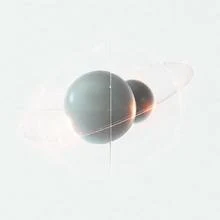
A lead sphere hangs above another lead sphere. According to the usual laws of gravitation, they attract each other exactly along the vertical — along the line connecting their centers.
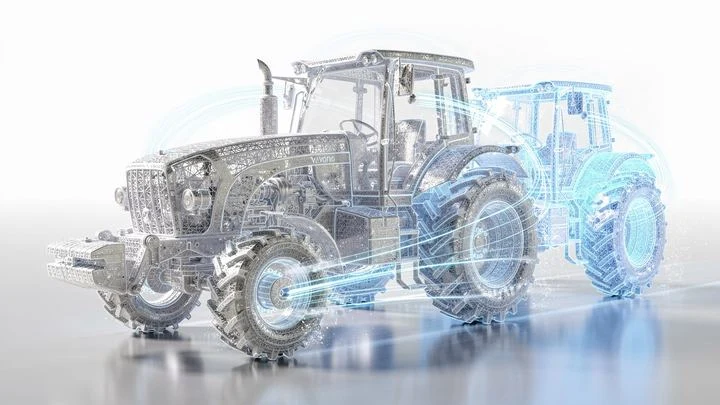
The tractor traces a perfect circle on the stubble. At that same moment, its digital shadow, an exact virtual copy, repeats the maneuver on a computer screen, diverging from the original by only a few percent.
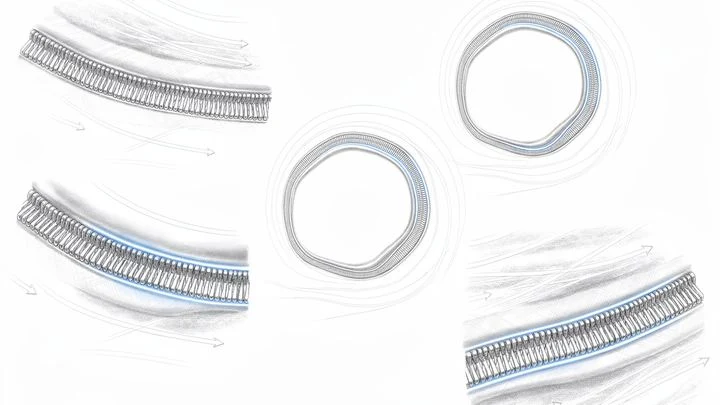
Membraneless organelles, tiny factories inside the cell, defy conventional rules. Take the nucleolus: here ribosomal RNA is synthesized — long chains woven from carbon sugars, rich in oxygen phosphate groups, and stitched with hydrogen bonds, suspended in the watery environment of the nucleus.
Right after the Big Bang, space was a hot plasma — a mix of charged particles and light. In such a medium, electric currents couldn't flow on their own: a 'potential difference' was needed to push electrons relative to photons.
Our universe isn't just expanding: it's doing so faster and faster. It's like raisin bread dough in the oven: the raisins move apart, and the farther they've already separated, the faster they continue to recede. The strange force pushing the cosmos apart is called dark energy. Most scientists think it's constant, like a permanent spring built into the very fabric of space.
In 1867, James Clerk Maxwell proposed an image that still stirs physicists today. Two compartments of gas are separated by a door. Molecules dart about chaotically: fast and slow. A tiny gatekeeper opens the door only for fast ones, letting them through to one side, and slow ones to the other. The hot compartment gets hotter, the cold one colder.
Imagine inflating a balloon. At first, it expands slowly; then someone gives a sharp blast of air, and it swells faster. But as the airflow weakens, the balloon's growth slows again. According to a new study, the Universe has behaved much the same way: after the Big Bang, it expanded, then suddenly accelerated, and now that acceleration is fading.
When a typical computer searches for a law of nature from data, it tries to guess a complete formula in one go. It's like a cook who, without knowing the recipe, dumps all the ingredients into a pot at once and hopes for soup. Most often, the result is an inedible mess: the formula is long but meaningless, and it fails on new data.
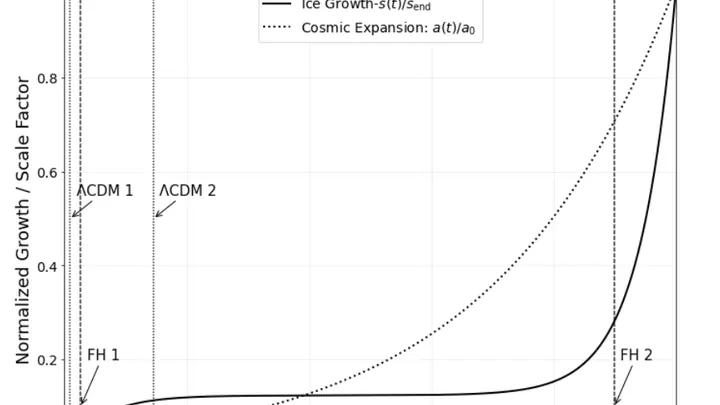
In winter, a lake freezes over, and this simple process turns out to be a living model of an expanding universe. Ice thickness grows according to the same mathematical law as the distances between distant galaxies.
The secret lies in the movement of water beneath the ice crust.
An atom excited by light gives its energy back in an instant — it emits a photon. This process is like a tired runner dropping a heavy load. But if the runner is on a mountain slope, it's harder to pick up speed. Gravity acts on the atom similarly: near a massive body, time flows slower, and the atom emits differently.
In every cell lives a tireless scribe — an enzyme that copies the long thread of DNA. It moves along it like a read head over a tape, building a new strand alongside. It picks letters by strict rule: opposite A it always places T, opposite G it places C. But sometimes, very rarely, its hand trembles, and a different letter slips in.
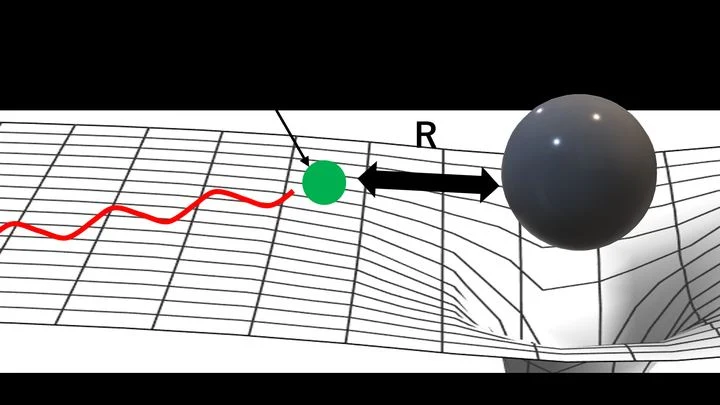
An ultracold atomic cloud, resembling fog, hints that gravity might not work as Newton said. On the outskirts of galaxies stars move faster than expected, and MOND theory tweaks the law of gravitation over large distances, removing the need for dark matter.
A quantum particle, an inhabitant of the elementary particle world, resembles a coin spinning in the air: neither heads nor tails, but a blend of possibilities. Yet when it lands on the table, the outcome becomes definite. What serves as the table in a measurement?
In the quantum world, an object can be in several places at once. Yet in everyday life we see things strictly in their places. The reason is gravity. A massive star under its own weight inevitably collapses into a black hole or a neutron star, but it can't be both at the same time.
Two qubits, quantum bits, two-level systems, glide through hot and cold thermal baths. One moves at 0.8 times the speed of light. At that moment, familiar thermodynamics cracks: a moving qubit senses temperature differently than a stationary one. For it, the cold bath can feel hotter, and the hot bath colder.