Newton's laws of motion are the foundational principles of classical mechanics, describing how the motion of an object changes in response to forces. The first law states that an object at rest stays at rest and an object in motion stays in motion at constant velocity unless acted upon by an external force. The second law quantifies this: force equals mass times acceleration (F = ma). The third law states that for every action, there is an equal and opposite reaction. These laws form the basis for understanding everything from planetary orbits to the behavior of fluids and the design of vehicles.
History
Isaac Newton formulated these laws in his 'Philosophiæ Naturalis Principia Mathematica' published in 1687, building on the earlier work of Galileo Galilei and Johannes Kepler.
How it works
The laws operate in an inertial frame of reference, where objects not subject to forces move uniformly. The second law provides a differential equation that, when solved, gives the trajectory of a body under known forces. The third law ensures momentum conservation in isolated systems, which is crucial for analyzing collisions and propulsion. In practice, these laws are applied by identifying all forces acting on a body, summing them as vectors, and solving the resulting equations of motion.
In practice
Newton's laws are used in engineering to design structures, vehicles, and machinery; in aerospace to calculate rocket trajectories; and in biomechanics to analyze human movement. They also underpin the derivation of more advanced concepts, such as the Navier-Stokes equations for fluid dynamics, which appear in the title 'Толпа как жидкость: гидродинамика давки'.
Fun fact
The second law, F = ma, is a special case of the more general principle of least action, which also governs quantum mechanics, as hinted by the title 'Бильярд и кванты: единое уравнение классического и квантового миров'.
A sculptor looks at a block of marble and sees the figure within, waiting to be freed from excess material. Instead of adding clay, he removes everything that is not part of the form. The authors of a new study on magnetic resonance took a similar approach: rather than complicating the tissue model by adding ever more details, they stripped away the superfluous to reveal the essence.
At the center of a neutron star, matter is compressed so tightly that a teaspoon weighs a billion tons. You'd think there's no better place to look for signs of quantum gravity. But between the laboratory and the fundamental scale lies a chasm of 10⁸⁰ in density.
Three doors lead into this room.
As planets orbit the Sun, they don't just follow their paths: they give each other a slight tug. It's like a dance where each partner feels the movements of the others. Scientists set out to determine how strongly this mutual attraction alters the planets' trajectories.
It turns out there are small corrections that were previously overlooked.
A thrown stone arcs through the air, but a planet around the Sun follows a closed curve. Why an ellipse, and not a circle or a spiral? Kepler's first law provides the answer, but its usual proof requires heavy computation. This work offers a shorter path — through a single simple ratio of velocities.
Newton gave us a world where bodies move in a void and clocks tick the same for everyone. For three centuries, this picture worked flawlessly. But it relies on many invisible props: absolute position, the 'up-down' direction, and a single rhythm of time for the entire universe. We have never measured these directly — only through the relations between objects.
The Kerr-NUT black hole is not just a cosmic vacuum cleaner. It's a solution to Einstein's equations where the hole has mass, rotation, and a strange NUT parameter. This parameter behaves like a magnetic charge for gravity: seemingly invisible, yet it alters the properties of surrounding space.
Researchers took 16 everyday activities — from washing dishes to squatting — and broke the movements down into elementary components, much like a spectroscope splits light into a spectrum. Comparing three approaches, they found an unexpected key to recognition: a single averaged snapshot is enough. Only nine joints out of dozens carried the crucial information — the rest hardly mattered.
A lead sphere hangs above another lead sphere. According to the usual laws of gravitation, they attract each other exactly along the vertical — along the line connecting their centers.
When two neutron stars circle each other, they don't remain rigid spheres. The partner's gravity stretches each star, creating tidal bulges — much like the Moon raises ocean tides on Earth. But unlike water, here it's superdense matter that deforms: a teaspoon of this stuff weighs billions of tons.
Right after the Big Bang, space was a hot plasma — a mix of charged particles and light. In such a medium, electric currents couldn't flow on their own: a 'potential difference' was needed to push electrons relative to photons.
A black hole is like a perfect vacuum cleaner: anything that crosses its horizon vanishes without a trace. But this vacuum cleaner has a strange feature: its "dust bag" grows, and by the size of the bag you can tell how much has been sucked in. In black hole physics, this size is linked to entropy entropy — a measure of hidden information about what fell inside.
Light cones are not about light; they are boundaries in spacetime that separate causes from effects. These cones are not rigid: a massive object curves them, like a heavy ball pressing into a stretched sheet.
Two pebbles drop into water, and the ripples on the surface intersect, blending their patterns. Neutrinos behave much the same way: light particles that pierce us by the billions every second. They can transform from one type to another, like an actor changing masks. Physicists call this dance oscillations.
In 1867, James Clerk Maxwell proposed an image that still stirs physicists today. Two compartments of gas are separated by a door. Molecules dart about chaotically: fast and slow. A tiny gatekeeper opens the door only for fast ones, letting them through to one side, and slow ones to the other. The hot compartment gets hotter, the cold one colder.
In the quantum world, light and matter constantly exchange energy. Previously, they were described statically, like frozen poses. The new approach follows the dance itself: the transitions between states, like a continuous sequence of movements.
In one model, spacetime is a smooth lake, and quantum particles are fish swimming in it. Their motion inevitably creates ripples. The math insists that the water trembles — otherwise the theory collapses. This trembling is strictly ordered and comes in two types.
A stone falls to the ground along the most economical route — the one that expends the least time and energy. This principle of least action governs all of classical physics. But in the microworld, everything jitters: fields fluctuate, and you can't say precisely where anything is.
If you pour sand into a glass, it settles in a flat layer. But instead of sand, take the tiniest particles of gas: in a gravitational field they don't just fall: each particle races along its own trajectory, collides with neighbors, and all this commotion creates pressure.
A stone thrown into a pond creates ripples that spread far. But if you throw it into thick jelly, the waves die out almost immediately. That's roughly how an additional gravity field behaves under different mathematical descriptions.
The authors built a unified approach to calculate how such a field manifests itself in the Solar System.
Before measurement, a quantum object lives in a world of possibilities, where wave amplitudes add up like sound waves in a studio before pressing the “record” button. Crests amplify each other, troughs cancel out.
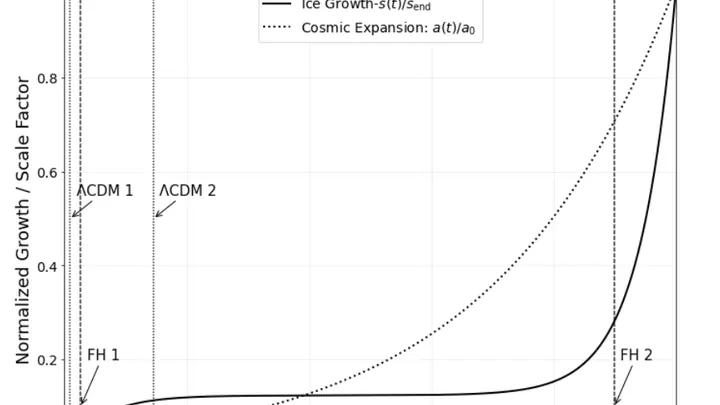
In winter, a lake freezes over, and this simple process turns out to be a living model of an expanding universe. Ice thickness grows according to the same mathematical law as the distances between distant galaxies.
The secret lies in the movement of water beneath the ice crust.
The world of physics works like a music box: there's a speed knob. Turn it slowly, and the melody is strict — balls roll along trajectories (classical mechanics). Speed it up — the notes blend into a chord: a particle is in many places at once, all probabilities (quantum regime).
The secret of switching is in the parameter κ.
The third law of black hole mechanics, proposed by Stephen Hawking, forbids a hole from spinning up to its limit in finite time — much like a whirlpool would need an eternity to reach absolute speed. Yet numerical simulations in five dimensions break this rule.
An ultracold atomic cloud, resembling fog, hints that gravity might not work as Newton said. On the outskirts of galaxies stars move faster than expected, and MOND theory tweaks the law of gravitation over large distances, removing the need for dark matter.
A quantum particle, an inhabitant of the elementary particle world, resembles a coin spinning in the air: neither heads nor tails, but a blend of possibilities. Yet when it lands on the table, the outcome becomes definite. What serves as the table in a measurement?
We are used to thinking that events have causes, objects exist independently, and signals cannot outpace the speed of light. Quantum mechanics, which describes the Standard Model of particles, challenges all these assumptions at once — as if a recipe couldn't use all seven ingredients.
Intelligent action begins with a plan. Just as an architect needs blueprints to evaluate options, any agent with will needs to repeatedly copy data about reality.
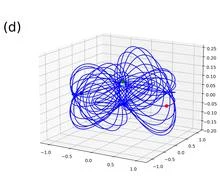
Three bodies attracting each other by universal gravitation: a problem that has stumped mathematics for three centuries. After Poincaré, it became clear that no general solution exists and trajectories are chaotic. But within this chaos there are islands of order: periodic orbits where motion repeats.