The wave equation is a fundamental mathematical equation that describes how waves propagate through a medium or field. It relates the second derivative of a wave's displacement with respect to time to its second derivative with respect to space, with a constant factor representing the wave speed. This equation applies to a vast range of phenomena, from sound waves in air and seismic waves in the Earth to light waves in electromagnetism and gravitational waves in spacetime.
History
The wave equation was first formulated by Jean le Rond d'Alembert in 1746 for vibrating strings, and later generalized by Leonhard Euler and Daniel Bernoulli. It was extended to three dimensions and applied to light by James Clerk Maxwell in the 1860s.
How it works
The wave equation works by expressing the principle that the acceleration of a wave disturbance at any point is proportional to the curvature of the wave at that point. This means that a localized disturbance, like a plucked string, spreads outward in a predictable pattern. Solutions to the equation are functions that describe the shape and motion of the wave, and they can be superposed — meaning multiple waves can pass through the same region without permanently altering each other, which is why waves can carry information over long distances.
In practice
The wave equation is used in seismology to model earthquake propagation, in acoustics to design concert halls, and in telecommunications to simulate how signals travel through optical fibers. It is also central to numerical simulations of gravitational waves from merging black holes.
Fun fact
The wave equation is linear, which means that two waves can pass through each other without interacting — this is why you can hear individual conversations in a crowded room, even though sound waves overlap.
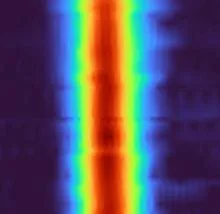
A wave packet is like a traveler who either loses steam and spreads out along the way, holds a steady pace, or gathers into a fist. In a 50-meter flume with water 5 meters deep, scientists tracked how a bell-shaped group of waves behaves when its height is changed but not its width.
A spotlight with an adjustable beam width sweeps along the shore. Its light is the long ocean waves that are born in the surf zone and spread in both directions: toward the beach and out to the open sea. Previously, this spotlight was considered a point source, but the actual breaking zone, where short waves break, has a finite width, and it changes as the wave front advances and retreats.
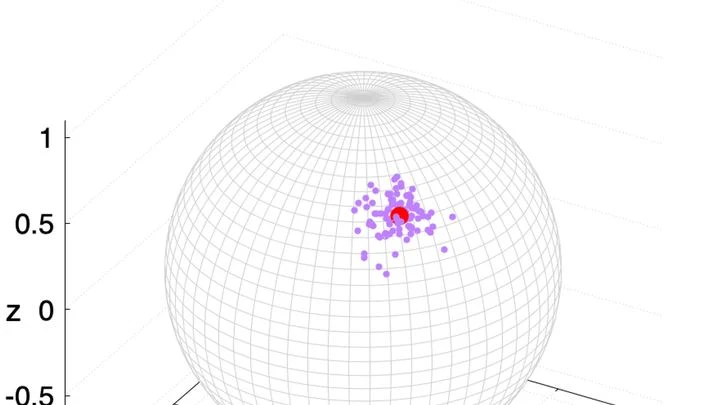
Two massive bodies frozen in a quantum superposition resemble a pair of dancers trying to keep a single rhythm while an orchestra blares around them. Each gravitational wave is a musician throwing them off beat.
In a vast hall, billiard balls are scattered about. At first they lie sparsely, each on its own. Then someone adds more, and suddenly the balls compress into dense clusters. This is a phase transition — the moment when matter abruptly changes its state.
Physicists have long described such a picture with the hard-sphere model: particles are identical balls that cannot overlap.
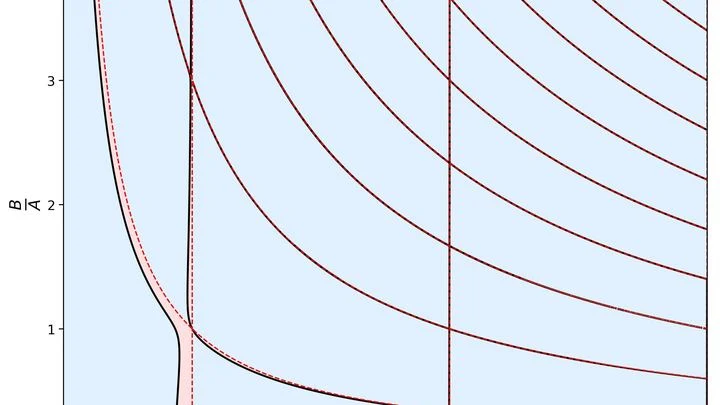
A stone falls into a pond, and ripples spread evenly in all directions. But some media behave as if the wave knows which way to turn, like water that only swirls clockwise. This asymmetry comes from odd viscosity and odd elasticity — properties of media with broken mirror symmetry.
Gravitational waves are not vibrations of matter, but tremors of spacetime itself, predicted by Albert Einstein. They travel at the speed of light and pass through objects, stretching and squeezing them.
When two dead stars collide in a distant galaxy, two messengers bring us the news: a shiver in space, a gravitational wave, and a flash of light. Both messengers race toward us across the entire Universe, but their paths can differ slightly. Light sometimes gets delayed by cosmic dust, while gravitational waves pass through everything almost without noticing obstacles.
In a thin semiconductor channel, electrons behave not like lone runners but like a crowd at rush hour. They constantly bump into each other, and these collisions determine how easily heat and electric current pass through the material.
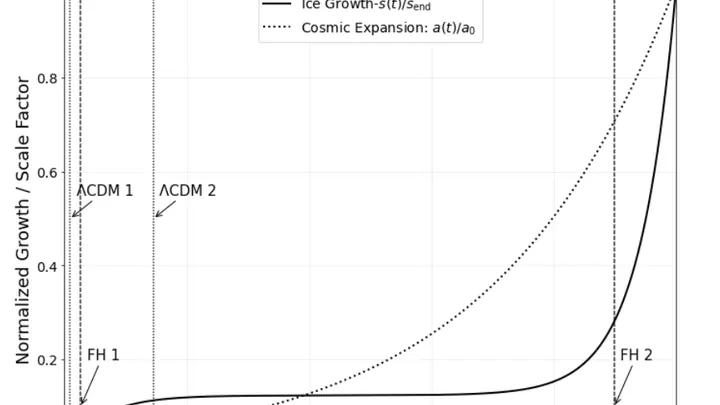
In winter, a lake freezes over, and this simple process turns out to be a living model of an expanding universe. Ice thickness grows according to the same mathematical law as the distances between distant galaxies.
The secret lies in the movement of water beneath the ice crust.
Gravitational waves are ripples in space, born, for example, when pairs of supermassive black holes spiral around each other. To catch them, scientists monitor pulsars — dead stars that emit radio pulses with clockwork precision.
A stone drops into a pond — ripples spread across the water. Do short waves outrun long ones? No, in deep water it's the opposite: long waves overtake short ones. In metal, sound of one pitch travels at one speed, another pitch at another.
The ocean is like a layered cake: warm, light water on top, cold, heavy water below. Between the layers, at the interface, invisible waves roam. They don't lift crests like a storm; instead, they slowly rock the entire water column, as if someone were shaking a giant aquarium from within.