Radio Telescope Spots Shadow Cast by Galaxy Cluster express
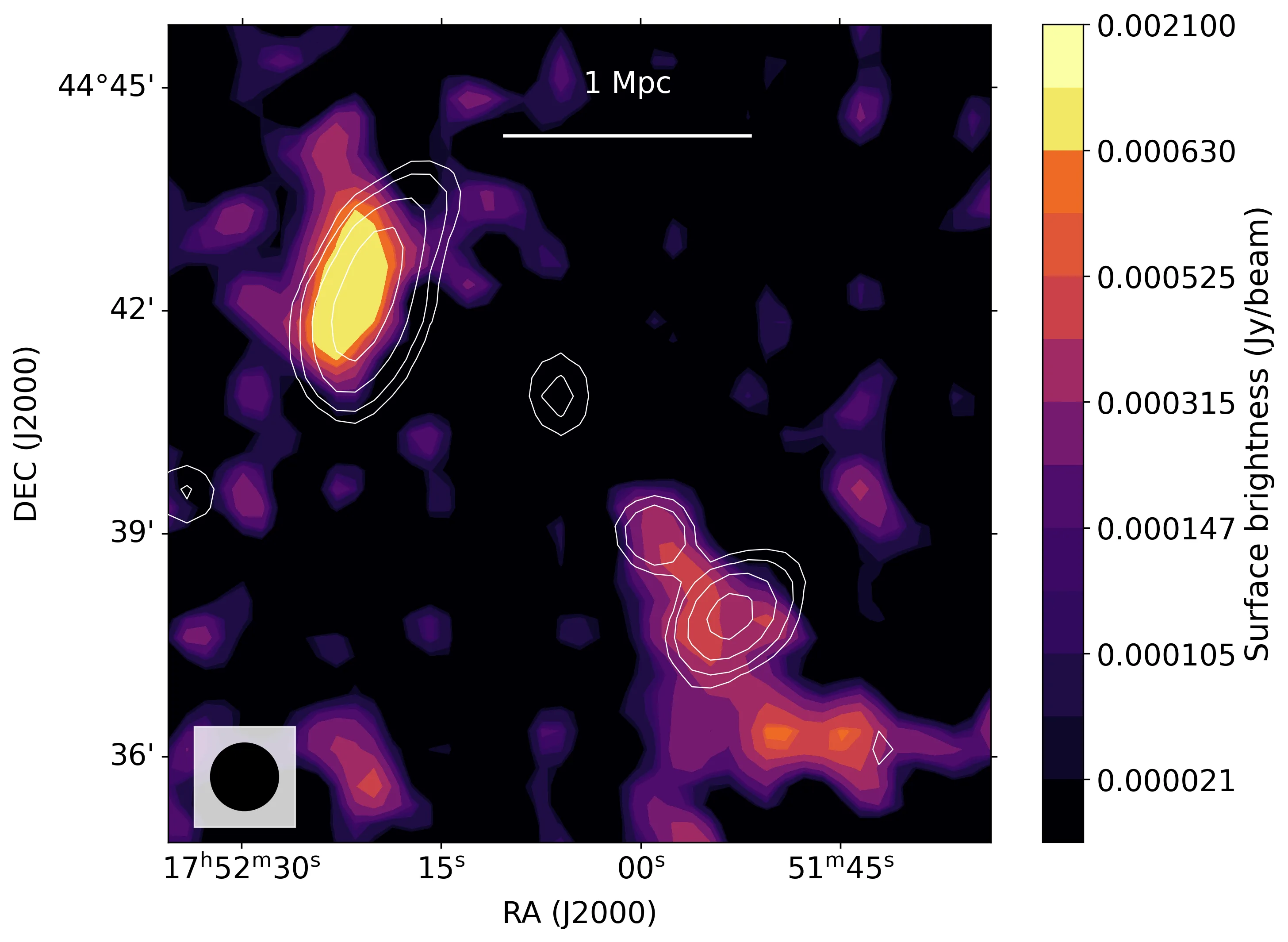
The cosmic microwave background is faint light left over from the Big Bang. It fills the sky uniformly, but it encounters obstacles along the way. One such obstacle is galaxy clusters, which contain very hot gas. When CMB photons pass through this gas, some of them get an extra kick and change energy. As a result, in the direction of the cluster, the CMB looks slightly dimmer, like a shadow appearing on a bright background.
Astronomers pointed the radio telescope at the Sardinia Observatory toward the galaxy cluster MACS J1752+4440. At 18.6 GHz, they saw exactly such a shadow — a slight decrease in brightness at the very center of the cluster. This is the first time the effect has been caught from the ground at such a low frequency and with high angular resolution. Previously, such observations were mostly made by space probes, which see the whole sky at once but cannot distinguish fine details.
To understand how the gas is distributed inside the cluster, the scientists built a model and fitted its parameters. It turned out that the gas cloud has a radius of about 500 thousand light-years, and at its center there are about 2500 electrons per cubic centimeter. These numbers agree with what was expected for a cluster of this mass. So the method works, and it can be applied to other clusters.
The shadow on the CMB is not just a pretty picture. Its shape can be used to reconstruct how the gas spreads inside the cluster, which in turn helps weigh the cluster and test how gravity works on enormous scales. The Sardinian telescope has shown that it can see such shadows from the ground, and now astronomers will be able to study galaxy clusters in more detail than before.
The effect where hot gas in galaxy clusters distorts the CMB is named after Soviet physicists Rashid Sunyaev and Yakov Zeldovich, who predicted it in 1969.
In Carl Sagan's novel 'Contact', radio telescopes pick up a signal from an alien civilization — here, the telescope listens not to a signal, but to the echo of the Big Bang itself.