Avalanche Inside a Crystal express
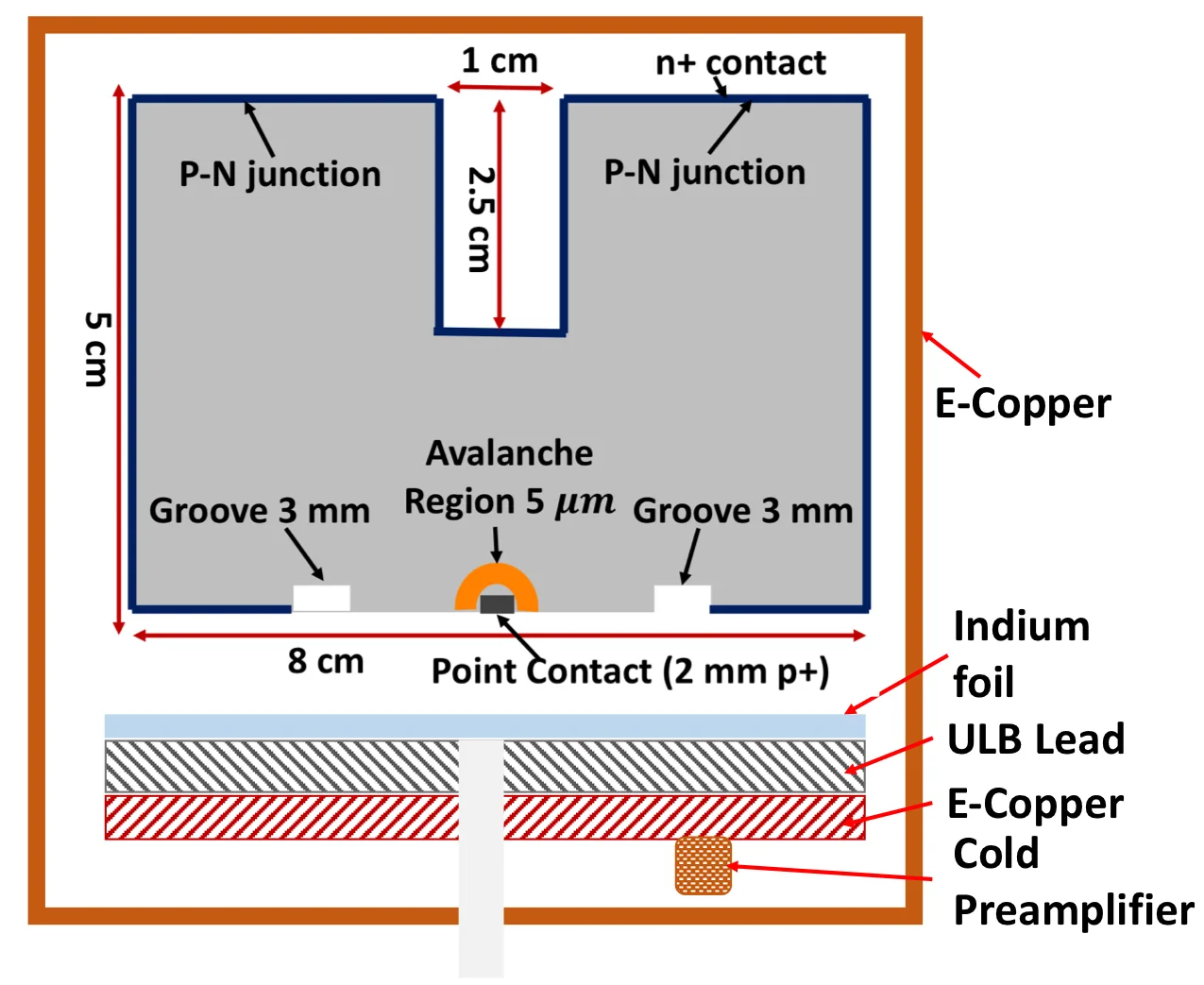
In an ultra-pure germanium crystal cooled to near absolute zero, a single electron can trigger a whole avalanche of charges, like a small pebble dislodged from a slope that sweeps down a stream of snow. Such internal signal amplification is a dream for detectors of dark matter or rare decays. But the avalanche doesn't always start; it only begins when the electric field inside the crystal crosses a critical threshold. Predicting this threshold in advance is like predicting exactly which slope angle will set a snowball rolling.
The authors of the new work have assembled a simple but reliable "avalanche map." They combined two old ideas: one estimates the field from the electron's longest free path, the other accounts for the fact that at high energies a particle can skip past dangerous spots without colliding, like a skier who flies over bumps at speed. The result is a convenient formula: the critical field depends on temperature, crystal size, and how easily charge carriers move in the material. They tested it on electrons and holes — the predictions matched experiments better than previous models.
The benefit here is not only for fundamental science. Germanium-based detectors search for dark matter particles, catch rare nuclear decays, and monitor material purity. If the avalanche threshold is known in advance, the device can be tuned to amplify only the useful signal while leaving noise behind. Stable operation without false triggers is exactly what's needed for multi-year experiments deep underground.
Original abstract
as written by the authors arXiv:2603.02391
Internal charge amplification (ICA) in cryogenic high-purity germanium (HPGe) can lower detection thresholds by providing gain inside the detector crystal, but reliable operation requires a predictive estimate of the avalanche-onset \emph{critical electric field} \(E_{\mathrm{crit}}\). We present a compact framework for \(E_{\mathrm{crit}}\) at 77~K and 4~K (typical HPGe operating temperatures) that bridges (i) a mobility-based single-free-flight (SFF) upper bound with (ii) a physics-informed impact-ionization model incorporating energy-dependent scattering, nonparabolic (Kane) dispersion, intervalley transfer, and the high-energy ``lucky-drift'' tail. This unified treatment yields closed-form, design-useful relations, including \(E_{\mathrm{crit}}^{(\mathrm{PI})}=B(T)/\ln[A(T)d]\), and a practical calibration workflow that maps measured low-field mobility \(\mu(T)\) and gain curves \(M(V)\) (Chynoweth analysis) to device-level bias targets with propagated uncertainty bands. Example electron and hole estimates indicate that realistic transport typically lowers \(E_{\mathrm{crit}}\) relative to SFF and increases the predicted change in \(E_{\mathrm{crit}}\) between 77~K and 4~K. The resulting portable formulas connect materials/transport inputs to geometry, excess noise, and field shaping, providing design-ready guidance for stable, unipolar-favored ICA with controlled quenching in Ge and other cryogenic semiconductors.
Pure germanium for detectors is grown so that there is less than one impurity atom per billion germanium atoms — making it one of the purest materials ever created by humans.