Independent Component Analysis (ICA) is a computational technique for separating a multivariate signal into additive subcomponents, assuming the subcomponents are non-Gaussian and statistically independent from each other. It is best known for solving the 'cocktail party problem': extracting a single voice from a recording of multiple overlapping conversations. ICA is a cornerstone of blind source separation, where neither the sources nor the mixing process are known beforehand.
History
ICA was formally introduced in the 1980s and 1990s, with key contributions by Pierre Comon (1994) who defined the problem and by Aapo Hyvärinen and Erkki Oja who developed the FastICA algorithm in 1997.
How it works
ICA models the observed signals as a linear mixture of unknown independent sources. The algorithm searches for a linear transformation that maximizes the statistical independence of the resulting components. Independence is typically measured by non-Gaussianity, since mixtures of independent variables tend toward Gaussian distributions (by the central limit theorem). ICA iteratively adjusts the transformation to maximize a measure like kurtosis or negentropy, thereby recovering the original sources up to scaling and permutation.
In practice
ICA is used in brain imaging (EEG and fMRI) to isolate neural signals from artifacts, in finance to identify hidden factors in stock returns, and in audio processing to separate mixed recordings.
Fun fact
ICA can separate two people speaking simultaneously in a room using only two microphones, even though the microphones each pick up a blend of both voices.
A single photon is like a perfectly smooth brick from which quantum technologies can be built. But to build a house, you need thousands of identical bricks. Rubidium atoms are natural emitters: each atom emits photons of exactly one wavelength, like a tuning fork that always produces a single note.
2,41 hours. That's exactly how long a day lasts on SIMP 0136 — a lonely planet-like object 6,1 parsecs away. That's twice as far as Proxima Centauri. Its mass ranges from 12,7 to 17,8 Jupiter masses, placing it on the boundary between planet and star.
A search party combs a foggy field. At first, people spread out wide: a high 'temperature' of search means a great variety of attempts. Upon finding a trace, they close in. But the speed of convergence is critical — narrow the circle too early, and the best find stays aside. The coordinator assesses the spread of searchers and commands when to speed up or slow down.
The float in a toilet tank is an ideal controller: sensing the water level, it instantly brings the system into equilibrium without looking back at the past. Engineers applied this principle to neural networks.
Wireless devices flood the airwaves with signals that blend into chaos — as if everyone in a room started talking at once. Scientists have proposed a solution: smart panels, reminiscent of acoustic tiles. Each cell can either reflect a radio wave on command, like a wall echo, or absorb it, as soundproofing dampens noise.
Inside each of us, invisible clocks are ticking. They control the release of cortisol — the hormone that helps us wake up in the morning, cope with anxiety, and keep our immune system on its toes. In adrenal insufficiency, these clocks break down: the body can't produce the right amount of cortisol on its own.
A dance of hundreds of particles: some pairs spin slowly and gracefully, others twitch in a frantic rhythm. To understand the essence of the dance, you need to watch the slow movements: they are the main choreography of the system. In molecular science, such slow movements are called 'slow modes,' and they determine how a protein folds into a ball or how a drug binds to its target.
Imagine an interpreter sitting in a meeting room, translating every word. But then they notice their translation could improve if they learned from their mistakes. They start noting which phrases caused confusion and adjust them. Within an hour, their translation is more accurate and the meeting runs smoother.
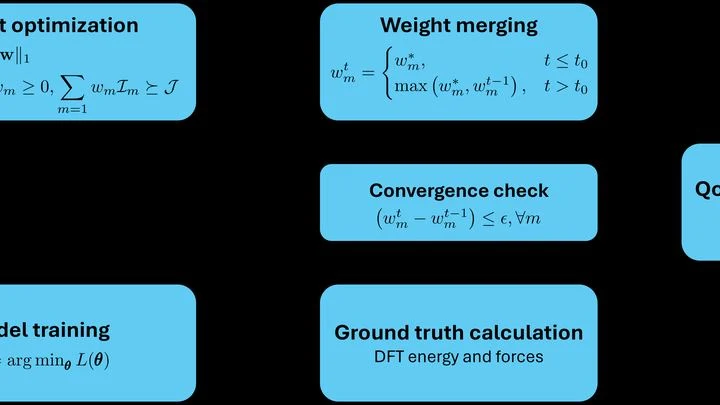
A chef doesn't waste ingredients cooking the whole dish to check the taste: they just taste a drop of sauce. The same logic underlies the "information matching" method for predicting metal strength. Instead of expensive calculations of every atom's behavior, scientists "taste" only simple indicators linked to plasticity — a metal's ability to bend without breaking.
A person looks at a door lock and sees a keyhole. They know that a key is inserted and turned. But if instead of a keyhole there's a touch panel, the familiar frame breaks. The person doesn't just make a mistake: they realize that the usual approach won't work and can say, "There's no place for a key here; a different approach is needed."
Such an honest stop with an explanation is rare for machines.
The quantum world does not like being pinned down to exact numbers. Physicists usually expand a complex interaction into a long series, like a sum of ever-smaller corrections.
No one has ever seen dark matter, but every galaxy feels its pull. Usually, it's pictured as a sea of identical, silent particles. The new work paints a livelier picture: two kinds of particles, heavy and light, constantly exchanging between them.
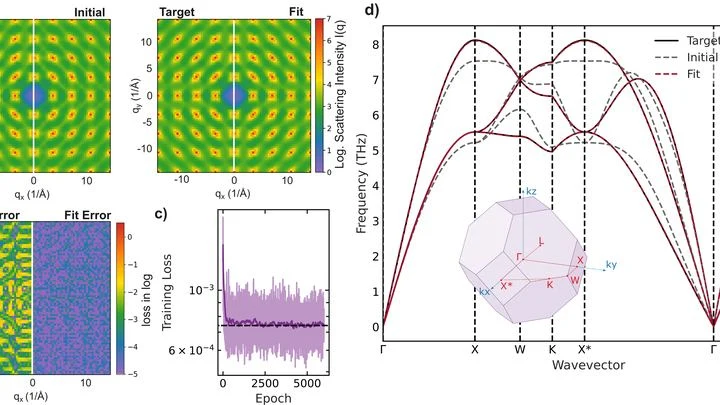
Heat a crystal, and its atoms start to jiggle like plucked strings. An X-ray beam passing through the crystal scatters off these vibrations, painting on the detector not only sharp spots but also faint, smeared patterns. These patterns are like fingerprints: from them, you can reconstruct how strongly atoms pull and push on each other.
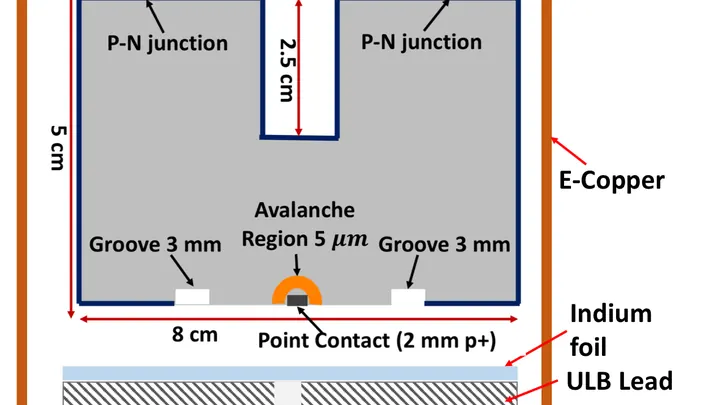
In an ultra-pure germanium crystal cooled to near absolute zero, a single electron can trigger a whole avalanche of charges, like a small pebble dislodged from a slope that sweeps down a stream of snow. Such internal signal amplification is a dream for detectors of dark matter or rare decays.
To tell one protein from another, you need to describe its shape and composition. There are dozens of such descriptions: molecular length, charge, solubility. But not all are equally useful. A method called Differentiable Information Imbalance (DII) can pick out the most informative features while discarding the rest.
The proton is not a smooth ball but a tangle of smaller particles in constant motion. To peek inside, physicists fire electrons at protons and watch how they bounce off. The new machine, the Electron-Ion Collider, will do this with unprecedented accuracy.
Scientists have run simulations to see what would happen if data were collected at different energies.
Ocean currents intertwine like sticky spider silk: every disturbance leaves a trace that does not vanish instantly. Climatologists have been used to treating random jolts in this web as invisible and memoryless, but new research shows that noise has memory, and that memory strengthens connections between distant nodes.
The ice cover of a river looks solid, but beneath it lie cracks that alter the flow. So it is with a time series: behind the smooth surface of numbers hide moments when the rules of the game change. These moments are called change points, and finding them is like tapping the ice to locate weak spots.