Nucleardecay is the process by which an unstable atomic nucleus spontaneously loses energy by emitting radiation, such as alpha particles, beta particles, gamma rays, or in rare cases, other particles. It is a fundamental phenomenon that drives radioactivity, powers stars, and shapes the composition of the universe. The concept is central to understanding the stability of matter, the energy released in nuclear reactions, and the behavior of cosmic rays, as highlighted in the provided articles. For instance, the 'knee' in cosmic ray spectra—where the flux of nuclei changes slope—is linked to how different nuclei decay or interact during their journey through space. Similarly, the decay of neutrinos, though hypothetical, is explored in the context of reconciling cosmological models with laboratory observations.
History
The concept of nucleardecay emerged from the discovery of radioactivity by Henri Becquerel in 1896, followed by the identification of alpha, beta, and gamma radiation by Ernest Rutherford and others in the early 1900s. The exponential decay law was formulated by Rutherford and Frederick Soddy in 1902, and the quantum mechanical explanation of alpha decay was provided by George Gamow in 1928.
How it works
Nucleardecay occurs because the nucleus is in a state of higher energy than a possible alternative configuration. Quantum mechanics allows the nucleus to tunnel through the energy barrier that separates it from a more stable state, even if classically it would be forbidden. The probability of decay per unit time is characterized by the half-life, which ranges from fractions of a second to billions of years. The decay process is governed by the weak nuclear force (for beta decay) and the strong nuclear force (for alpha decay), with the emitted particles carrying away the excess energy and angular momentum. In some cases, such as in the decay of a false vacuum in a ring of atoms, the process is analogous to quantum tunneling on a macroscopic scale, as described in the article about laboratory-created quantum decay.
In practice
Nucleardecay is used in radiometric dating (e.g., carbon-14 dating), medical imaging and therapy (e.g., PET scans and radiation treatment for cancer), and in nuclear power generation, where the decay of fission products contributes to the heat output of spent fuel.
Fun fact
The decay of a single nucleus is a random event, but for a large sample, the decay rate is so predictable that it serves as the basis for the most accurate timekeeping in the world—atomic clocks rely on the precise frequency of radiation emitted during certain nuclear transitions, not decay itself, but the same quantum principles apply.
Buried in Antarctic ice, there's a detector the size of a cubic kilometer. It doesn't catch light but ghostly particles — neutrinos. Yet sometimes, a different beast might flash through: a pair of muons born together and flying apart in a wide fan. No known particle of ordinary matter can paint that pattern.
Solar neutrinos are tiny particles born in the Sun's core by the trillions every second. They pass through Earth almost without noticing it, and for a long time they were considered absolutely stable. But perhaps they too can "age"—decaying imperceptibly, vanishing on their way to us.
Imagine an hourglass where the sand grains transform into other grains as they fall: that's what unstable atomic nuclei are like. They live for an instant and then decay, ejecting an electron (this is beta decay). In September 2025, theorists and experimentalists gathered under the FRIB Theory Alliance to discuss how to use such decays to probe the structure of matter.
The quantum vacuum is not a dead void but a boiling cauldron of probabilities. In some theories, our Universe is frozen in a metastable state: like superheated water, it's ready to explode into steam at the slightest nudge.
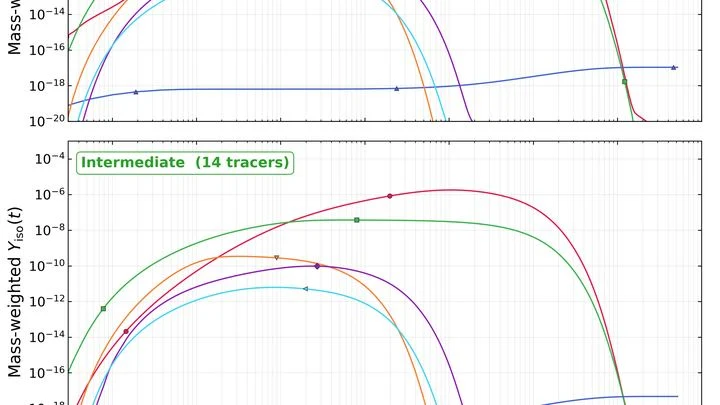
A collision of two neutron stars is a cosmic forge where the heaviest elements of the periodic table are hammered out in seconds. In 2017, detectors picked up gravitational waves from such a merger, and telescopes saw a flash — a kilonova.
An atomic nucleus is like a crowded bus. To free up space, a group of two protons and two neutrons — a helium nucleus, an alpha particle — exits through the front door: this is alpha decay, described by George Gamow as tunneling under an energy barrier.
An atomic nucleus usually follows its own rules: its decay doesn't care about temperature, pressure, or molecular neighbors. But the uranium-235m isotope is a striking exception. This nucleus sits in an excited state, like a tightly coiled spring, and sooner or later it releases the extra energy.
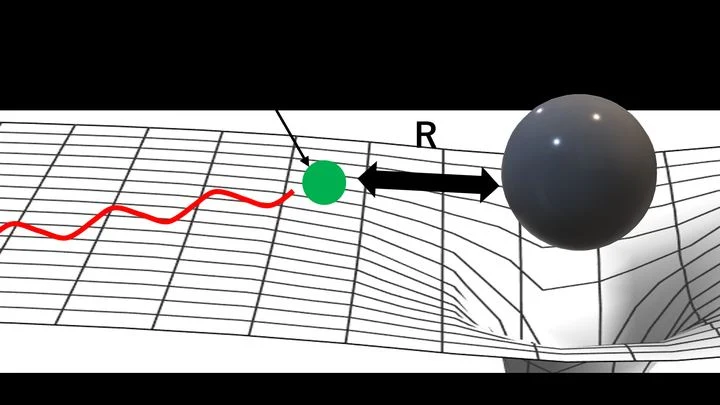
An atom excited by light gives its energy back in an instant — it emits a photon. This process is like a tired runner dropping a heavy load. But if the runner is on a mountain slope, it's harder to pick up speed. Gravity acts on the atom similarly: near a massive body, time flows slower, and the atom emits differently.
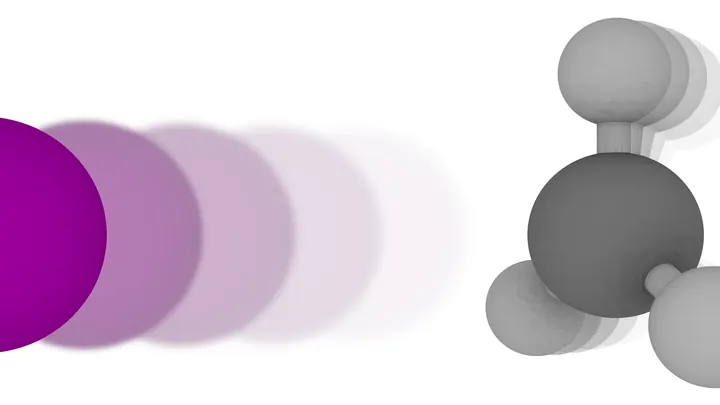
A chemical bond is like a stretched spring between atoms. When it's snapped, the molecular fragments fly apart, but they don't freeze: they keep vibrating, like a plucked string. That's exactly the vibration a team of researchers caught when they broke a methyl iodide molecule with an ultraviolet laser.
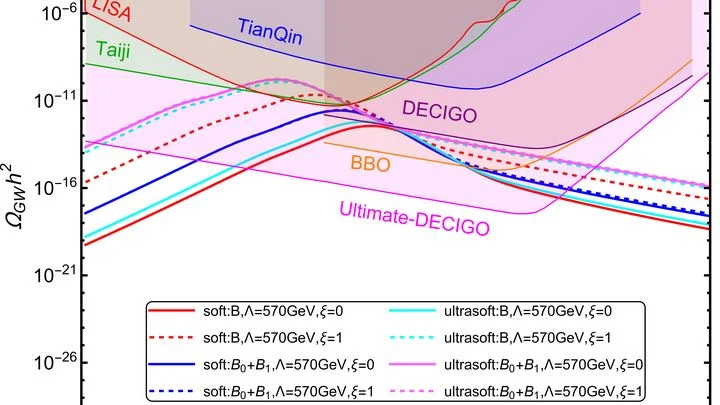
In the infant universe, right after the Big Bang, space was expanding rapidly, and the vacuum resembled a superheated liquid. When 'boiling' began, bubbles of true vacuum emerged. Expanding at the speed of light, they triggered gravitational waves — tremors of space itself that have reached us.
Our Universe may have arisen from a highly unstable state that physicists call the false vacuum. Imagine a glass of water cooled below its freezing point: the liquid remains liquid only until the first jolt, which instantly triggers crystallization into ice.
In the thirties, Pauli realized: without tiny ghost-like particles, the energy of stars doesn't add up. Thus neutrinos were born — intangible wanderers that permeate everything.
Cosmic rays are atomic nuclei accelerated to near-light speeds. They arrive at Earth from all directions, and their composition tells us what's happening in the far reaches of the Galaxy.
Cosmic rays are charged particles that fly to us from the depths of the Galaxy. If you plot how many particles arrive at each energy, the line runs smooth, then suddenly drops sharply.
High above Earth, a satellite flies, and inside it is an instrument the size of a small wardrobe. It catches particles that have been racing through the galaxy for billions of years and finally slam into the detector. Such particles are called cosmic rays, and they bring news of distant stellar explosions.