The Heart of a Neutron Star: How Particle Partners Change Its Temperature express
A neutron star is the remnant of an exploded star, compressed to the size of a city. In its core, matter is packed so densely that a teaspoon of such material would weigh as much as a mountain. At such densities, as predicted by the theory of strong interactions, particles acquire 'twins'—parity partners. It's as if every resident of a city suddenly had a twin with the same habits but mirrored.
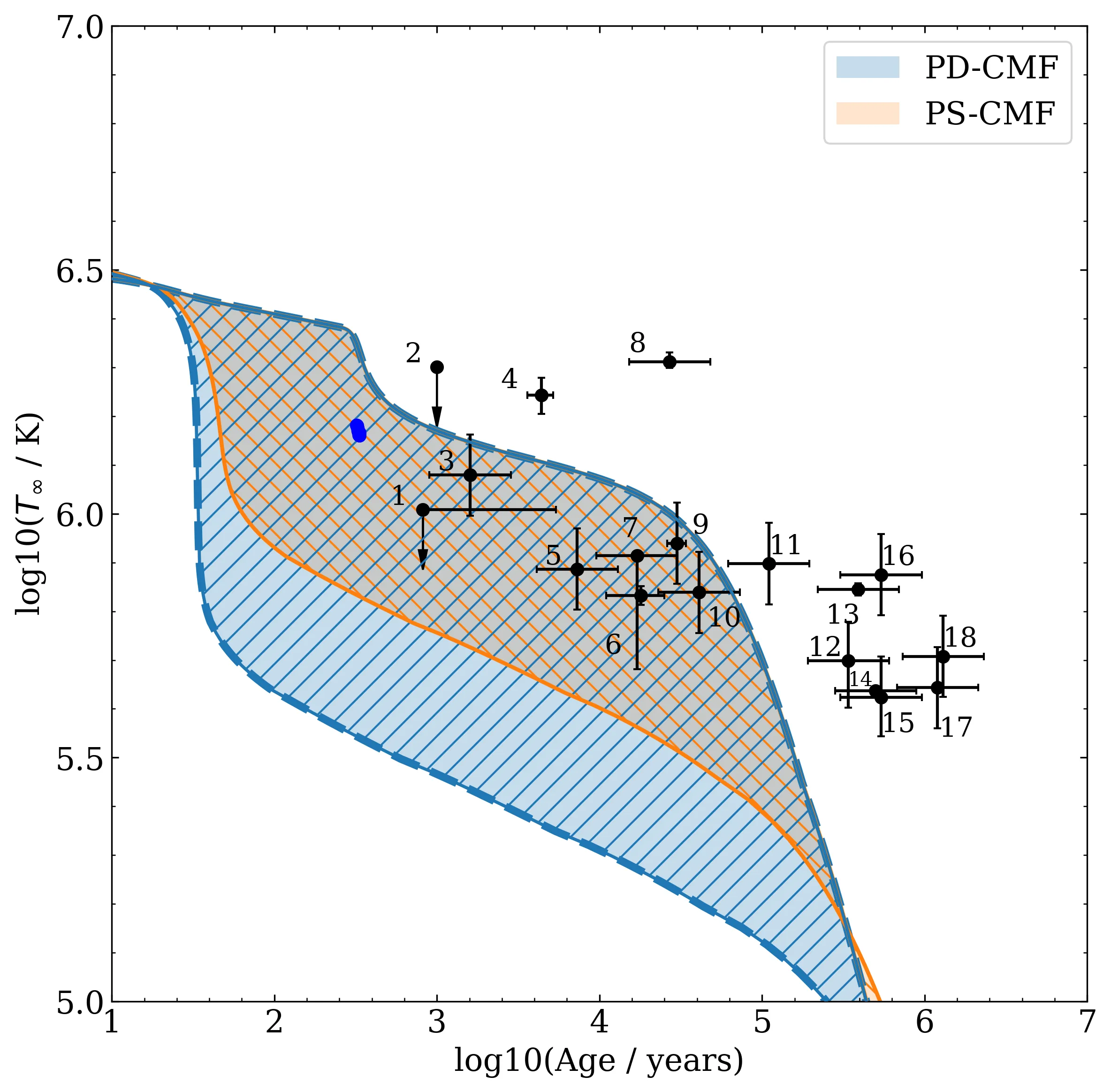
For the first time, scientists have included these twins in calculations of how a neutron star cools. It turns out that the twins participate in special reactions that carry heat away from the core, like an open window drawing warm air out of a room. For massive stars, this dramatically changes the picture: they cool faster than previously thought.
The new calculations match observations better: the temperatures and ages of real neutron stars are now explained more accurately. This means that particle twins may indeed exist in the depths of such stars. And it's a step toward understanding the densest matter in the universe.
Original abstract
as written by the authors arXiv:2603.06789
Although restoration of chiral symmetry is predicted by quantum chromodynamics to take place at high baryon density, most modeling of neutron star interiors disregards a chiral phase transition. We model neutron star cores with a parity doublet model, which allows for dynamical chiral symmetry restoration and predicts the appearance of the parity partners of nucleons and hyperons at large densities, as well as deconfined quark matter. We study the thermal evolution of neutron stars, focusing for the first time on the impact of Urca processes involving the parity partners in neutron star cooling simulations. We find that Urca processes for the parity partners of the nucleons significantly affect the thermal evolution of massive stars and allow for improved agreement with observed surface temperature and ages.
A neutron star the size of a city can weigh more than the Sun, and its temperature in youth reaches a billion degrees, like at the moment of the Big Bang.
In Bruce Sterling's novel 'Schismatrix', neutron stars and exotic matter play a key role in interstellar politics.