A massive star is a star with a mass significantly greater than the Sun's — typically more than 8 solar masses. These stars are the cosmic engines that forge heavy elements, and their lives are dramatically shorter than those of lighter stars. A massive star burns through its nuclear fuel at a furious rate, living only a few million years compared to the Sun's 10-billion-year lifespan. Their high internal pressures and temperatures allow them to fuse elements all the way up to iron in their cores, and when they can no longer sustain fusion, they collapse and explode as supernovae.
History
The concept that stars have different masses and that massive ones end in supernovae was developed in the early 20th century. The term 'massive star' came into common use in the 1950s as stellar evolution models matured, particularly through the work of Fred Hoyle and others on nucleosynthesis.
How it works
Massive stars generate energy through a sequence of nuclear fusion reactions in their cores, starting with hydrogen and progressing through helium, carbon, neon, oxygen, and silicon. Each stage produces heavier elements and releases energy, but the process becomes less efficient as the atomic number increases. When the core reaches iron, fusion no longer releases energy — it consumes it. The core then collapses under its own gravity in less than a second, triggering a shockwave that tears the star apart in a supernova explosion, leaving behind a neutron star or black hole.
In practice
Massive stars are natural laboratories for studying extreme physics, and their supernova explosions are used as standard candles to measure cosmic distances. They also produce the heavy elements that make up planets and life, and their remnants — neutron stars and black holes — are key targets for gravitational wave observatories.
Fun fact
The most massive known star, R136a1, has about 265 times the mass of the Sun and is so luminous that it would strip away the atmosphere of any planet within a few light-years.
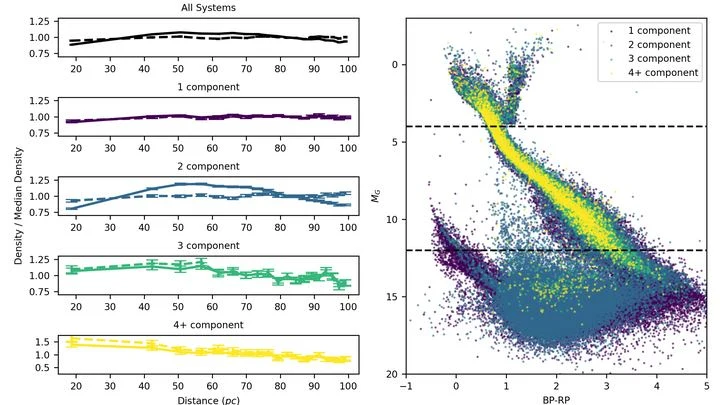
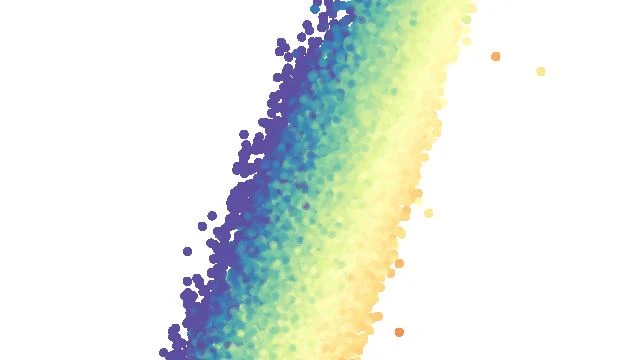
The most massive stars are like overinflated balloons: their envelope stops stretching and instead begins to furiously vent material. At a certain stage, the mass loss becomes so intense that the star stops growing in size. Astronomers see this moment as a kink in the diagram where stars are sorted by luminosity and temperature.
Eight hundred million years after the Big Bang, and at the heart of a young galaxy a monstrous engine is already throbbing. A black hole with a mass of ten billion suns devours matter so greedily that its radiation should outshine everything around it. But outside, silence.
In the quiet of cold molecular clouds, where interstellar gas under gravity condenses into dense clumps, the birth of massive stars is one of the great puzzles of astrophysics.
In a giant cosmic cradle, the Tarantula Nebula, astronomers took a close look at 122 massive stars, each at least 30 times heavier than the Sun. They measured the nitrogen abundance in their atmospheres, and the picture turned out to be unexpected.
For years, the Sun teased astrophysicists. In its atmosphere, refractory elements, like spices in a basic recipe, were slightly less abundant than in nearly identical twin stars. Suspicion arose: could our star be modest, skipping the planetary "dessert" that others devour with gusto?
Massive stars are cosmic titans, living under the sign of indomitable energy. When such a star enters the B[e] supergiant phase, its radiation is so powerful that it would seemingly pulverize any molecule into atoms. The spectral lines, once systematized by Johann Balmer, blaze here with particular fury.
The standard cosmological model ΛCDM, where dark matter and dark energy act as the chief architects of the cosmos, has predicted astronomical data with Swiss-watch precision for decades. Its foundation was laid by three geniuses.
The birth of planets resembles the workings of a cosmic forge. Rocky blocks collide and fuse together. A powerful impact strikes a spark — material heats to white-hot and glows like cooling metal. Computer simulations show: the flash is visible from days to years, peaking at a tenth of the sun's light.
The galaxy NGC 1277 is like an old book that no one has opened for billions of years. It formed quickly at the dawn of the Universe and has barely changed since — no collisions with neighbors, no new layers added.
On the periphery of the Solar System lurk thousands of objects comparable in size to an exoplanet — a body of planetary mass not bound to our star. Their orbits are chaotic, and from time to time the trajectory of such a wanderer crosses Earth's path.
Picture a tightrope walker balancing over an abyss. Every step changes the rope's tension, and the slightest shift in center of gravity can prove fatal. That's roughly what the dance of an ordinary sun-like star around a black hole of ten solar masses looks like when the orbit is highly elongated.
In an orchestra, each musician plays their own part, but at a certain moment all instruments pause on a single note. Cosmic rays behave somewhat like this — particles flying toward us from distant stars.
Black holes come in two types: tiny ones — the remnants of supernova explosions, and giants in the cores of galaxies. But where are the intermediate ones, with hundreds and thousands of solar masses? The answer may lie in star swarms, where black holes collide like balls on a billiard table and, merging, bulk up.
Two lamps in a shop window: one glows with a cool, bluish light, the other a bit warmer and yellower. That's roughly how the two types of supernovae, Ib and Ic, look when astronomers view them through a telescope.
Stars tens of times heavier than our Sun don't die as thought before. Computer models show that their core often doesn't ignite a supernova, but quickly collapses into a black hole. Imagine a soufflé: the center suddenly sinks, and almost all the batter falls into the funnel, with just a few drops splashing out.
In the early Universe, star clusters were so dense that they gave birth to giants the size of the Solar System. If such a giant had taken the place of the Sun, its edge would have reached as far as Jupiter. These stars sometimes swallowed small black holes. The black hole would sink into the core and begin to grow, turning the star into a ghostly glow — a quasi-star.
The light from two galaxies, caught by the James Webb telescope, traveled 13 billion years to us, beginning just 600 million years after the Big Bang. Breaking this light into colors (spectral analysis), astronomers saw not just distant galaxies but true lighthouses: within them blazed giant stars.
In a vast dark hall, someone invisible plucks the strings. The cosmic gas, the tenuous hydrogen that filled the young universe, resembles stretched strings that can resonate at a radio wavelength of 21 centimeters. This is hydrogen whispering about its temperature.
A stream of scorching gas races away from a star, and suddenly stalls, as if it hit an invisible wall. That's exactly what researchers saw when they tried to reproduce a stellar eruption on a laboratory scale. They used a laser to create a plasma jet and shot it through a magnetic field — first weak, then strong, like that of many stars.
A baker adds more sugar to the dough, and the pie turns out different. So it is with a star: the composition of its "dough"—the cloud of gas and dust from which planets are born — determines what worlds will form around it.
Two very small, cool stars, similar to the famous TRAPPIST-1, reside in the young Upper Scorpius star cluster. They are only 5–10 million years old — by cosmic standards, mere infants. Each is surrounded by a disk of gas and dust from which planets may eventually assemble.
Light from a distant quasar, the bright core of a galaxy, passes by a massive galaxy and bends, like a flashlight beam through uneven glass. If the lens and source align almost perfectly, we see not one quasar but several copies.
Ancient stars, nearly devoid of heavy elements, are like fossilized remnants of the first cosmic flashes. For a long time, the odd ratio of carbon, hydrogen, and helium in three such stars was thought to require a hypernova — an ultra-bright supernova with hundreds of times more energy than a regular one.
Deep inside a massive star, before it explodes, layers sit on top of each other like the layers of an onion. Sometimes two adjacent layers, the carbon and oxygen layers, mix together. It's like how layers of broth and vegetables in a pot of soup blend when you stir them with a spoon.
Every molecule is like a set of building blocks: the same pieces can be assembled in different ways. Two assemblies with the same atoms but different geometry are called isomers. If one can be turned into the other by a simple rotation around a bond, they are conformers, like a bent arm versus a straight one.
In its youth, Earth resembled a beehive: it grew by sticking together from countless rocky chunks. When the main construction was over, a late swarm of meteorites rained down on the young planet — the so-called late veneer. These impacts, scientists thought, brought platinum, gold, and other rare metals to Earth's upper layers.
In the southern sky, the star Acrux shines brightly — the lowest point of the Southern Cross constellation. It is not a single star but a whole family. New observations revealed that it contains not five, but seven stars bound by gravity, like children holding hands in a circle dance.
The light of every star is its unique passport, but the entries are written in the language of spectra and colors. For old giants, such documents are almost indistinguishable: their spectra overlap, and deciphering the details by hand was practically impossible.
Black holes heavier than a trillion Suns act like cosmic umbrellas. They cast a shadow on the faint afterglow of the Big Bang — ancient light that fills the entire sky. The shadow turns out not blurred, but with a sharp edge, as if cut out with scissors: around it glows a bright ring of photons trapped by gravity.
Two spotlights placed side by side: from a distance, their light blends into one patch, and it seems there's a single source. The same happens in space: about 10–20% of faint stars are actually close pairs of identical stars. Individually, they can't be resolved, but together they shine noticeably brighter than a single star with the same parameters.
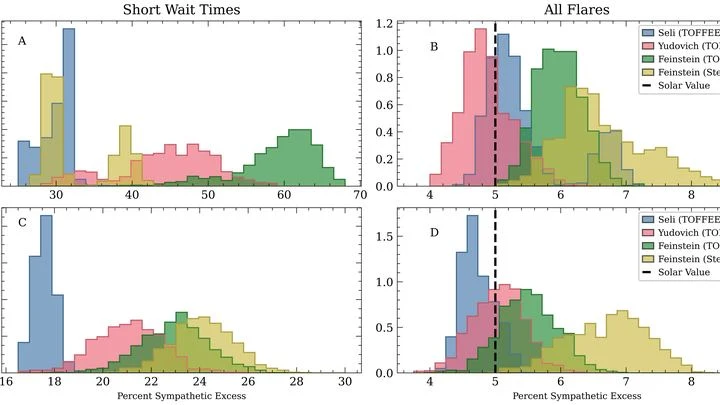
The Sun occasionally produces flares — powerful bursts of energy that last from minutes to hours. Most are random, like raindrops hitting a roof. But sometimes one flare seems to ignite another: the second begins almost immediately after the first, even though they occur in different locations. Astronomers call these sympathetic flares.
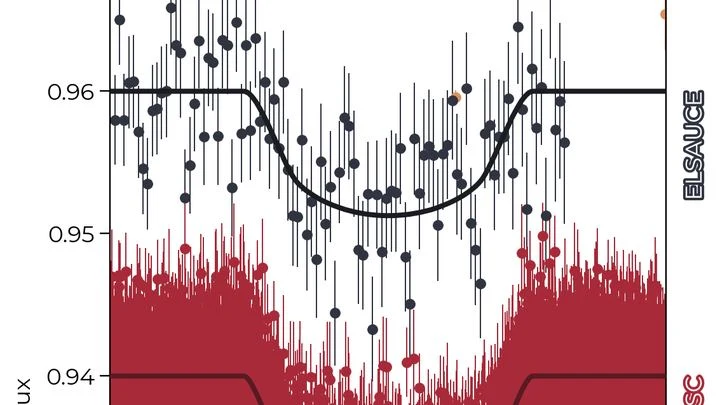
NASA's TESS space telescope monitors thousands of stars, catching the moment when a planet crosses its star's disk — the star's light dims slightly. That's how astronomers spotted two planets orbiting stars similar to our Sun. One, TOI-883 b, completes an orbit in ten days; the other, TOI-899 b, takes nearly thirteen.
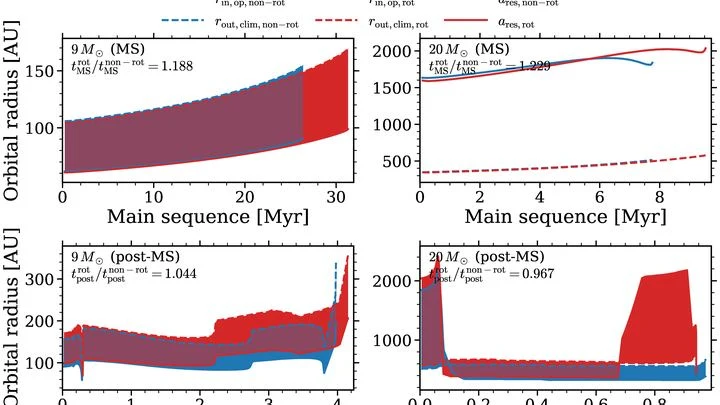
A star nine times heavier than the Sun ignites a zone around it where liquid water could slosh on a planet's surface. But this zone is like a narrow strip of beach at low tide: it will vanish in 30 million years. Such stars live bright and die young, leaving life no time for the long journey from microbes to complex beings.
The galaxy CEERS2-588 flared up like a bonfire fed with an armful of wood all at once. Just 400 million years after the Big Bang, it had already built up a mass of a billion suns and ignited countless stars. But then the fuel ran out, and over the last 10 million years, star formation in it has almost completely ceased.
Two stars circle each other like a pair of figure skaters on ice. Both resemble the Sun, but one shines brighter and has puffed up, while the other remains compact. Astronomers peered into their light using spectrographs, instruments that split light into colors, and found something odd: one star is clearly poorer in heavy elements than the other.
In the Large Magellanic Cloud, a galaxy that orbits our Milky Way, astronomers have caught five stars that look like fossils from the very distant past. They contain almost no metals, only one-hundredth to one-thousandth of what the Sun has, but they have tens of times more carbon.
A red giant is like a balloon slowly letting out gas. The star swells, its outer layers weaken, and stellar wind carries mass into space. But exactly how much does a star lose? This is a crucial question: the answer determines what kind of remnant it will leave behind — a white dwarf, a neutron star, or a black hole.
Astronomers pointed the James Webb at three galaxies whose light traveled 12 billion years. Early data pointed to incredibly fast growth — like an infant reaching adult height in just a year, clashing with the expansion of the Universe.
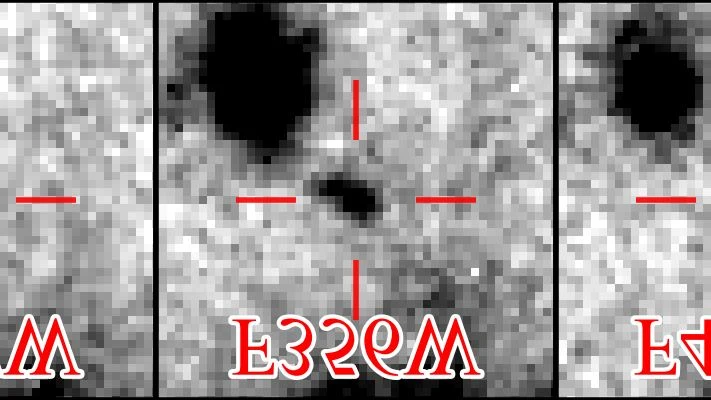
In 2014, astronomers spotted a massive yellow star in the Andromeda galaxy. By 2022, it had vanished without a trace — without the usual blinding explosion of a supernova. It was as if someone simply switched off the light.
Some stars fizzle out like a dud firework: instead of a bright blast, just a cloud of smoke. Usually, a massive star ends with a supernova explosion, leaving a black hole. But sometimes there's no bang: the star collapses straight into a black hole, almost unnoticed.