Soft Particles Assemble into Patterns express
A drop of water with tiny particles dries on a table. The water evaporates, leaving the particles behind, and they arrange into a pattern, like sand after the tide. But if the particles are soft, the pattern turns out quite different. Researchers studied this process under a microscope, varying only one property of the particles: their elasticity.
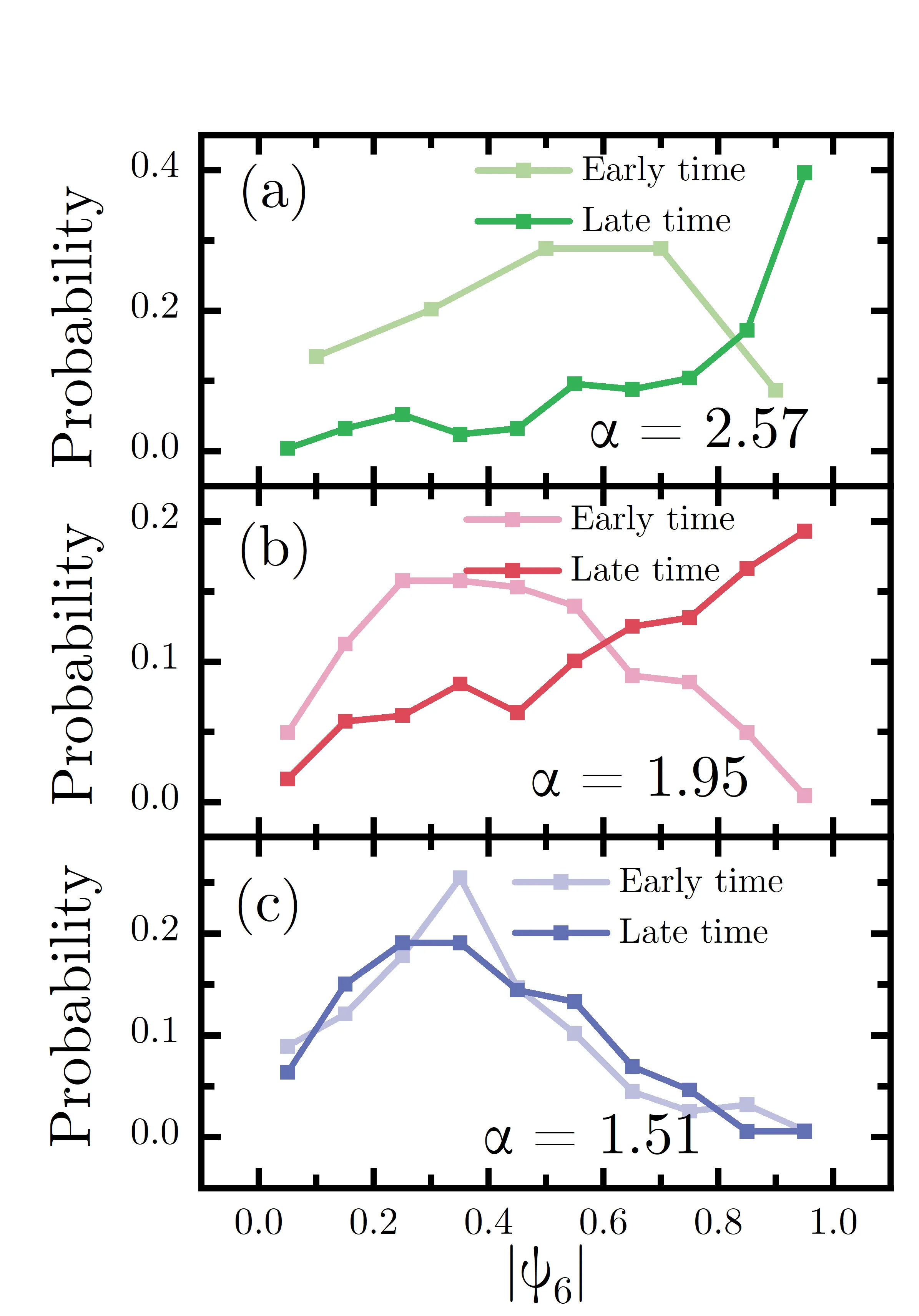
Stiff particles, like billiard balls, repel each other and assemble into a regular lattice — a crystal. Soft particles, like cushions, flatten upon contact and start sticking to each other. Then, instead of a crystal, a gel forms — a loose network of stuck-together clumps, with voids and uneven aggregates. Between these extremes lie intermediate states: isolated islands, holes, elongated chains.
To verify their observations, the authors built a computer model that accounted for four forces: hydrophobicity, capillary attraction, repulsion upon compression, and magnet-like interaction. The model reproduced all the observed patterns. The conclusion is simple: particle elasticity is the main lever for controlling colloidal assembly on a liquid surface.
Original abstract
as written by the authors arXiv:2603.07355
We study the self-assembly of colloidal microgel particles at a quasi-two-dimensional air-water interface of a drying droplet. Using bright-field microscopy, we demonstrate that increasing particle elasticity drives interfacial organization from repulsion-stabilized crystallization to attraction-dominated gelation, via diverse metastable structures including clusters, voids and anisotropic aggregates. Molecular dynamics simulations using an effective potential that captures the interplay between hydrophobic, capillary, steric and dipolar interactions, reproduce the overall phenomenology of the observed colloidal morphogenesis. Our findings establish particle elasticity as a key parameter governing non-equilibrium structural organization of colloids at an interface.
If you dry a drop of coffee on a saucer, a dark ring remains at the edge: that's also colloidal self-assembly, only there the particles are stiff and gather at the boundary.