Ice Is Slippery Because of Heat express
Ice slips away from under a skate blade like a bar of soap in wet hands. For a hundred years, scientists argued about where this slipperiness comes from. Some said there is already a thin layer of water on top: it acts as a lubricant. Others countered that water only appears when you start moving, due to friction. In a new study, physicists combined both approaches, and found out who was right.
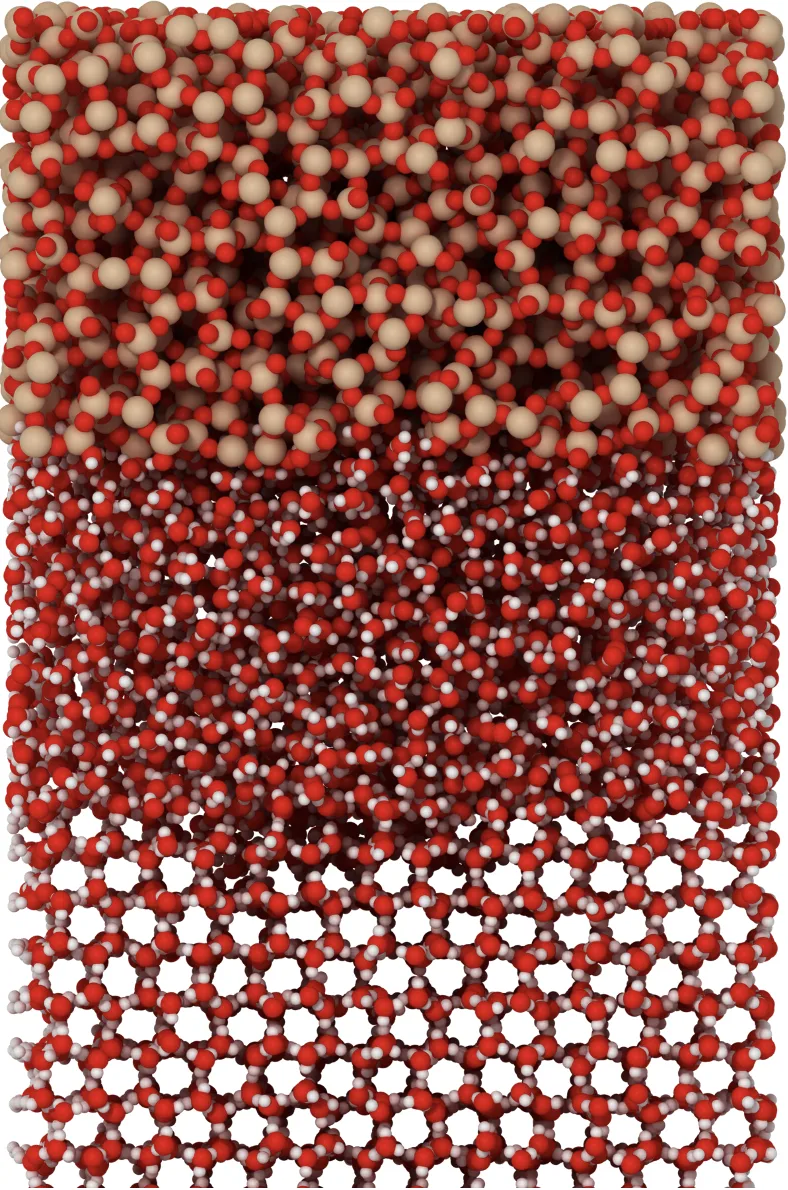
First, they built a computer model of ice sliding against glass at the level of individual atoms. The model showed that if you consider only nanoscale effects, friction comes out too high. So the researchers added what happens during real sliding, frictional heating, to the calculation. It turned out that even at a speed of just 0.1 meters per second, the temperature at the contact point jumps to nearly zero degrees Celsius — the melting point of ice. The ice begins to melt right under the skate blade or runner, and the water acts as a lubricant.
The calculations matched experimental data for a wide range of speeds — from slow sliding to fast skating. So the main secret of ice is not a pre-existing film, but the heat generated by motion. Ice lubricates itself when you start moving. It is as if the road melts under your feet just enough to let you keep gliding.
Original abstract
as written by the authors arXiv:2603.11539
The origin of ice's slipperiness has long puzzled scientists. To resolve this question, we simulate ice-glass (amorphous silica) friction at the nanoscale from first principles and upscale to the macroscale using a frictional heating model. We find that nanoscale simulations alone cannot capture the correct velocity dependence of ice friction, resulting in an overestimated coefficient of friction. By properly accounting for frictional heating, we find a strong increase in contact temperature toward the melting point, even under modest motion of 1 millimeter with velocities above 0.1 m/s, yielding excellent agreement with experimental friction data across a wide range of velocities. While the initial formation of a lubricating film on ice may occur without heating, the ultimate slipperiness of ice hinges on frictional heating, as proposed by Bowden and Hughes in 1939, but without incorporating melting.
Under the pressure of a skate blade, ice melts not because of pressure but because of frictional heat: the temperature at the contact point rises to zero degrees Celsius even during slow motion.