The Synchronous Dance of Quantum Tops express
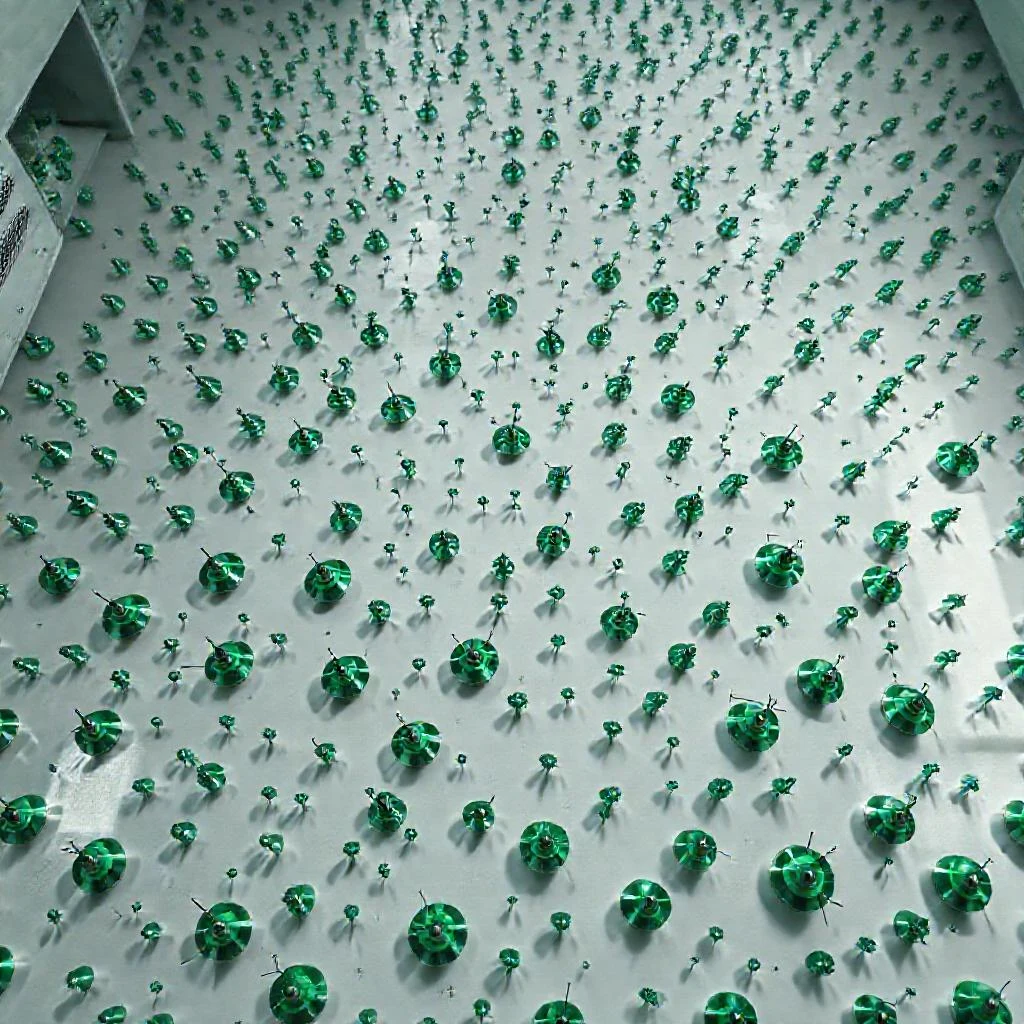
Physicists took 28 quantum tops, particles with intrinsic spin, and ran a cyclic process on a quantum computer predicted by Werner Heisenberg nearly a century ago. At first, each top spun however it pleased. But after a few cycles, their wobbles aligned: without any external force, they whirled in unison — order emerged from disorder.
The secret to synchronization is a hidden symmetry, reminiscent of a rule that lets tops spin in any direction yet still "agree." Once the symmetry was broken, the collective dance fell apart. Thus, symmetry protects harmony in the quantum world — a principle that also pervades the standard model of particles.
But the real surprise came with 156 tops. With a small initial spread, all synchronized. But with a large spread, a quantum chimera formed: within small groups, tops spun together, while the rest remained disordered. It's like a crowd of pedestrians where some groups walk in step while others move chaotically, even though the rules of movement are the same for all. Such a mix of order and chaos has been seen before in lasers and chemical reactions, but at the quantum level, it paves the way for ultra-stable devices.
Original abstract
as written by the authors arXiv:2603.11910
Synchronization is a hallmark of collective behavior in classical nonlinear systems, yet its realization as a robust many-body phenomenon in coherent quantum systems remains largely unexplored. Here we demonstrate symmetry-protected quantum synchronization and a quantum chimera state in coherent Floquet dynamics on programmable superconducting quantum processors. By implementing stroboscopic evolution of a two-dimensional Heisenberg model on IBM heavy-hex devices, we observe that initially phase-randomized spins spontaneously self-organize into coherent lattice-wide oscillations. On 28 qubits, synchronization persists even for strongly randomized initial states and is stabilized by SU(2) symmetry, as confirmed by explicit symmetry breaking. Scaling up to 156 qubits reveals a qualitatively distinct regime. For weak initial randomness, global synchronization extends across the device. For strong randomness, the system fails to synchronize globally, yet subsets of qubits exhibit robust local phase coherence under homogeneous unitary dynamics. This coexistence of globally desynchronized and locally synchronized regions constitutes a quantum analogue of a classical chimera state. Statevector and matrix-product-state simulations reproduce both the symmetry-protected synchronization and the chimera coexistence, demonstrating that these phenomena arise from the intrinsic Floquet many-body dynamics. Our results establish symmetry-protected synchronization and quantum chimera states as experimentally accessible nonequilibrium dynamical phases in programable many-body quantum systems.
Chimera states, a blend of order and chaos, were long considered a curiosity, but were later found in chemical reactions, lasers, and even pedestrian behavior.
In Peter Watts' 'Blindsight,' the collective mind resembles a quantum chimera: its parts act independently but form a unified whole.