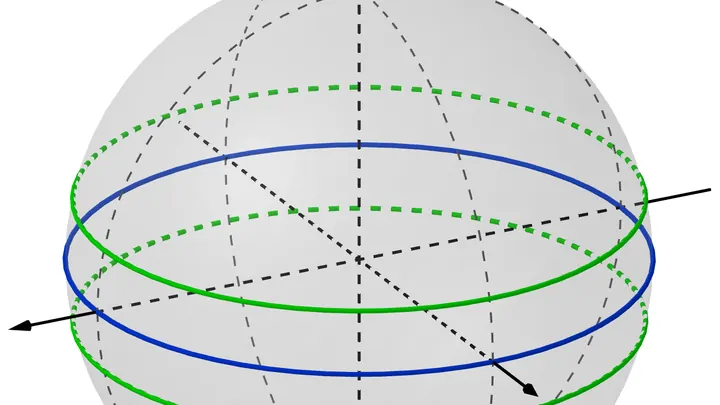
Symmetry principles are fundamental to quantum mechanics, governing conservation laws and selection rules. In quantum dynamics, symmetries dictate which transitions are allowed and how quantum states evolve. They also play a crucial role in understanding decoherence—the loss of quantum coherence due to interactions with the environment. Symmetry can protect quantum states from certain types of noise, a concept known as 'symmetry-protected coherence'.
History
The connection between symmetry and conservation laws was formalized by Emmy Noether in 1918. The application of symmetry to quantum decoherence and error correction developed in the 1990s with the work of Zanardi and Rasetti on decoherence-free subspaces.
How it works
A symmetry of the Hamiltonian (the operator that determines time evolution) implies a conserved quantity (Noether's theorem). For example, rotational symmetry leads to conservation of angular momentum. In decoherence, if the system-environment interaction has a symmetry, certain superposition states are immune to that noise channel. This is exploited in 'decoherence-free subspaces' where quantum information is encoded in symmetric states that are unaffected by collective noise.
In practice
Symmetry principles are used in designing quantum error correction codes, in understanding topological phases of matter, and in predicting selection rules in atomic and molecular spectroscopy.
Fun fact
The SO(8) symmetry, mentioned in one of the titles, is a special mathematical symmetry that appears in certain particle collision processes and is related to the unification of quarks and leptons in some grand unified theories.
Imagine a perfectly tuned orchestra, where every instrument is adjusted with flawless precision, trying to play in a noisy hall. That noise is quantum gravity — the microscopic ripples of spacetime. It constantly threatens to throw the musicians off.
A quantum computer is like an orchestra: each musician plays their own part, but the slightest noise from the audience can throw off the whole ensemble. The particles that store information easily lose their coherence from thermal jolts or stray magnetic fields.
Throw a stone into a pond, and ripples spread across the water. Throw two stones nearby, and the ripples intersect, creating a pattern of reinforced and canceled waves. That's interference.
Three twins on the run constantly change clothes. That's roughly how neutrinos behave — nearly elusive particles that pass through us by the trillions every second.
A candle flame flickers in a draft but doesn't go out — the tongue of fire briefly changes shape and then returns. Optical skyrmions behave much the same way — tiny vortices in a light beam, reminiscent of swirling eddies. Until recently, they were created only in the perfect, smooth light of a laser.
A handful of coins drops onto a table. While they spin, each can land heads or tails: that's quantum uncertainty. But once they settle, the picture becomes definite, classical. That's roughly how noise destroys quantum order, turning it into ordinary disorder.
Physicists took 28 quantum tops, particles with intrinsic spin, and ran a cyclic process on a quantum computer predicted by Werner Heisenberg nearly a century ago. At first, each top spun however it pleased.
Dark matter makes up 85% of the matter in the Universe, yet remains invisible. It only reveals itself through gravity. We can catch it by its cosmic 'hum' — a faint vibration that permeates space. A single detector is powerless here: the signal is too quiet.
Physicists turn many sensors into a quantum ensemble.
In a chain of cold spins stretched along a single line, order and disorder can intertwine into a pattern that defies the usual rules. Two states of matter, two kinds of "order," are separated by a crossroads where the roads do not converge but diverge.