Why Earth Is Getting Worse at Cooling Off ✛
A radiator in a room heats up, but if its surface is covered in dust, heat escapes poorly. Something similar is happening to our planet. Earth gets energy from the Sun and must release excess heat back into space, otherwise it gets hotter. A planet's ability to shed excess heat is called radiative feedback. The better it works, the more stable the climate.
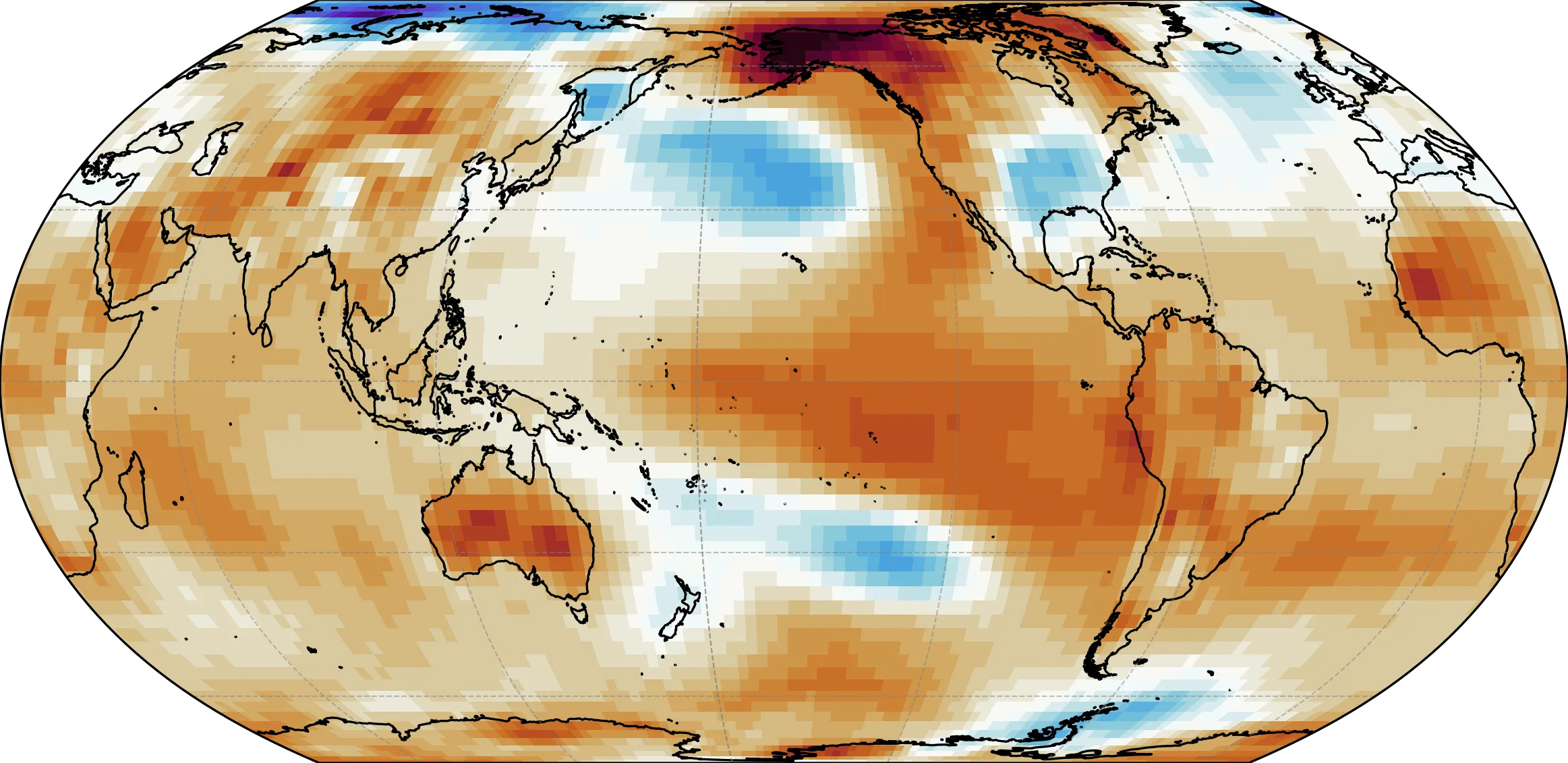
For years, scientists couldn't measure this ability for recent years because climate model runs ended around 2014. So they trained a computer program (a neural network) on model data to predict how well Earth loses heat from maps of surface temperature. Then they applied this program to real temperature observations up to 2025. It turned out that the feedback has weakened: in the 1990s it was about −3 W/m²/K, and now it's about −2 W/m²/K. This means that for the same amount of heating, the planet sheds less heat.
Now climatologists can monitor climate stability almost in real time, without waiting for new models. Previously, it was unclear what was happening after 2014, but now it's clear: the planet is getting worse at shedding heat, which accelerates warming. In the future, scientists will add sea ice data to the program to make predictions more accurate.
A neural network trained only on surface temperature was able to explain more than 80% of the variations in radiative response, even though it never saw clouds, ice, or atmospheric composition.