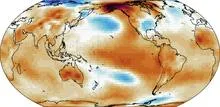
The preliminary version of NOAA's daily quarter-degree sea-surface temperature grid, available one day behind; the final version follows about two weeks later and revises the last days by a few hundredths.
About two weeks after the NRT product is released, a final version becomes available. This final version incorporates additional data, including more accurate satellite retrievals and in-situ measurements from ships and buoys that arrive late. It also applies improved corrections for known biases, such as those caused by volcanic aerosols or instrument drift. The final product revises the NRT temperatures by a few hundredths of a degree Celsius—a small amount, but significant for detecting long-term climate trends. The NRT version is essential for applications that need current data, such as weather forecasting and marine navigation, while the final version is used for climate research where precision is paramount.
History
NOAA's operational SST analysis began in the 1980s with coarse 1-degree resolution. The current quarter-degree product, known as OISST (Optimum Interpolation Sea Surface Temperature), was introduced in the early 2000s and has been continuously updated to incorporate new satellite sensors.
How it works
The SST maps are produced by blending satellite infrared and microwave measurements with in-situ observations. Infrared sensors (like VIIRS) provide high-resolution data but are blocked by clouds, while microwave sensors (like AMSR2) can see through clouds but have coarser resolution. The data assimilation system merges these sources, along with ship and buoy measurements, using optimal interpolation to fill gaps and produce a complete, smooth field. The NRT version uses only data available within a day, while the final version waits for delayed-mode data and applies additional quality control.
In practice
The NRT SST product is used to initialize weather models, track marine heatwaves, and support fisheries management, while the final version underpins climate monitoring and studies of ocean warming trends.
Fun fact
The difference between the NRT and final versions, though only a few hundredths of a degree, is large enough to affect the calculation of global average temperature trends, which are measured in tenths of a degree per decade.
For decades, global atmospheric models resembled artists forced to paint planetary storms with coarse brushstrokes: a resolution of 25–100 km forced them to 'guess' convection through approximate schemes, introducing systematic errors in rainfall and climate forecasts.
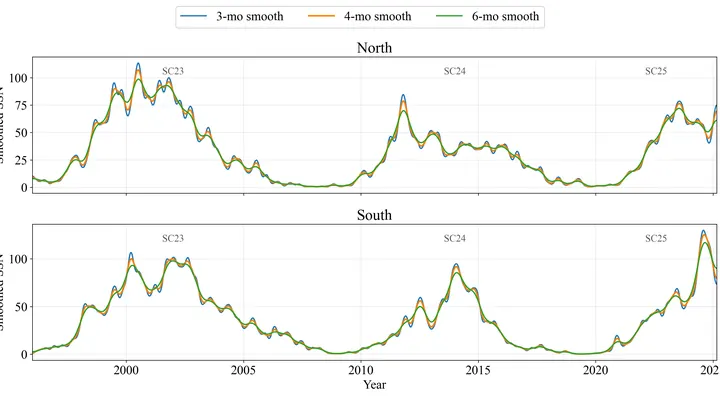
The Sun doesn't burn steadily: it erupts in series. Like a campfire that dies down and then suddenly throws out showers of sparks, these "fiery seasons" last from six months to a year and a half, and during them the star shows an unusually high number of sunspots.
When matter is heated to millions of degrees, it turns into plasma — a mix of free electrons and ions, like a boiling soup of charged particles. You can't measure the temperature of such a 'soup' with an ordinary thermometer, but you can shine X-rays through it.
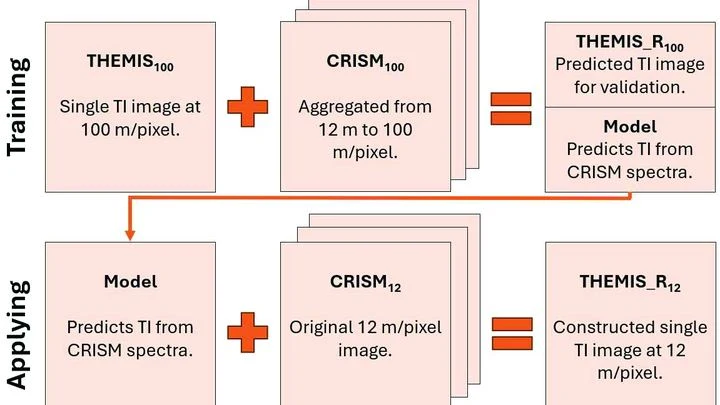
Warm rock and cold sand cool at different rates at night. An instrument orbiting Mars measures this heat, revealing whether the surface is loose dust, a dense crust, or solid rock. But thermal images have a resolution of 100 meters per point: an entire football stadium fits into a single pixel. Fine details (the beds of ancient streams, the edges of lava flows) are simply invisible.
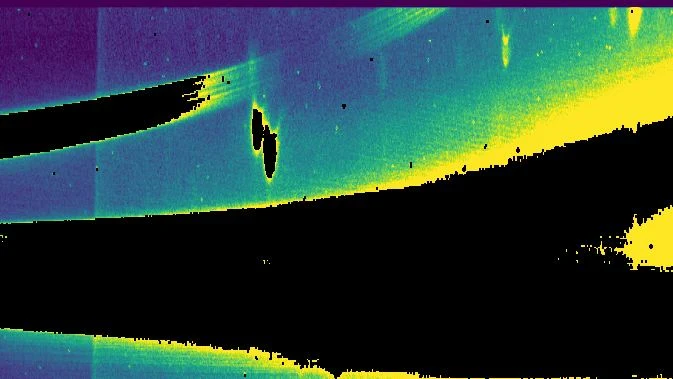
When an exoplanet briefly eclipses its star, starlight passes through its air and absorbs its chemical taste. This technique, the transit method, is the core of how the James Webb telescope works.
A neutron star is the dead core of a star that once exploded, compressed to the size of a city. If a normal star is nearby, the neutron star siphons matter from it like a vacuum cleaner. This matter falls onto the surface and forms a crust — a solid layer of neutron-rich atomic nuclei.
In 2023, the ocean off the coast of Peru warmed so much that fishermen came back empty-handed, while meteorologists argued over the strength of the upcoming El Niño. The sea surface temperature map they were looking at was the only one available, but how much could they trust it?
Imagine a radiator in a room: it heats up, but if its surface is clogged with dust, heat escapes less efficiently. Something similar is happening to our planet. Earth receives energy from the Sun and must radiate the excess back into space, otherwise temperatures rise. Scientists call this ability to shed excess heat radiative feedback.
A customs officer can't take a suitcase apart to see what's inside. They shine X-rays through it and, from the shadows on the screen, tell: here's metal, here's organic matter. In much the same way, an inspector for future nuclear disarmament treaties should be able to check a warhead — without opening it or seeing its secret internals.
Neutrons are better suited for this than X-rays.
A radiation sensor in the city is like a street musician: it has to hit the right notes even when fingers go numb from cold or the instrument is baked by the sun. Usually, such devices are kept in greenhouse conditions, with heating or cooling, otherwise the energy scale (which distinguishes harmless potassium in concrete from dangerous cesium) starts to lie.
In a meeting room, an interpreter listens not only to the speaker but to the entire buzz of voices, catching who is looking at whom and who falls silent before an important remark. That's how SEA-ViT reads the ocean: it sees not isolated points from buoys but the whole current field at once, like a single conversation of water.
In February 2022, the eastern coast of Australia was hit by rains that lasted several days in a row. Water inundated towns in Queensland and New South Wales, insurers paid out 3.35 billion dollars, and the flood became the costliest in the country's history.
A translator who gets distracted by every rustle in the room turns a one-hour meeting into two. That is how old statistical El Niño models worked: they picked out individual numbers from ocean maps but missed how a warm patch off Peru connects to a cool tongue near Australia. The new neural network behaves differently: it follows not every word but the meaning of the paragraph.
A fisherman in Queensland notices that in some years snapper are harder to catch, even though the nets and boat are the same. The reason hides not in the catch itself but in the water temperature several months earlier, when the fry were just hatching. A warm current arrived not for the whole year but only for a few weeks, and that short episode decided the fate of an entire fish generation.
An interpreter at an important negotiation keeps a draft of their speech at hand but checks against the live conversation as they go: if what is said diverges from the prepared text, they adjust the translation on the fly.
A gunner adjusts the eyepiece of a telescope: one more click, and the blurry blob becomes a crisp image. Climate scientists at the Institute of Atmospheric Physics, Chinese Academy of Sciences, made a similar adjustment to their model ICM.