The Climate Has Become Worse at Shedding Heat ✛
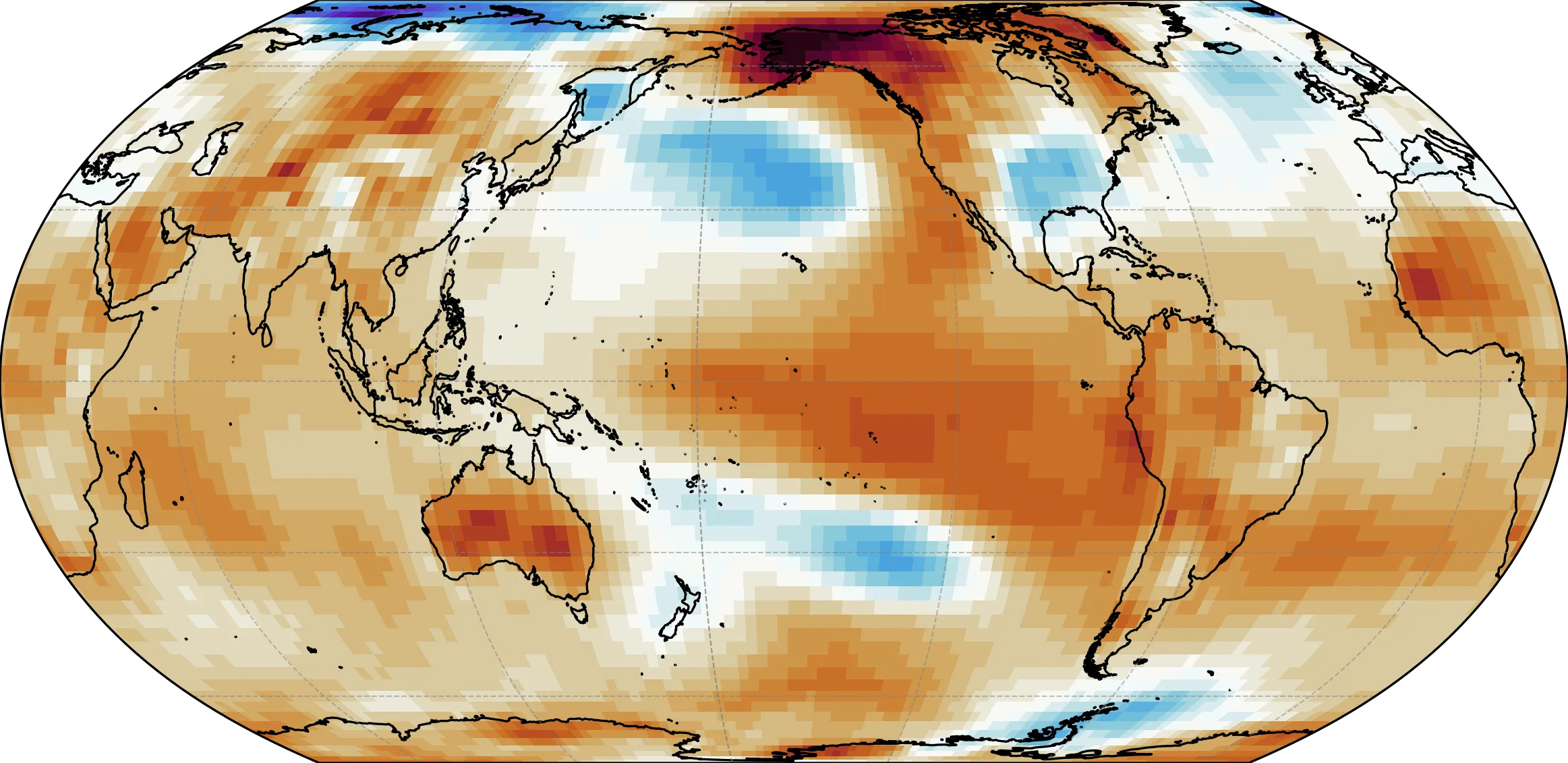
Imagine a radiator in a room: it heats up, but if its surface is clogged with dust, heat escapes less efficiently. Something similar is happening to our planet. Earth receives energy from the Sun and must radiate the excess back into space, otherwise temperatures rise. Scientists call this ability to shed excess heat radiative feedback. The stronger it is (that is, the more negative the number), the faster Earth cools when heated, and the more stable the climate.
For a long time, this parameter was estimated only from climate models, and calculations ended around 2014. But now researchers have trained a convolutional neural network on data from the CMIP5 and CMIP6 models to predict, from surface temperature maps, how effectively the planet loses heat. They then applied this network to seven observational datasets, including the ERA5, JRA-3Q, and MERRA-2 reanalyses, and temperature reconstructions from Berkeley Earth, HadCRUT5, NOAAGlobalTemp, and DCENT-I. The result is troubling: feedback has weakened.
It is as if the radiator has become worse at giving off heat: under the same heating, the planet now sheds less energy, and excess heat accumulates. The weakening is not significantly linked to El Niño or the Pacific Decadal Oscillation, so this is not just natural variability. The main culprit turned out to be warming in the subtropical northeastern Pacific. Using the SHAP method, scientists calculated that this region contributed about 30% to the overall weakening, and they confirmed this in targeted experiments with the E3SMv2 model.
Now climatologists have a tool that allows them to monitor climate stability almost in real time, without waiting for new model runs. Previously, it was unclear how feedback had changed after 2014, but now it is evident: the climate has become less stable. This is important for refining future warming projections and for early warning systems for climate shifts.
The radiator from the beginning now works less efficiently, and we are beginning to understand where the dust has accumulated. The next step is to add sea ice data to the network and check how land temperature affects the result. But already it is clear: the planet has become worse at shedding heat, and this changes our understanding of how fast warming will proceed.
A neural network trained only on surface temperature was able to explain more than 80% of the variations in radiative response, even though it never saw clouds, ice, or atmospheric composition.