Climate Has Become Worse at Shedding Heat ✛
Context
This work sits somewhat apart: nearby in the archive are studies on neutrinos and climate springs, but there are few direct topical neighbors. The closest works concern how climate gives an early signal and how the fourth spring of climate affects its stability. This is a measurement, not an opinion: the density of neighbors is low, and the thematic group points to leptons and neutrino oscillations, which only underscores the isolation of this paper in our archive.
Methods
The researchers trained a convolutional neural network on data from CMIP5 and CMIP6 climate models to predict the global radiative response from surface temperature maps. They then fine-tuned the network on experiments with prescribed ocean temperatures and applied it to seven observational datasets, including the reanalyses ERA5, JRA-3Q, MERRA-2, and the reconstructions Berkeley Earth, HadCRUT5, NOAAGlobalTemp, and DCENT-I. For attribution of individual regions' contributions, they used SHAP values.
Results
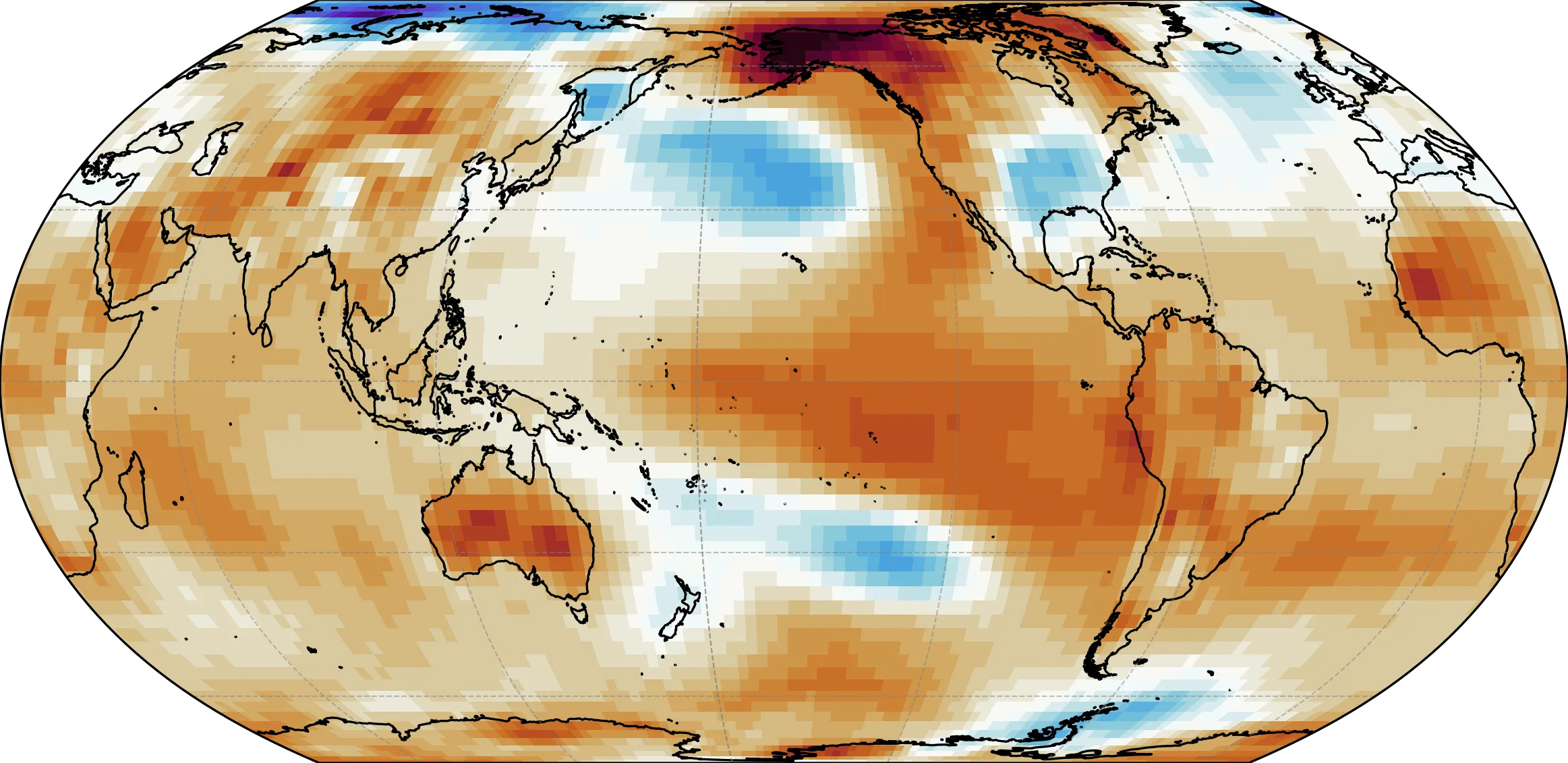
The feedback parameter reached a minimum around the mid-1990s, at about −3 W/m²/K, meaning maximum climate stability. By 2025, it had weakened to about −2 W/m²/K. The weakening is not significantly linked to El Niño or the Pacific Decadal Oscillation. Warming in the subtropical northeastern Pacific contributed about 30% to this weakening, confirmed by targeted experiments with the E3SMv2 model.
Implications
Unlike neighboring works that consider climate signals broadly or through other mechanisms, this paper is the first to apply machine learning to monitor global radiative feedback in near real time. It not only detects the trend but also breaks it down by region, showing that warming in the northeastern Pacific plays a key role. This provides a new tool for quickly assessing climate stability without waiting for new model runs.
Future development
The topic could evolve by incorporating additional predictors into the neural network, such as sea ice or aerosols, to improve prediction of shortwave radiation. A comparison with models where land temperature is fixed could test the causal role of continental surfaces. Also promising is training separate neural networks for different climate models to identify sources of inter-model spread.
Impact
The results will affect estimates of future warming and the interpretation of the recent acceleration in global temperature rise. They are also important for developing early warning systems for climate shifts.
Next steps
The next step will be to include sea ice data in the neural network and run experiments with fixed land temperature. They also plan to compare attribution maps across different temperature reconstructions to assess observational uncertainty.
Key open problems
This work directly addresses an unresolved problem in climatology: how much of the variation in radiative feedback is due to internal variability versus external forcing. It also touches on why models reproduce pattern effects differently and how regional ocean temperature changes govern global climate stability.
The knowledge machine's view
This section is addressed to the author of the paper and their colleagues. Neighbouring works were found by meaning-based search across our archive, not by word overlap. We do not review: we show the field around the work.
What the work does
The study applies a convolutional neural network trained on climate models to observational data to estimate the global radiative feedback. It shows that since the mid-1990s, the feedback parameter has weakened, with the main contribution coming from warming in the subtropical northeastern Pacific Ocean.
Where its strength is
The strength is that the method allows near-real-time tracking of global radiative feedback and its regional breakdown, without waiting for new model runs.
Where it could go next
- It might be interesting to see how the near-real-time method combines with approaches to predicting El Niño a year and a half ahead: this would allow testing how predictable regional feedback contributions are in advance.based on: El Niño Can Be Predicted a Year and a Half in Advance arXiv:2601.12251
- Related work on the 'fourth spring of climate' suggests that its mechanism could be considered as an additional factor affecting climate stability, and compared with the feedback weakening.based on: The Fourth Spring of Climate arXiv:2602.10369
- It would be interesting to compare with research on how Antarctica responds to carbon dioxide: this could provide insight into how radiative feedback relates to the long-term memory of ice sheets.based on: Ice Has a Memory: How Antarctica Responds to Carbon Dioxide arXiv:2601.06986
Worth trying
- Test whether the method can predict future changes in feedback using El Niño forecasts.
- Use data on the 'fourth spring' to check whether it explains part of the feedback weakening.
- Compare SHAP contribution maps with Antarctic CO2 sensitivity maps to look for common regional patterns.
Why this may matter
If the method can predict changes in feedback, it would enable early assessment of climate risks, and comparison with other mechanisms could reveal hidden connections in the climate system.
Nearby works in our archive
- The Fourth Spring of Climatesimilarity 0.56
- The Earth’s Neutrino Confession: IceCube Reads the Planet in the Language of Weak Interactionssimilarity 0.54
- Martian Weather, Earthly Playbooksimilarity 0.53
- Neutrino Tomography of Earth: A New Look at the Planet's Interiorsimilarity 0.53
- Ice Has a Memory: How Antarctica Responds to Carbon Dioxidesimilarity 0.53
- Earth Can Heat Itself Upsimilarity 0.52
- El Niño Can Be Predicted a Year and a Half in Advancesimilarity 0.52
The archive is sparse around this work: the closest review is only 0.56, against a usual 0.64. It looks like few have drilled nearby.
A neural network trained only on surface temperature was able to explain more than 80% of the variations in radiative response, even though it never saw clouds, ice, or atmospheric composition.
Key numbers
- minimum feedback in the 1990s: −3 W/m²/K
- weakening by 2025: −2 W/m²/K
- contribution of the northeastern Pacific: 0.33 W/m²/K
- explained variance of land temperature: 85%
- standard deviation across models: 0.43 W/m²/K