Tumor Memory: How Fractional Order Changes the Prognosis express
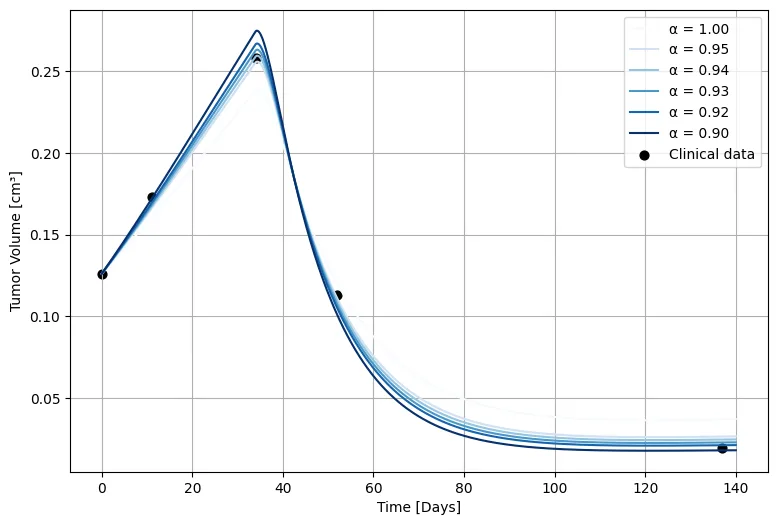
A tumor doesn't grow like a tree; it grows like a city: today's skyline is shaped by yesterday's construction and the fires of the day before. Standard tumor growth equations don't account for this: they only look at the current moment, as if the city were rebuilt from scratch every day. The authors added "memory" to the model: now the equation remembers what came before, and that changes the forecast.
Such memory is described by fractional derivatives — a mathematical tool that stretches the influence of the past into the present. Instead of an integer order (the usual derivative), a fractional order, less than one, is used. It's like viewing tumor growth through a lens that slightly blurs the past but doesn't erase it completely. The model was calibrated on data from five patients with real measurements of tumor volume.
The result: for all five patients, the fractional model matched observations more closely than the classical one. Each patient had their own optimal fractional order — some had longer memory, others shorter. This means that each person's tumor grows in its own way, and there is no universal equation.
The difference is visible in the graphs: the trajectories of the fractional and standard models diverge like two roads that run side by side at first, then one veers off. This isn't just a mathematical detail — the shape of the curve determines when a doctor notices dangerous growth and has time to intervene.
For now, this is only a first step. In the future, the model could be extended to account for treatment and uncertainty, and tested on hundreds of patients. But already it's clear: to understand how a tumor grows, you need to remember where it started.
Original abstract
as written by the authors arXiv:2603.14562
In this work, we investigate a fractional-order tumor growth model aimed at capturing memory effects and nonlocal temporal dynamics inherent to tumor evolution. The model is formulated using Caputo fractional derivatives and incorporates key biological mechanisms related to tumor growth, vascular interaction, and cell clearance. To numerically solve the resulting fractional differential equations, a second-order fractional Runge-Kutta scheme is derived based on a truncated fractional Taylor expansion, providing an accurate and stable computational framework. The proposed model is calibrated using experimental tumor volume data from five patients, and its performance is evaluated through the Root Mean Square Deviation (RMSD) between numerical simulations and experimental observations. The results show that, for all patients considered, the fractional-order model significantly improves the agreement with experimental data compared to the classical integer-order formulation. An optimal fractional order {\alpha} < 1 is identified in each case, highlighting the relevance of memory effects in tumor growth dynamics and their patient-specific nature. Further insight is obtained through phase-space and projection analyses, which reveal substantial geometric differences between integer-order and fractional-order dynamics. Although the present study is based on a limited number of patient datasets, the results demonstrate the potential of fractional-order modeling as a flexible and powerful framework for describing individualized tumor growth behavior. The proposed approach provides a solid basis for future extensions involving larger datasets, uncertainty quantification, and the incorporation of treatment effects and control strategies.
Fractional derivatives were invented back in 1695, when the mathematician L'Hôpital asked Leibniz what would happen if the order of a derivative were made half. Leibniz replied that it would lead to a paradox from which, someday, useful things would be drawn. Three centuries later, that "useful thing" is helping model tumor growth.