The time derivative is a mathematical operation that measures how quickly a quantity changes with respect to time. In physics, it appears everywhere: velocity is the time derivative of position, acceleration is the time derivative of velocity, and the rate of change of energy, momentum, or any other observable is expressed through its time derivative. It is the language of dynamics, encoding the rules of motion and evolution for physical systems.
History
The concept of the derivative was developed independently by Isaac Newton and Gottfried Wilhelm Leibniz in the late 17th century. Newton called it the 'fluxion' and used it in his laws of motion.
How it works
Formally, the time derivative of a function f(t) is defined as the limit of the ratio [f(t+Δt) − f(t)]/Δt as Δt approaches zero. This gives the instantaneous rate of change at a single moment. In practice, physicists use it in differential equations, such as Newton's second law (F = m·d²x/dt²) or the Schrödinger equation, where the time derivative of the quantum state determines how the state evolves.
In practice
Time derivatives are used in every simulation of physical systems, from predicting planetary orbits to modeling electrical circuits and weather patterns.
Fun fact
In quantum mechanics, the time derivative of an observable is not always simply the rate of change of its expectation value—it also involves the commutator with the Hamiltonian.
A crowd at the entrance to a narrow corridor behaves differently than in a spacious hall: some people get pressed against the walls, others are pushed forward. Roughly the same happens when an elongated particle finds itself in a fluid teeming with self-propelled dumbbells. Until now, it was unclear why such a particle moves faster along its long axis than across it, and how the crowd density affects its speed.
When a fluid flows around an obstacle, it spawns vortices and shock waves. Describing their behavior means solving a nonlinear equation in which the flow velocity depends on itself. Classical supercomputers spend days on this, while quantum computers have barely been used: their native language is linear operations, but fluids are inherently nonlinear.
When two neutron stars circle each other, they don't remain rigid spheres. The partner's gravity stretches each star, creating tidal bulges — much like the Moon raises ocean tides on Earth. But unlike water, here it's superdense matter that deforms: a teaspoon of this stuff weighs billions of tons.
A dance of hundreds of particles: some pairs spin slowly and gracefully, others twitch in a frantic rhythm. To understand the essence of the dance, you need to watch the slow movements: they are the main choreography of the system. In molecular science, such slow movements are called 'slow modes,' and they determine how a protein folds into a ball or how a drug binds to its target.
A crowd at a metro station during rush hour. Some hurry toward the escalator, others slow down at the departure board, still others weave around a column. Each step is not merely a reaction to what's right in front of your nose. A person estimates in advance where a neighbor will be a second from now and adjusts their route accordingly. Physicists call this forward-looking behavior anticipatory.
A flashlight beam travels straight into the dark: that's how we usually think of light. But near a massive body, like a star or a black hole, space is curved, and the beam bends smoothly, as if guided by an invisible hand. The authors of a new study have worked out exactly how gravity alters the familiar laws of electricity and magnetism.
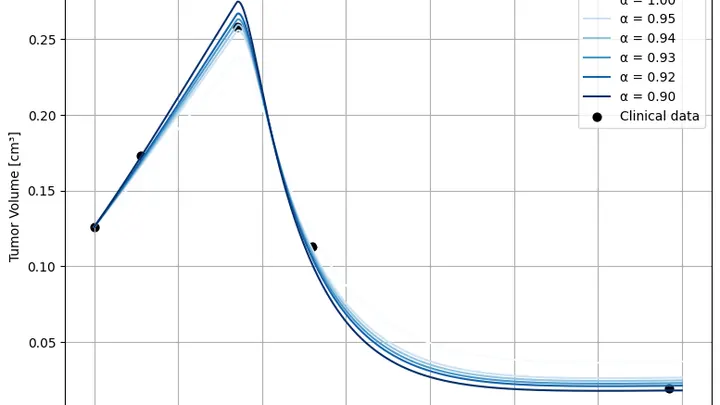
A tumor doesn't grow like a tree; it grows like a city: today's skyline is shaped by yesterday's construction and the fires of the day before. Standard tumor growth equations don't account for this: they only look at the current moment, as if the city were rebuilt from scratch every day. The authors added "memory" to the model: now the equation remembers what came before, and that changes the forecast.
A tiny particle floats in a laser beam like a speck of dust in a flashlight's glow. Water molecules constantly jostle it — randomly, from all sides. Usually these bumps are a nuisance: the particle twitches, and precise measurements turn into a lottery. But physicists have figured out how to turn the interference into an advantage.
Thick honey spreads slowly across a plate. In such a world, where friction suppresses inertia, motion is governed not by force but by viscosity. This is how many soft materials behave: polymer gels, colloidal suspensions, the contents of living cells.
When water churns behind a boat, the energy of motion is converted into heat through a cascade of vortices. Measuring how quickly this happens directly is difficult: you'd need to track all the vortices at once. So scientists use a simplification: they look at only one velocity component at a single point.
In a tropical forest, the dry season gives way to the rainy season, and with the weather, the rules of life change: some animals go into hibernation, while others come out of hiding. Likewise, in complex systems, from climate to economics, the links between processes are not set in stone. They depend on a hidden "regime" that itself switches from time to time.
The Galaxy is a forest where birds don't start singing right away. First, trees must grow — stars, around which planets eventually appear. The Drake equation counts how many birds might be singing in this forest right now, but it implicitly assumes that their number doesn't change: as many as there are, that's how many there have always been.