The logarithmic derivative of a function is the derivative of its natural logarithm, often written as f'(x)/f(x). It provides a measure of the relative rate of change of the function, independent of its overall scale. This makes it particularly useful in physics when dealing with quantities that vary over many orders of magnitude, such as in exponential growth or decay, or in the analysis of differential equations where the absolute value is less important than the rate of change relative to the current value.
History
The concept has been used implicitly since the early days of calculus, but it was formalized in the 19th century in the context of complex analysis and differential equations, particularly in the work of mathematicians like Cauchy and Riemann.
How it works
Given a function f(x), the logarithmic derivative is computed as d/dx [ln f(x)] = f'(x)/f(x). This operation simplifies products and powers: the logarithmic derivative of a product is the sum of the logarithmic derivatives of the factors, and for a power f(x)^n it is n times the logarithmic derivative of f(x). This property makes it a powerful tool for separating variables in differential equations and for analyzing the stability of solutions.
In practice
It appears in the analysis of radioactive decay, in the study of logarithmic potentials in electrostatics, and in the solution of linear differential equations in quantum mechanics and fluid dynamics.
Fun fact
In the theory of special functions, the logarithmic derivative of the gamma function is known as the digamma function, which appears in many areas of physics and statistics.
Two massive bodies frozen in a quantum superposition resemble a pair of dancers trying to keep a single rhythm while an orchestra blares around them. Each gravitational wave is a musician throwing them off beat.
Two charged spheres collided and flew apart in different directions. You'd think it was all over — but the light from their farewell still wanders through space. In the ordinary world, this is a well-known effect: an accelerated charge always radiates.
The Universe has a rate at which it expands — called the Hubble constant. The problem is that the two most precise ways to measure it give different numbers. One method, using the early light of the Universe (the cosmic microwave background), gives one value.
The shape of a riverbed precisely follows the equation describing the growth of a universe with negative curvature. In the lab, water flowing over sand spontaneously carves a cross-section that matches the solution for the Anti-de Sitter model.
A river tends toward a shape that maximizes bottom friction.
Previously, astronomers calculated galaxy mass as if they were perfect spheres. But a galaxy is a flat pancake. The new 'Lost and Found' model takes the actual shape into account: it sums up the gravitational pull from all parts of the disk, not just the central bulge. The result is stunning: many galaxies need a third less invisible dark matter than previously thought.
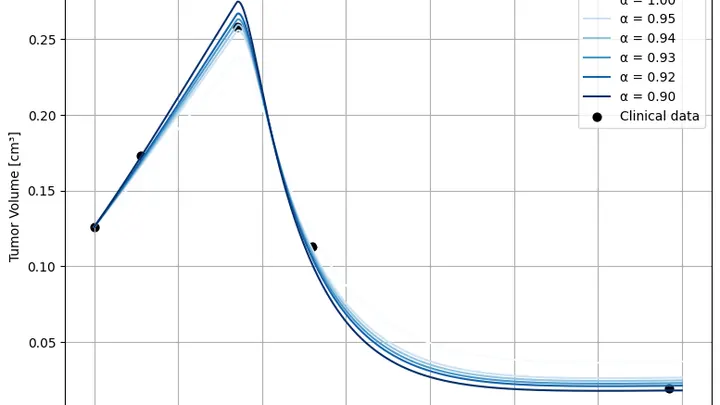
A tumor doesn't grow like a tree; it grows like a city: today's skyline is shaped by yesterday's construction and the fires of the day before. Standard tumor growth equations don't account for this: they only look at the current moment, as if the city were rebuilt from scratch every day. The authors added "memory" to the model: now the equation remembers what came before, and that changes the forecast.
A tiny particle floats in a laser beam like a speck of dust in a flashlight's glow. Water molecules constantly jostle it — randomly, from all sides. Usually these bumps are a nuisance: the particle twitches, and precise measurements turn into a lottery. But physicists have figured out how to turn the interference into an advantage.