Solar Wind: Fast Streams Inside Slow Ones express
The Sun's corona looks like a shaggy dandelion: bright petal-like loops hold hot gas near the surface, while long, tenuous jets escape into space between them. These jets, the heliospheric current sheet, stretch across the entire solar system. But how exactly plasma transitions from closed loops into open flow has remained a mystery.
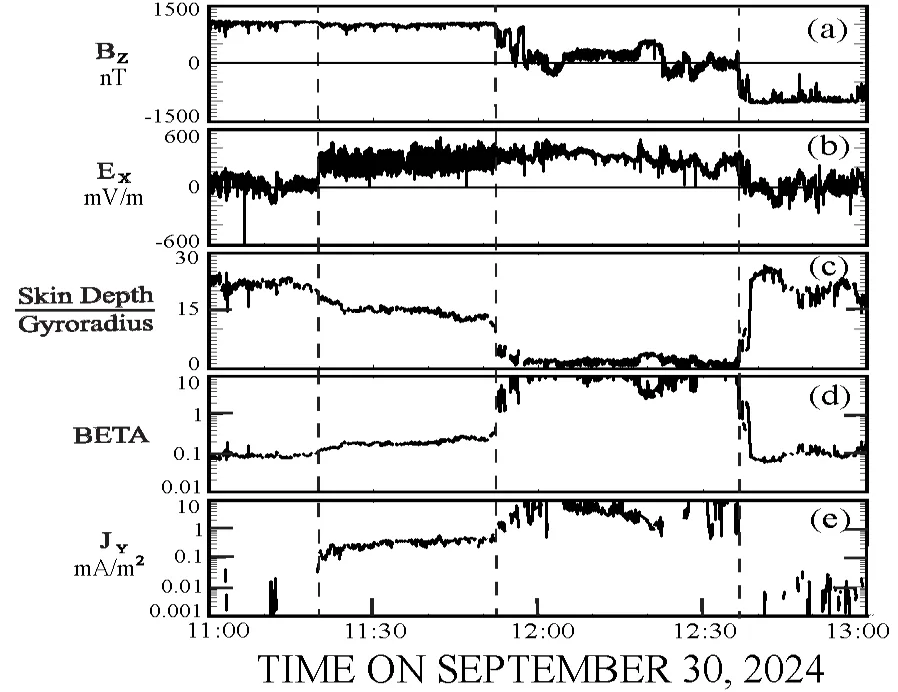
A probe flying at 11.7 solar radii from the center pierced one of these jets, a streamer, for the first time. Instruments recorded an electric field of 400 millivolts per meter. That's like a discharge appearing between the ends of a battery in your pocket, but on a cosmic scale. Such a field breaks the simple rule that "plasma and magnetic field move together," so it's explained by an extra term in Ohm's law — the Hall effect.
Fifteen such crossings showed that plasma inside streamers races at 326 km/s, while outside it's only 266 km/s. Previously, streamers were thought to be the source of the slow solar wind. Now it's clear: there are fast streams inside them. This changes our understanding of how the Sun feeds the entire heliosphere.
The electric field in a streamer is comparable to that inside a running microwave oven, but stretched over thousands of kilometers.