Quasi-stars: Cocoons with a Black Hole Inside express
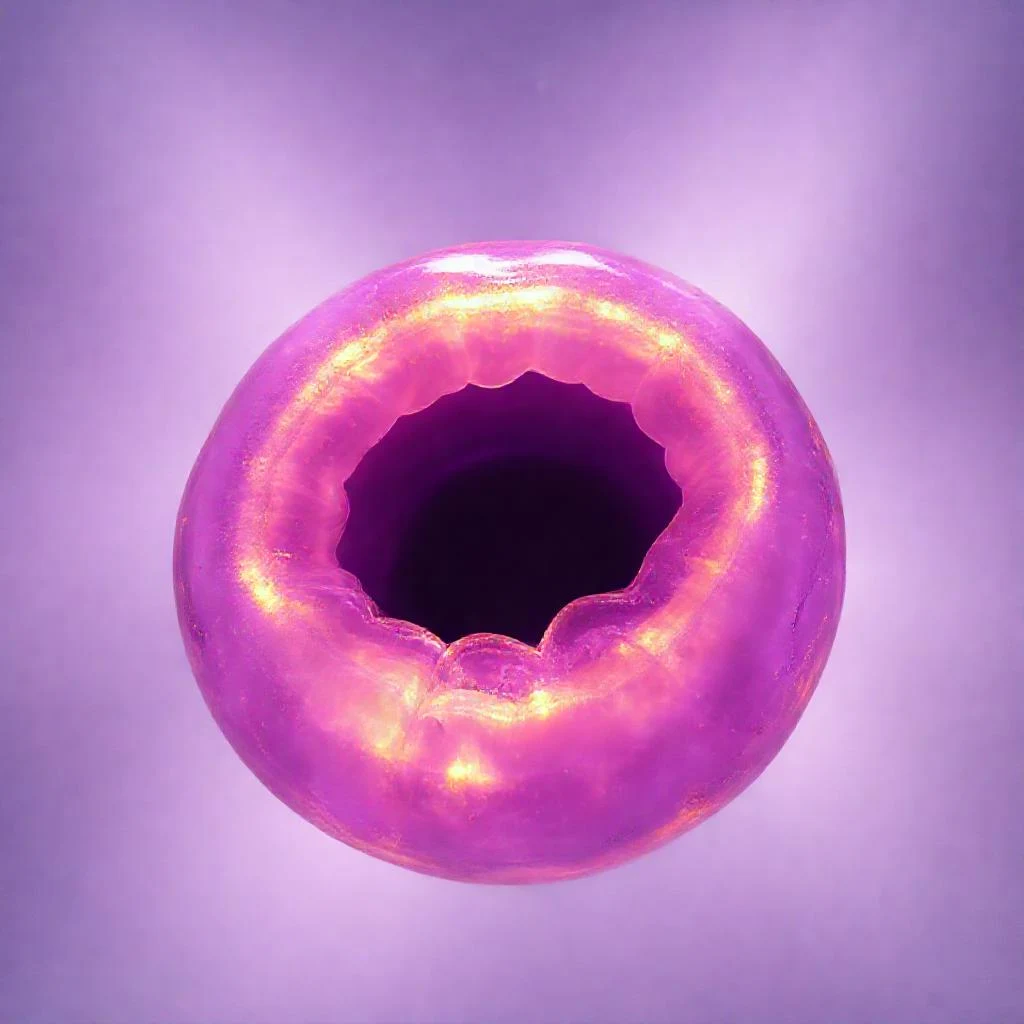
The mystery of how black holes grew so fast in the early Universe might be solved by quasi-stars. These are giant gas cocoons with a black hole tucked inside. Matter falling into the hole heats up and blasts out so much light that it prevents the cocoon from collapsing. Such an object weighs thousands of Suns and outshines an entire galaxy.
New simulations reveal: if the black hole gobbles up at least a tenth of a solar mass per year, the whole cocoon churns and glows with a reddish light — exactly like the mysterious 'little red dots' in the distant cosmos. These dots have long puzzled astronomers. Because of the expansion of the Universe, their light is shifted to the red, but what exactly is shining remained unknown. Once the cocoon's mass reaches tens of thousands of solar masses, spacetime curvature triggers an instability, and a black hole is born at the center.
The paradox is that a black hole, typically a light-gobbling monster, becomes the main source of illumination itself. By comparing the observed brightness of the little red dots with models, scientists found that they match the required accretion rate. This is how quasi-stars likely ignited in the young cosmos and, perhaps, became the seeds of supermassive black holes.
Original abstract
as written by the authors arXiv:2603.21714
The recently discovered Little Red Dots identified by the James Webb Space Telescope are compact high-redshift sources whose properties have motivated models involving black holes embedded within optically thick gaseous envelopes. We investigate their rest-frame optical emission by modeling quasi-stars, i.e. stellar envelopes powered by accretion onto a central black hole, formed from rapidly accreting proto-stars that reach the supermassive star regime ($$>10^4$$~\Msun) before undergoing general relativistic instability. We compute stellar evolution models with mass gain rates of 0.01, 0.1, and 1~\Msun/yr and metallicities $$Z=0$$-$$0.01$$. For accretion rates $$\ge0.1$$~\Msun/yr, stars remain nearly fully convective with $$T_\mathrm{eff}\sim4000$$-$$9000$$~K. General relativistic instability occurs at $$M_\star\sim3.5\times10^4$$~\Msun\ ($$6.8\times10^4$$~\Msun) for $$\dot{m}=0.1$$~\Msun/yr (1~\Msun/yr), at $$L\sim10^9$$~\Lsun. Assuming the black hole supports the envelope until complete accretion ($$M_{\rm BH,max}/M_{\rm QS}=1$$), quasi-stars reach maximum lifetimes of $$10^7$$-$$10^8$$~yr, $$\sim100$$-$$1000$$ times longer than their progenitors. Their formation and evolution are nearly independent of metallicity. Matching our models to Little Red Dots at $$z<4.5$$ ($$L_\mathrm{bol}\sim10^{9.5}$$-$$10^{11.5}$$~\Lsun) implies quasi-star masses of $$10^{4.5}$$-$$10^{6.5}$$~\Msun, while the minimum observed luminosity requires progenitor accretion rates $$\gtrsim0.1$$~\Msun/yr. Our models support quasi-stars as the origin of Little Red Dot optical emission and constrain their masses, lifetimes, progenitor environments, and luminosities. Our models offer a framework supporting quasi-stars as the source of Little Red Dot optical emission, and provide insights into their lifetimes, composition, progenitor's environment as well on their minimum and maximum observed luminosities.
If a quasi-star were placed where the Sun is, its envelope would stretch beyond the orbit of Jupiter, and inside it would hide a black hole the size of a small city.