Galaxy formation is the process by which galaxies — vast systems of stars, gas, dust, and dark matter — emerge from tiny density fluctuations in the early universe. According to the standard cosmological model, these fluctuations, seeded during cosmic inflation, grew over billions of years under gravity, pulling matter into clumps that eventually became galaxies. The process is not a single event but a continuous evolution involving mergers, gas accretion, and star formation, shaped by both visible matter and the invisible scaffolding of dark matter.
History
The modern theory of galaxy formation was developed in the 1970s and 1980s, building on the earlier discovery of cosmic microwave background fluctuations and the dark matter hypothesis. Key contributions came from Simon White, Carlos Frenk, and others who simulated structure formation in the cold dark matter paradigm.
How it works
Primordial density fluctuations — regions slightly denser than their surroundings — acted as gravitational seeds. Dark matter, which interacts only gravitationally, collapsed first into halos, creating deep gravitational wells. Ordinary gas then fell into these wells, heated up, and cooled by radiating energy, allowing it to fragment into clouds that formed stars. Galaxies grew through hierarchical merging: smaller systems collided and combined to form larger ones, while gas inflows and feedback from supernovae and black holes regulated star formation.
In practice
Understanding galaxy formation is crucial for interpreting astronomical surveys, such as those mapping galaxy distributions to constrain cosmological parameters and the nature of dark matter and dark energy.
Fun fact
Recent observations show that thin galactic disks, once thought to be a late cosmic development, were already common just a few billion years after the Big Bang.
A census by body shape: that's one way to describe what astronomers did with 6348 massive galaxies. Instead of height and weight, they measured how concentrated the light is toward the center, how flattened the galaxy is, and how asymmetric its shape is. Then they ran the same measurements on galaxies from three computer models of the universe and compared the results.
At the center of an ultra-compact dwarf galaxy, a very dense stellar system spanning tens of light-years, there is a vacuum cleaner at work. But instead of dust, it sucks in gas shed by dying stars. This gas does not fly off in all directions; instead, it spirals into a funnel, a rotating disk that gradually settles onto the black hole.
In the first half-billion years after the Big Bang, galaxies grew like crazy. Gas fell in rapidly and collapsed into stars without any resistance. This period is called 'unimpeded star formation.' It's like frying pancakes on a scorching skillet without a lid: splatters fly, but nothing holds them back.
In the first moments after the Big Bang, matter and antimatter should have been created in equal amounts. But today, everything around us is ordinary matter, and antimatter is almost nowhere to be found. Where did it all go? The standard answer: a tiny imbalance in favor of matter wiped out almost all antimatter.
Dark matter is the invisible scaffolding of the universe. It's there, we know from the motion of stars and galaxies, but what this scaffolding is made of remains unknown. One guess is ultra-light particles similar to axions. They barely interact with ordinary matter, yet occasionally they do get involved.
In the first moments after the Big Bang, the universe underwent a rapid expansion — inflation. Space stretched faster than light, and quantum jitters of the vacuum turned into real particles. This is how dark matter, the invisible substance that holds galaxies together, could have been born.
In the first moments after the Big Bang, the universe expanded at an incredible rate — a phase known as inflation. Even the vacuum was restless back then: quantum jitters shook the fields like wind rustling through a wheat field.
The standard cosmological model ΛCDM (which includes dark energy and cold dark matter) is the score of a cosmic symphony. It describes how space expanded after the big bang. How dark matter clumped together. How galaxies ignited. For a long time, everything played flawlessly.
In the galaxy NGC 1052 DF2, stars move at only 8 kilometers per second, as if there were no invisible mass around. For comparison: in our Milky Way, outlying stars accelerate to 200 kilometers per second, held by a massive dark matter halo.
The cosmos resembles silk fabric with threads of the dark web showing through. We only glimpse tiny swatches of the real tapestry — through telescopes, in actual galaxy catalogs. To separate the fundamental signal from astrophysical noise in the cosmic pattern, statistical analysis demands thousands of plausible sketches — synthetic sky maps.
Eight bright spots on the radio sky. They are all the same quasar HS 0810+2554, whose light passed through a gravitational lens — a massive foreground galaxy.
Boiling water in a pot is a good place to start. Bubbles of steam rise, pop, and the surface settles down. Something similar might have happened in the first moments of the universe's life with a special field filling space: bubbles of a new phase inflated and collided, like islands of steam in liquid.
The Orion Nebula is a showcase of astrophysics, a laboratory for studying star formation right in our backyard. For over a century, its light has been split into spectra, and each forbidden line whispers its own version of how many electrons per cubic centimeter.
Like an exquisite clockwork mechanism, a multi-planet system responds sensitively to the slightest nudge. And when the star at the heart of this mechanism dies, shedding its envelope and turning into a white dwarf, even a modest kick at a speed of 0.75 km/s can trigger a cascade of events, flinging entire worlds into interstellar emptiness.
When we peer deep into space, we see the past. Edwin Hubble’s law turns redshift into a time machine: light from galaxy UDS 12999 traveled to us for 7.6 billion years — more than half the age of the Universe.
Dark matter remains one of the greatest mysteries of modern physics. Back when Vera Rubin observed galaxy rotation, she proved that visible matter is insufficient to keep stars from flying apart.
At the center of a tiny galaxy lies a dense clump of stars and dark matter. This clump, called a soliton, is not frozen in place: it quivers and oscillates like jelly on a plate.
In the first moments after the Big Bang, the universe inflated at an unimaginable rate. This inflation left behind ripples — tiny overdensities in the hot radiation and plasma.
The story began with a missing mass. In the 1930s, Fritz Zwicky, measuring velocities in galaxy clusters, first suspected the presence of invisible matter. Later, Vera Rubin showed that the outskirts of spiral galaxies rotate too fast for the visible matter.
Lenticular galaxies are the cosmic quiet types: they have a disk but no bright spiral arms. For a long time, their origin remained a mystery. A team of scientists ran the Hydrangea computer simulation and traced the fate of each galaxy from its youth to the present day.
On the mass–size diagram, these galaxies line up in a V shape.
The early universe was a restless place. Space trembled with gravitational waves — ripples in the very fabric of reality. In this churning cauldron, dark matter is thought to have been born. But the newborn particles had no mass: it had to come from somewhere.
Usually, the Higgs field is responsible for mass.
Stars are born in cold clouds of cosmic dust and hydrogen. Inside these cocoons, protostars — the cores of future suns — were long thought to be just hot clumps. But it turns out many of them are powerful accelerators: they shoot out narrow jets of gas that, slamming into surrounding matter, produce invisible gamma-ray light.
The galaxy NGC 1277 is like an old book that no one has opened for billions of years. It formed quickly at the dawn of the Universe and has barely changed since — no collisions with neighbors, no new layers added.
The Universe is singing. Not in the usual sense: its symphony is recorded in tiny density variations from which galaxies and ourselves grew. After the Big Bang, space was almost uniform, but quantum fluctuations during inflation left a faint pattern — slightly more matter here, slightly less there.
Elliptical galaxies are quiet stellar metropolises in retirement. By all rights, their light should be calm, reddish, like a sunset. But their spectra scream otherwise: in the far ultraviolet, these old-timers blaze like holiday lights. For three decades, astronomers have puzzled over this 'ultraviolet upturn' (UV upturn).
The first two billion years after the Big Bang were an era when the universe resembled a boiling construction pit. Dark matter clumped the gas together, igniting the first stars. It seemed there simply wasn't enough time to assemble massive elliptical galaxies—'dormant' stellar metropolises — from this raw material.
Drop a stone into a pond, and ripples spread outward. Something similar happens inside compact clumps of dark matter when they encounter a special medium — a scalar field. This field, which pervades everything around us, can spontaneously intensify in the depths of such objects, much like ripples on water growing ever taller and more pronounced.
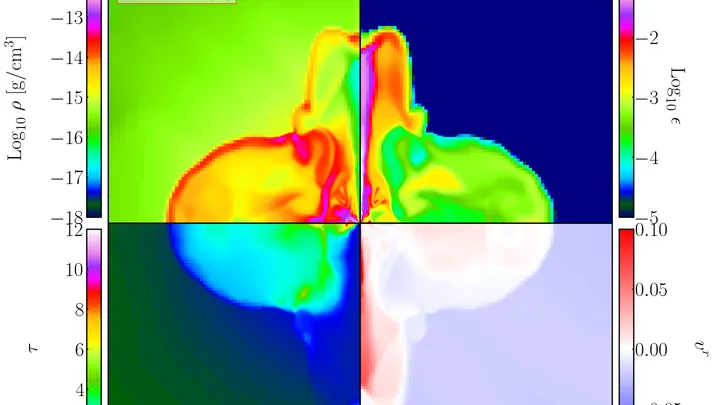
Water plunges into an abyss, but part of it shoots back up — churning and foaming at the very edge. That's roughly how gas behaves as it flows onto a supermassive black hole when its stream becomes too dense. In a new study, scientists traced this picture using computer simulations.
A street where houses have just been built. Some shine with clean windows, others are covered in construction dust. That's roughly what galaxies looked like when the universe was only a few hundred million years old. The new James Webb telescope peered into that era and saw dozens of bright star islands.
An artist paints a portrait stroke by stroke, and then someone offers them a flash camera — one click, and it's done. That's roughly the shift from multi-step models to one-step models in generating images of galaxies.
Typical neural networks for image synthesis work like a watercolorist: they apply a layer, blur it, add details.
In the scorching solar corona, where temperatures soar past a million degrees, float cold, dense clouds — solar prominences. They hang for weeks, neither falling nor dissolving, like icebergs in a boiling ocean. How they got there is a question that has puzzled astronomers for decades.
Axions are hypothetical elementary particles introduced in 1977 by Roberto Peccei and Helen Quinn to resolve the so-called strong CP problem in the Standard Model of particle physics.
Globular clusters are dense 'balls' of hundreds of thousands of stars that orbit the center of the Milky Way. Some were born in our Galaxy, others were captured when the Milky Way swallowed dwarf satellite galaxies. They can be distinguished by chemical composition, but astronomers now have a new tool — dynamical age.
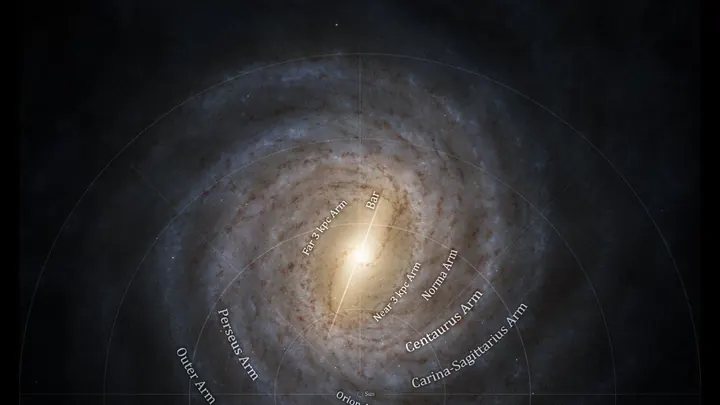
Other galaxies are just ancient snapshots, but we watch the Milky Way live. Comparing data over 30 years, scientists found that the Galaxy’s center is, like, speeding up: the supermassive black hole got heavier, swallowing the mass of a large asteroid each year; the stellar bar (a huge beam of billions of suns, like the…
The mystery of how black holes grew so fast in the early Universe might be solved by quasi-stars. These are giant gas cocoons with a black hole tucked inside. Matter falling into the hole heats up and blasts out so much light that it prevents the cocoon from collapsing. Such an object weighs thousands of Suns and outshines an entire galaxy.
Dough rises faster when it already contains yeast. Similarly, galaxies may have assembled faster if they already had black holes inside. Astrophysicists considered a scenario where the universe contained primordial black holes from the very beginning — objects that could have formed in the first instants after the Big Bang.
The first stars ignited from clouds that contained nothing but hydrogen and helium. Heavy elements (carbon, oxygen, iron) came later, forged inside stars. But among those pioneers, there could have been lightweight stars, with masses just below that of the Sun.
The universe began with the Big Bang and subsequent inflation — a rapid expansion. Alan Guth suggested that in some regions this growth never stopped. They remained ‘underbaked’ pockets of eternal expansion forever.
The universe can behave like a spring: compressing to microscopic sizes and then expanding again. In this cycle of contraction and bounce, black holes and dark matter are born.